
Matched Antibody Pairs
A matched antibody pair is a capture and detection antibody combination selected to bind distinct, non-overlapping epitopes on the same target antigen, so both antibodies can bind the antigen at the same time without interference.1 Our range covers over 600 matched pairs across cytokines, chemokines, tumour biomarkers and extracellular matrix proteins, each supplied as a validated capture and detection antibody set for sandwich ELISA.
Browse Antibody PairsCapture and Detection Antibody Function
Sandwich ELISA requires two antibodies raised against the same antigen but specific for different regions of it.1 One antibody captures the antigen from the sample, and the second detects it once bound, producing a measurable signal only when both antibodies find their target.1 Antibody pairs supplied as a set have already been tested together to confirm that binding of one antibody does not block the other, which removes a major source of assay development delay for a researcher pairing individual antibodies from scratch.
Capture Antibody
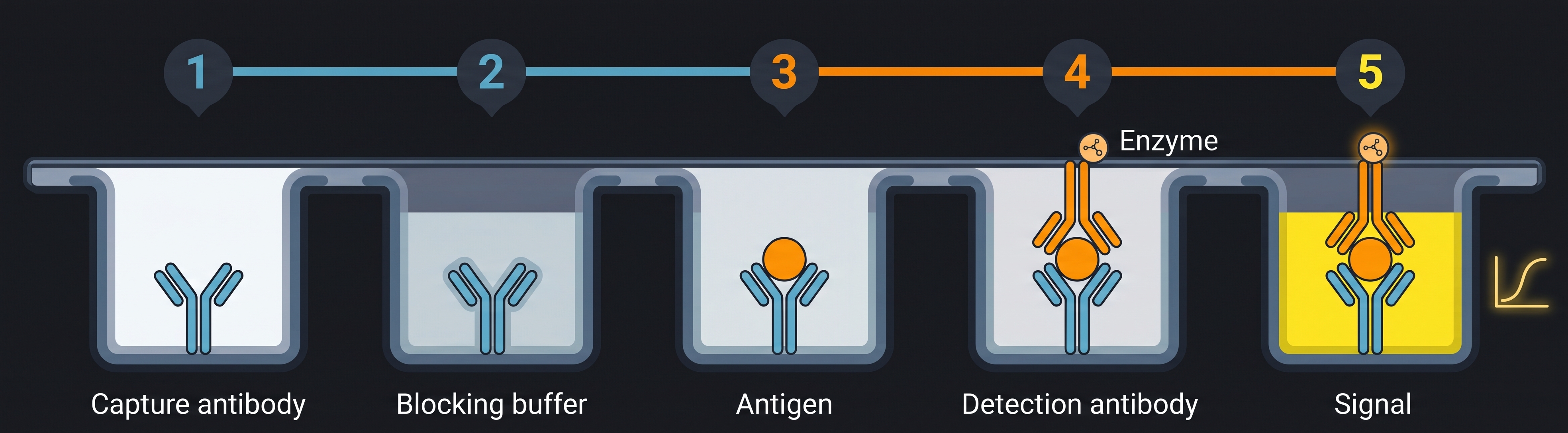
Immobilised on the surface of the assay plate. It binds and concentrates the target antigen out of a complex sample such as serum, plasma or cell lysate, holding it in place for the steps that follow.
Detection Antibody
Added after the capture step. It binds a second, non-overlapping epitope on the same antigen, so it can still reach its target even while the capture antibody remains bound, and it carries or recruits the label that generates the final signal.
| ✓ | Epitope compatibility already testedCapture and detection antibodies in a pair have been checked for simultaneous binding, removing the epitope-mapping step a researcher would otherwise run against a panel of candidate antibodies. |
| ✓ | Faster assay set-upCoating concentration and detection antibody titre still need optimising for a given sample type, but the underlying antibody combination does not need re-screening. |
| ✓ | Consistent lot-to-lot performanceCapture and detection components are manufactured and supplied together, so the pairing used for validation is the same pairing shipped with each order. |
Two Pairs Built Around Specific Research Demand
IL-6 is one of the most widely used cytokine targets in inflammation and immunology research,2 while FXN is a specific, single-gene target central to Friedreich's ataxia research.
Human IL-6 (Interleukin-6) Antibody Pair (STJAP00040)
A capture and detection antibody set for human IL-6, a cytokine that regulates acute-phase responses, immune activation and haematopoiesis.2 Used across inflammation, immunology and cytokine profiling studies where IL-6 is measured alongside other acute-phase markers.
View product → FXN · Human · ELISAHuman FXN (Frataxin-Mitochondrial) Antibody Pair (STJAP00507)
A capture and detection antibody set for human frataxin, a mitochondrial protein required for iron-sulfur cluster assembly. Reduced frataxin expression is the underlying defect in Friedreich's ataxia, making this pair relevant to neurodegeneration and mitochondrial function studies.
View product →Matched Antibody Pairs by Research Area
Our range covers targets across inflammation and immunology, oncology, neuroscience and extracellular matrix biology. Each table below lists a target together with its reactivity, typical application and research relevance, expand a target to see the specific antibody pairs available for it.
Inflammation & Immunity
Cytokines, chemokines and acute-phase proteins used to profile immune activation and inflammatory signalling by sandwich ELISA.
| Target | Reactivity | Application | Notes | Pairs |
|---|---|---|---|---|
| IFN-γ | Human/Mouse | ELISA | Th1 cytokine central to macrophage activation and antiviral and antitumour immune responses | |
| IL-6 | Human | ELISA | Pleiotropic cytokine driving acute-phase responses, haematopoiesis and immune regulation2 | |
| IL-6R | Human/Rat | ELISA | IL-6 receptor alpha subunit, required for classic (membrane-bound) IL-6 signalling | |
| TNF-α | Human/Mouse | ELISA | Pro-inflammatory cytokine central to immune activation and apoptosis signalling | |
| CRP | Human/Rat | ELISA | Acute-phase protein produced by the liver, used as a marker of inflammation and infection | |
| IFN-β | Human | ELISA | Type I interferon involved in antiviral immunity and studied in autoimmune disease research | |
| CXCL2 | Human | ELISA | Neutrophil-recruiting chemokine (Gro-Beta) studied in acute inflammation | |
| GzmB | Human | ELISA | Serine protease released by cytotoxic T cells and NK cells during target cell killing | |
Oncology
Established tumour biomarkers used in cancer research and diagnostics development.
| Target | Reactivity | Application | Notes | Pairs |
|---|---|---|---|---|
| CA125 | Human | ELISA | Mucin-16, an established biomarker in ovarian cancer research and diagnostics | |
| CEA | Human | ELISA | Carcinoembryonic antigen, a marker used mainly in colorectal cancer research and monitoring | |
| AFP | Human | ELISA | Alpha-fetoprotein, a marker used in liver cancer and germ cell tumour research | |
Neuroscience
Targets tied to amyloid processing and amyloid precursor protein biology in neurodegeneration research.
| Target | Reactivity | Application | Notes | Pairs |
|---|---|---|---|---|
| Aβ 1-40 | Human | ELISA | Amyloid beta fragment central to Alzheimer's disease pathology research | |
| ADAM10 | Human | ELISA | Metalloproteinase involved in amyloid precursor protein processing and neurodegeneration research | |
Extracellular Matrix & Tissue Remodelling
Proteases involved in cartilage and connective tissue turnover, relevant to arthritis and fibrosis research.
| Target | Reactivity | Application | Notes | Pairs |
|---|---|---|---|---|
| ADAMTS4 | Human | ELISA | Aggrecanase implicated in cartilage degradation and arthritis research | |
| ADAMTS5 | Human | ELISA | Related aggrecanase studied in connective tissue disorders | |
| HTRA1 | Human | ELISA | Serine protease involved in extracellular matrix degradation and fibrosis research | |
Antibody Pairs by Species
Reactivity, the species the antigen itself belongs to, is what determines whether a pair suits your model organism. Each tab below highlights key pairs available for that reactivity.
Human IL-6 Antibody Pair (STJAP00040)
Cytokine driving acute-phase responses, haematopoiesis and immune regulation.2 A standard inclusion in cytokine profiling panels.
View product → TNF-α · Human · ELISAHuman TNF-Alpha Antibody Pair (STJAP00005)
Pro-inflammatory cytokine central to immune activation and apoptosis signalling, widely used alongside IL-6 in inflammation studies.
View product → IFN-γ · Human · ELISAHuman IFN-Gamma Antibody Pair (STJAP00033)
Th1 cytokine central to macrophage activation and antiviral and antitumour immune responses.
View product → CA125 · Human · ELISAHuman CA125 Antibody Pair (STJAP00128)
Mucin-16, an established biomarker in ovarian cancer research and diagnostics.
View product →Mouse TNF-Alpha Antibody Pair (STJAP00084)
Pro-inflammatory cytokine used across mouse models of inflammation, sepsis and autoimmune disease.
View product → IFN-γ · Mouse · ELISAMouse IFN-Gamma Antibody Pair (STJAP00521)
Th1 cytokine measured in mouse models of infection, autoimmunity and antitumour immune response.
View product → TF · Mouse · ELISAMouse TF (Tissue Factor) Antibody Pair (STJAP00546)
Initiator of the coagulation cascade, studied in thrombosis and vascular injury models.
View product → ST2 · Mouse · ELISAMouse ST2 (Interleukin-1 Receptor-Like 1) Antibody Pair (STJAP00576)
IL-33 receptor studied in cardiac stress and type 2 immune response models.
View product →Rat CRP Antibody Pair (STJAP00088)
Acute-phase protein used as a marker of inflammation and infection in rat models.
View product → IL-6R · Rat · ELISARat IL-6R Antibody Pair (STJAP00622)
IL-6 receptor alpha subunit, required for classic IL-6 signalling in rat inflammation studies.
View product → KIM-1 · Rat · ELISARat KIM-1 Antibody Pair (STJAP00096)
Kidney injury molecule-1, a marker of proximal tubule damage used in nephrotoxicity studies.
View product → Notch 2 · Rat · ELISARat Notch 2 Antibody Pair (STJAP00360)
Notch family receptor studied in cell fate determination and developmental signalling.
View product →Porcine TFPI Antibody Pair (STJAP00644)
Tissue factor pathway inhibitor, a regulator of the coagulation cascade studied in pig models.
View product → IL-12 p40 · Porcine · ELISAPorcine IL-12 p40 Antibody Pair (STJAP00590)
Shared subunit of IL-12 and IL-23, studied in Th1 and Th17 immune response models.
View product → IL-10 · Porcine · ELISAPorcine IL-10 Antibody Pair (STJAP00586)
Anti-inflammatory cytokine studied in immune regulation and tolerance models.
View product →Monkey MCP-1 Antibody Pair (STJAP00627)
Chemokine driving monocyte recruitment, used in non-human primate models of inflammation and atherosclerosis.
View product → IGF-1 · Monkey · ELISAMonkey IGF-1 Antibody Pair (STJAP00625)
Growth factor studied in metabolic and growth signalling research in non-human primate models.
View product → ANG1 · Monkey · ELISAMonkey ANG1 Antibody Pair (STJAP00636)
Angiopoietin-1, studied in blood vessel formation and vascular stability research.
View product → MYO · Monkey · ELISAMonkey MYO Antibody Pair (STJAP00626)
Myoglobin, an oxygen-binding muscle protein used as a marker of muscle injury in preclinical models.
View product →Building a Sandwich ELISA
A matched pair supplies the capture and detection antibodies, but coating concentration, blocking conditions and detection reagents still benefit from optimisation for your specific sample type.1 The five steps below outline the standard sandwich ELISA workflow.
Learning and Support
Optimising a sandwich ELISA?
Read our step-by-step guide: Direct ELISA Protocol, or see how to build and read a standard curve from serial dilutions.
Not sure which reactivity or target fits your assay? Talk to us and our team can help you select the right pair.
Can't Find Your Target?
Browse the full range of over 600 matched antibody pairs, or contact us if your target isn't listed and we'll help source or develop the right pair.
Browse Antibody Pairs1. Lequin RM. Enzyme immunoassay (EIA)/enzyme-linked immunosorbent assay (ELISA). Clin Chem. 2005;51(12):2415-2418.
2. Tanaka T, Narazaki M, Kishimoto T. IL-6 in inflammation, immunity, and disease. Cold Spring Harb Perspect Biol. 2014;6(10):a016295.
For Research Use Only. All products are intended for research purposes and are not for use in diagnostic or other medical procedures.