

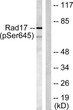

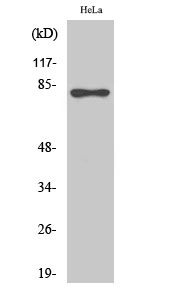
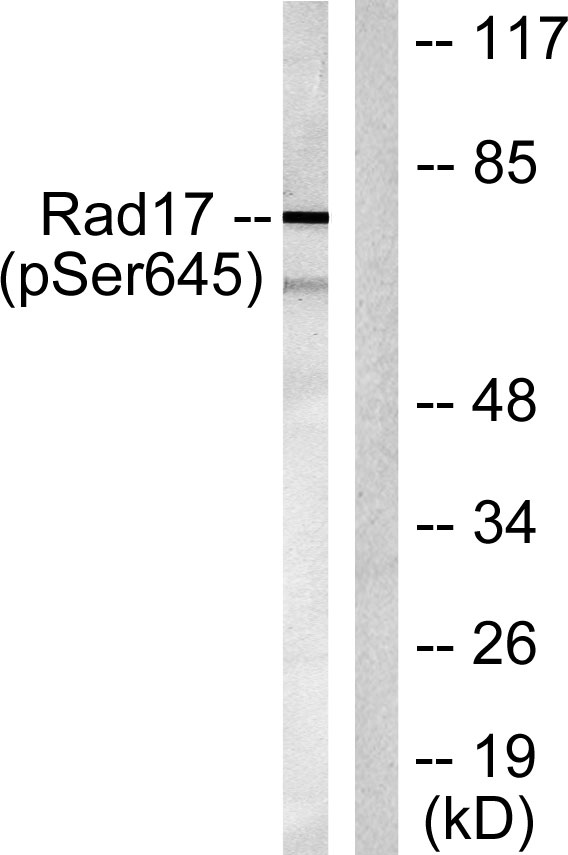
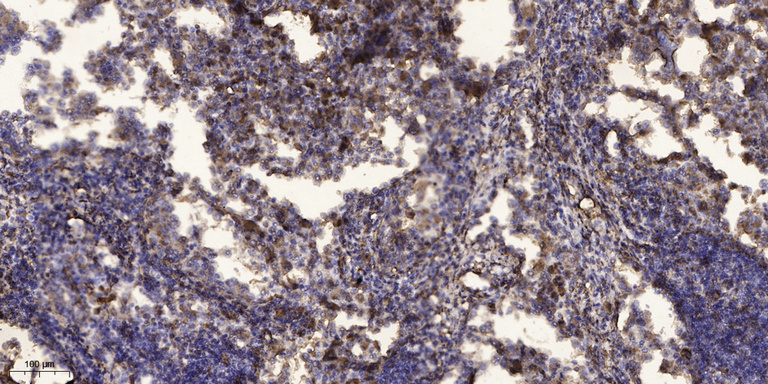

Anti-Phospho-RAD17-Ser645 antibody (621-670 aa) (STJ90451)
SPECIFICATIONS
ClonalityPolyclonal
HostRabbit
ConjugationUnconjugated
IsotypeIgG
ImmunogenThe antiserum was produced against synthesized peptide derived from the human RAD17 around the phosphorylation site of Ser645 at the amino acid range 621-670
General Information
| Short Description | Rabbit polyclonal anti-Phospho-Cell cycle checkpoint protein RAD17-Ser645 (621-670 aa) for use in WB, ELISA and IHC in Human and Mouse samples. Datasheet included with dilution recommendations, and related reagents. |
| Applications | WB/ELISA/IHC |
| Host | Rabbit |
| Reactivity | Human/Mouse |
| Note | STRICTLY FOR FURTHER SCIENTIFIC RESEARCH USE ONLY (RUO). MUST NOT TO BE USED IN DIAGNOSTIC OR THERAPEUTIC APPLICATIONS. |
Product Properties
| Clonality | Polyclonal |
| Isotype | IgG |
| Conjugation | Unconjugated |
| Concentration | 1 mg/mL |
| Purification | The antibody was affinity-purified from rabbit antiserum by affinity-chromatography using epitope-specific immunogen. |
| Dilution Range | WB 1:500-2000IHC-P 1:50-300ELISA 2000-20000 |
| Formulation | Liquid in PBS containing 50% Glycerol, 0.5% BSA and 0.02% Sodium Azide. |
| Storage Instruction | Store at-20°C for up to 1 year from the date of receipt, and avoid repeat freeze-thaw cycles. |
Target Information
| Gene Symbol | RAD17 |
| Gene ID | 5884 |
| Uniprot ID | RAD17_HUMAN |
| Immunogen | The antiserum was produced against synthesized peptide derived from the human RAD17 around the phosphorylation site of Ser645 at the amino acid range 621-670 |
| Immunogen Region | 621-670 aa |
| Specificity | Phospho-Rad17 (S645) Polyclonal Antibody detects endogenous levels of Rad17 protein only when phosphorylated at S645. |
Additional Info
| Post Translational Modifications | Phosphorylation on Ser-646 and Ser-656 is cell cycle-regulated, enhanced by genotoxic stress, and required for activation of checkpoint signaling. Phosphorylation is mediated by ATR upon UV or replication arrest, whereas it may be mediated both by ATR and ATM upon ionizing radiation. Phosphorylation on both sites is required for interaction with RAD1 but dispensable for interaction with RFC3 or RFC4. Phosphorylation at Thr-633 by ATM in response to DNA damage promotes interaction with NBN and recruitment of the MRN complex to DNA damage sites. |
| Function | Essential for sustained cell growth, maintenance of chromosomal stability, and ATR-dependent checkpoint activation upon DNA damage. Has a weak ATPase activity required for binding to chromatin. Participates in the recruitment of the 9-1-1 (RAD1-RAD9-HUS1) complex and RHNO1 onto chromatin, and in CHEK1 activation. Involved in homologous recombination by mediating recruitment of the MRN complex to DNA damage sites. May also serve as a sensor of DNA replication progression. |
| Protein Name | Cell Cycle Checkpoint Protein Rad17Hrad17Rf-C/Activator 1 Homolog |
| Database Links | Reactome: R-HSA-176187Reactome: R-HSA-5685938Reactome: R-HSA-5693607Reactome: R-HSA-5693616Reactome: R-HSA-6804756Reactome: R-HSA-69473Reactome: R-HSA-9709570 |
| Cellular Localisation | NucleusChromosomePhosphorylated Form Redistributes To Discrete Nuclear Foci Upon Dna DamageLocalizes To Dna Double-Strand Breaks (Dsbs) |
| Alternative Antibody Names | Anti-Cell Cycle Checkpoint Protein Rad17 antibodyAnti-Hrad17 antibodyAnti-Rf-C/Activator 1 Homolog antibodyAnti-RAD17 antibodyAnti-R24L antibody |
Information sourced from Uniprot.org