
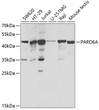


Anti-PARD6A antibody (1-100) (STJ24893)
SPECIFICATIONS
ClonalityPolyclonal
HostRabbit
ConjugationUnconjugated
IsotypeIgG
General Information
| Short Description | Rabbit polyclonal PARD6A (1-100) antibody for use in WB and ELISA in human and mouse samples. Datasheet included with dilution recommendations, and related reagents. |
| Applications | WB/ELISA |
| Host | Rabbit |
| Reactivity | Human/Mouse |
| Note | STRICTLY FOR FURTHER SCIENTIFIC RESEARCH USE ONLY (RUO). MUST NOT TO BE USED IN DIAGNOSTIC OR THERAPEUTIC APPLICATIONS. |
Product Properties
| Clonality | Polyclonal |
| Isotype | IgG |
| Conjugation | Unconjugated |
| Concentration | Lot specific |
| Purification | Affinity purification |
| Dilution Range | WB:1:500-1:2000ELISA:Recommended starting concentration is 1 Mu g/mL. Please optimize the concentration based on your specific assay requirements. |
| Formulation | PBS with 0.01% Thimerosal, 50% Glycerol, pH 7.3. |
| Storage Instruction | Store at-20°C for up to 1 year from the date of receipt, and avoid repeat freeze-thaw cycles. |
Target Information
| Gene Symbol | PARD6A |
| Gene ID | 50855 |
| Uniprot ID | PAR6A_HUMAN |
| Immunogen Region | 1-100 |
| Immunogen Sequence | MARPQRTPARSPDSIVEVKS KFDAEFRRFALPRASVSGFQ EFSRLLRAVHQIPGLDVLLG YTDAHGDLLPLTNDDSLHRA LASGPPPLRLLVQKRAEADS |
| Specificity | A synthetic peptide corresponding to a sequence within amino acids 1-100 of human PARD6A (Q9NPB6). |
Additional Info
| Tissue Specificity | Expressed in pancreas, skeletal muscle, brain and heart. Weakly expressed in kidney and placenta. |
| Post Translational Modifications | Phosphorylated by the TGF-beta receptor. Ubiquitinated by the SCF(FBXO31) complex, leading to its proteasomal degradation. |
| Function | Adapter protein involved in asymmetrical cell division and cell polarization processes. Probably involved in the formation of epithelial tight junctions. Association with PARD3 may prevent the interaction of PARD3 with F11R/JAM1, thereby preventing tight junction assembly. The PARD6-PARD3 complex links GTP-bound Rho small GTPases to atypical protein kinase C proteins. Regulates centrosome organization and function. Essential for the centrosomal recruitment of key proteins that control centrosomal microtubule organization. |
| Protein Name | Partitioning Defective 6 Homolog AlphaPar-6Par-6 AlphaPar-6aPar6cTax Interaction Protein 40Tip-40 |
| Database Links | Reactome: R-HSA-2173791Reactome: R-HSA-420029Reactome: R-HSA-4608870Reactome: R-HSA-9013148Reactome: R-HSA-9013149Reactome: R-HSA-9013420Reactome: R-HSA-9013424 |
| Cellular Localisation | CytoplasmCell MembraneCell ProjectionRuffleCell JunctionTight JunctionCytoskeletonMicrotubule Organizing CenterCentrosomeCentriolar SatelliteColocalizes With Gtp-Bound Cdc42 Or Rac1 At Membrane Ruffles And With Pard3 And Prkci At Epithelial Tight JunctionsRecruited To The Centrosome By A Microtubule And Dynein-Dynactin-Dependent Mechanism |
| Alternative Antibody Names | Anti-Partitioning Defective 6 Homolog Alpha antibodyAnti-Par-6 antibodyAnti-Par-6 Alpha antibodyAnti-Par-6a antibodyAnti-Par6c antibodyAnti-Tax Interaction Protein 40 antibodyAnti-Tip-40 antibodyAnti-PARD6A antibodyAnti-PAR6A antibody |
Information sourced from Uniprot.org