

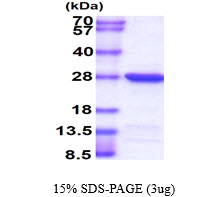

Human UBE2T protein (Recombinant) (His-Tag) (STJP016669)
SPECIFICATIONS
HostE.coli
ImmunogenHuman
General Information
| Short Description | Recombinant-Human UBE2T-His-Tag protein was developed from e.coli and has a target region of His-Tag. For use in research applications. |
| Applications | SDS-PAGE |
| Host | E.coli |
| Note | STRICTLY FOR FURTHER SCIENTIFIC RESEARCH USE ONLY (RUO). MUST NOT TO BE USED IN DIAGNOSTIC OR THERAPEUTIC APPLICATIONS. |
Product Properties
| Concentration | 1 mg/mL |
| Formulation | Liquid in 20mM Tris-HCl buffer (pH 8.0) containing 10% Glycerol 1mM DTT |
| Storage Instruction | For short term storage, keep at +2C to +8C for up to 1 week. For long term storage, aliquot and store at-20C, and avoid repeat freeze-thaw cycles. |
Target Information
| Gene Symbol | UBE2T |
| Gene ID | 29089 |
| Uniprot ID | UBE2T_HUMAN |
| Accession Number | NP_054895 |
| Immunogen | Human |
| Immunogen Region | 1-197aa |
| Immunogen Sequence | MQRASRLKRE LHMLATEPPP GITCWQDKDQ MDDLRAQILG GANTPYEKGV FKLEVIIPER YPFEPPQIRF LTPIYHPNID SAGRICLDVL KLPPKGAWRP SLNIATVLTS IQLLMSEPNP DDPLMADISS EFKYNKPAFL KNARQWTEKH ARQKQKADEE EMLDNLPEAG DSRVHNSTQK RKASQLVGIE KKFHPDVLEH HHHHH |
Additional Info
| Post Translational Modifications | Auto-ubiquitinated. Effects of auto-monoubiquitination at Lys-91 and Lys-182 are unclear: according to a report, monoubiquitination inactivates E2 enzyme activity. In contrast, according to another report, autoubiquitination does not affect E2 enzyme activity. |
| Function | Accepts ubiquitin from the E1 complex and catalyzes its covalent attachment to other proteins. Catalyzes monoubiquitination. Involved in mitomycin-C (MMC)-induced DNA repair. Acts as a specific E2 ubiquitin-conjugating enzyme for the Fanconi anemia complex by associating with E3 ubiquitin-protein ligase FANCL and catalyzing monoubiquitination of FANCD2, a key step in the DNA damage pathway. Also mediates monoubiquitination of FANCL and FANCI. May contribute to ubiquitination and degradation of BRCA1. In vitro able to promote polyubiquitination using all 7 ubiquitin Lys residues, but may prefer 'Lys-11'-, 'Lys-27'-, 'Lys-48'- and 'Lys-63'-linked polyubiquitination. |
| Protein Name | Ubiquitin-Conjugating Enzyme E2 TCell Proliferation-Inducing Gene 50 ProteinE2 Ubiquitin-Conjugating Enzyme TUbiquitin Carrier Protein TUbiquitin-Protein Ligase T |
| Database Links | Reactome: R-HSA-6783310Reactome: R-HSA-8866652 |
| Cellular Localisation | NucleusAccumulates To Chromatin |
| Alternative Protein Names | Ubiquitin-Conjugating Enzyme E2 T proteinCell Proliferation-Inducing Gene 50 Protein proteinE2 Ubiquitin-Conjugating Enzyme T proteinUbiquitin Carrier Protein T proteinUbiquitin-Protein Ligase T proteinUBE2T proteinHSPC150 proteinPIG50 protein |
Information sourced from Uniprot.org