

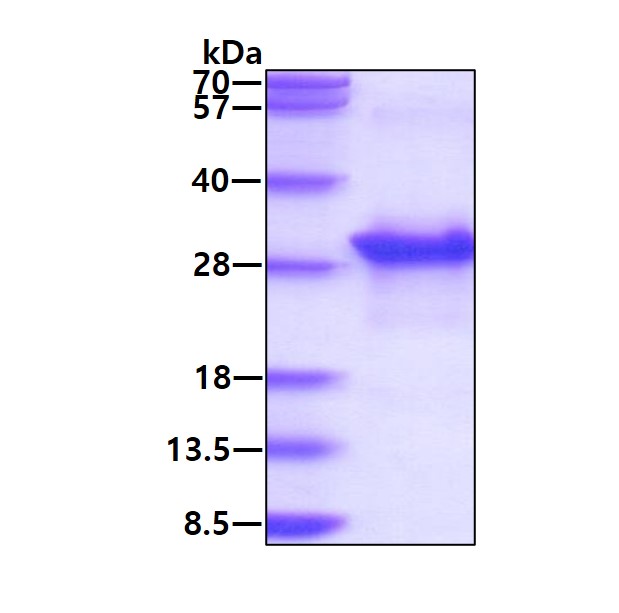

Human RhoA protein (Recombinant) (His-Tag) (STJP016987)
SPECIFICATIONS
HostE.coli
ImmunogenHuman
General Information
| Short Description | Recombinant-Human RhoA-His-Tag protein was developed from e.coli and has a target region of His-Tag. For use in research applications. |
| Applications | SDS-PAGE |
| Host | E.coli |
| Note | STRICTLY FOR FURTHER SCIENTIFIC RESEARCH USE ONLY (RUO). MUST NOT TO BE USED IN DIAGNOSTIC OR THERAPEUTIC APPLICATIONS. |
Product Properties
| Concentration | 1 mg/mL |
| Formulation | Liquid in 20mM Tris-HCl buffer (pH 8.0) containing 20% Glycerol, 0.1M NaCl, 1mM DTT |
| Storage Instruction | For short term storage, keep at +2C to +8C for up to 1 week. For long term storage, aliquot and store at-20C, and avoid repeat freeze-thaw cycles. |
Target Information
| Gene Symbol | RHOA |
| Gene ID | 387 |
| Uniprot ID | RHOA_HUMAN |
| Accession Number | NP_001655.1 |
| Immunogen | Human |
| Immunogen Region | 1-190aa |
| Immunogen Sequence |
Additional Info
| Post Translational Modifications | (Microbial infection) Substrate for botulinum ADP-ribosyltransferase. (Microbial infection) Cleaved by yopT protease when the cell is infected by some Yersinia pathogens. This removes the lipid attachment, and leads to its displacement from plasma membrane and to subsequent cytoskeleton cleavage. (Microbial infection) AMPylation at Tyr-34 and Thr-37 are mediated by bacterial enzymes in case of infection by H.somnus and V.parahaemolyticus, respectively. AMPylation occurs in the effector region and leads to inactivation of the GTPase activity by preventing the interaction with downstream effectors, thereby inhibiting actin assembly in infected cells. It is unclear whether some human enzyme mediates AMPylation.FICD has such ability in vitro but additional experiments remain to be done to confirm results in vivo. (Microbial infection) Glycosylated at Tyr-34 by Photorhabdus asymbiotica toxin PAU_02230. Mono-O-GlcNAcylation by PAU_02230 inhibits downstream signaling by an impaired interaction with diverse regulator and effector proteins of Rho and leads to actin disassembly. (Microbial infection) Glucosylated at Thr-37 by C.difficile toxins TcdA and TcdB in the colonic epithelium. Monoglucosylation completely prevents the recognition of the downstream effector, blocking the GTPases in their inactive form, leading to actin cytoskeleton disruption and cell death, resulting in the loss of colonic epithelial barrier function. (Microbial infection) Glycosylated (O-GlcNAcylated) at Thr-37 by C.novyi toxin TcdA. O-GlcNAcylation completely prevents the recognition of the downstream effector, blocking the GTPases in their inactive form, leading to actin cytoskeleton disruption. (Microbial infection) Stearoylated By S.flexneri N-epsilon-fatty acyltransferase IcsB, thereby disrupting the host actin cytoskeleton. Phosphorylation by PRKG1 at Ser-188 inactivates RHOA signaling. Phosphorylation by SLK at Ser-188 in response to AGTR2 activation. Ubiquitinated by the BCR(KCTD13) and BCR(TNFAIP1) E3 ubiquitin ligase complexes, leading to its degradation by the proteasome, thereby regulating the actin cytoskeleton and synaptic transmission in neurons. Ubiquitinated at Lys-135 in a FBXL19-mediated manner.leading to proteasomal degradation. Serotonylation of Gln-63 by TGM2 during activation and aggregation of platelets leads to constitutive activation of GTPase activity. |
| Function | Small GTPase which cycles between an active GTP-bound and an inactive GDP-bound state. Mainly associated with cytoskeleton organization, in active state binds to a variety of effector proteins to regulate cellular responses such as cytoskeletal dynamics, cell migration and cell cycle. Regulates a signal transduction pathway linking plasma membrane receptors to the assembly of focal adhesions and actin stress fibers. Involved in a microtubule-dependent signal that is required for the myosin contractile ring formation during cell cycle cytokinesis. Plays an essential role in cleavage furrow formation. Required for the apical junction formation of keratinocyte cell-cell adhesion. Essential for the SPATA13-mediated regulation of cell migration and adhesion assembly and disassembly. The MEMO1-RHOA-DIAPH1 signaling pathway plays an important role in ERBB2-dependent stabilization of microtubules at the cell cortex. It controls the localization of APC and CLASP2 to the cell membrane, via the regulation of GSK3B activity. In turn, membrane-bound APC allows the localization of the MACF1 to the cell membrane, which is required for microtubule capture and stabilization. Regulates KCNA2 potassium channel activity by reducing its location at the cell surface in response to CHRM1 activation.promotes KCNA2 endocytosis. Acts as an allosteric activator of guanine nucleotide exchange factor ECT2 by binding in its activated GTP-bound form to the PH domain of ECT2 which stimulates the release of PH inhibition and promotes the binding of substrate RHOA to the ECT2 catalytic center. May be an activator of PLCE1. In neurons, involved in the inhibition of the initial spine growth. Upon activation by CaMKII, modulates dendritic spine structural plasticity by relaying CaMKII transient activation to synapse-specific, long-term signaling. Acts as a regulator of platelet alpha-granule release during activation and aggregation of platelets. When activated by DAAM1 may signal centrosome maturation and chromosomal segregation during cell division. May also be involved in contractile ring formation during cytokinesis. (Microbial infection) Serves as a target for the yopT cysteine peptidase from Yersinia pestis, vector of the plague. |
| Protein Name | Transforming Protein RhoaRho Cdna Clone 12H12 |
| Database Links | Reactome: R-HSA-114604Reactome: R-HSA-193634Reactome: R-HSA-198203Reactome: R-HSA-209563Reactome: R-HSA-2173791Reactome: R-HSA-392451Reactome: R-HSA-3928662Reactome: R-HSA-3928663Reactome: R-HSA-4086400Reactome: R-HSA-416482Reactome: R-HSA-416550Reactome: R-HSA-416572Reactome: R-HSA-4420097Reactome: R-HSA-5625740Reactome: R-HSA-5625900Reactome: R-HSA-5625970Reactome: R-HSA-5627117Reactome: R-HSA-5663220Reactome: R-HSA-5666185Reactome: R-HSA-5689896Reactome: R-HSA-6785631Reactome: R-HSA-6798695Reactome: R-HSA-8849471Reactome: R-HSA-8980692Reactome: R-HSA-8985586Reactome: R-HSA-9013106 |
| Cellular Localisation | Cell MembraneLipid-AnchorCytoplasmic SideCytoplasmCytoskeletonCleavage FurrowCell CortexMidbodyCell ProjectionLamellipodiumDendriteNucleusLocalized To Cell-Cell Contacts In Calcium-Treated KeratinocytesTranslocates To The Equatorial Region Before Furrow Formation In A Ect2-Dependent MannerLocalizes To The Equatorial Cell Cortex (At The Site Of The Presumptive Furrow) In Early Anaphase In An Activated Form And In A Myosin- And Actin-Independent MannerColocalizes With Kank1 At The Contractile RingColocalizes With Daam1 And Kank1 Around Centrosomes |
| Alternative Protein Names | Transforming Protein Rhoa proteinRho Cdna Clone 12 proteinH12 proteinRHOA proteinARH12 proteinARHA proteinRHO12 protein |
Information sourced from Uniprot.org