

Human PTP1B protein (Recombinant) (No-Tag) (STJP019743)
SPECIFICATIONS
HostE.coli
ImmunogenHuman
General Information
| Short Description | Recombinant-Human PTP1B-No-Tag protein was developed from e.coli and has a target region of No-Tag. For use in research applications. |
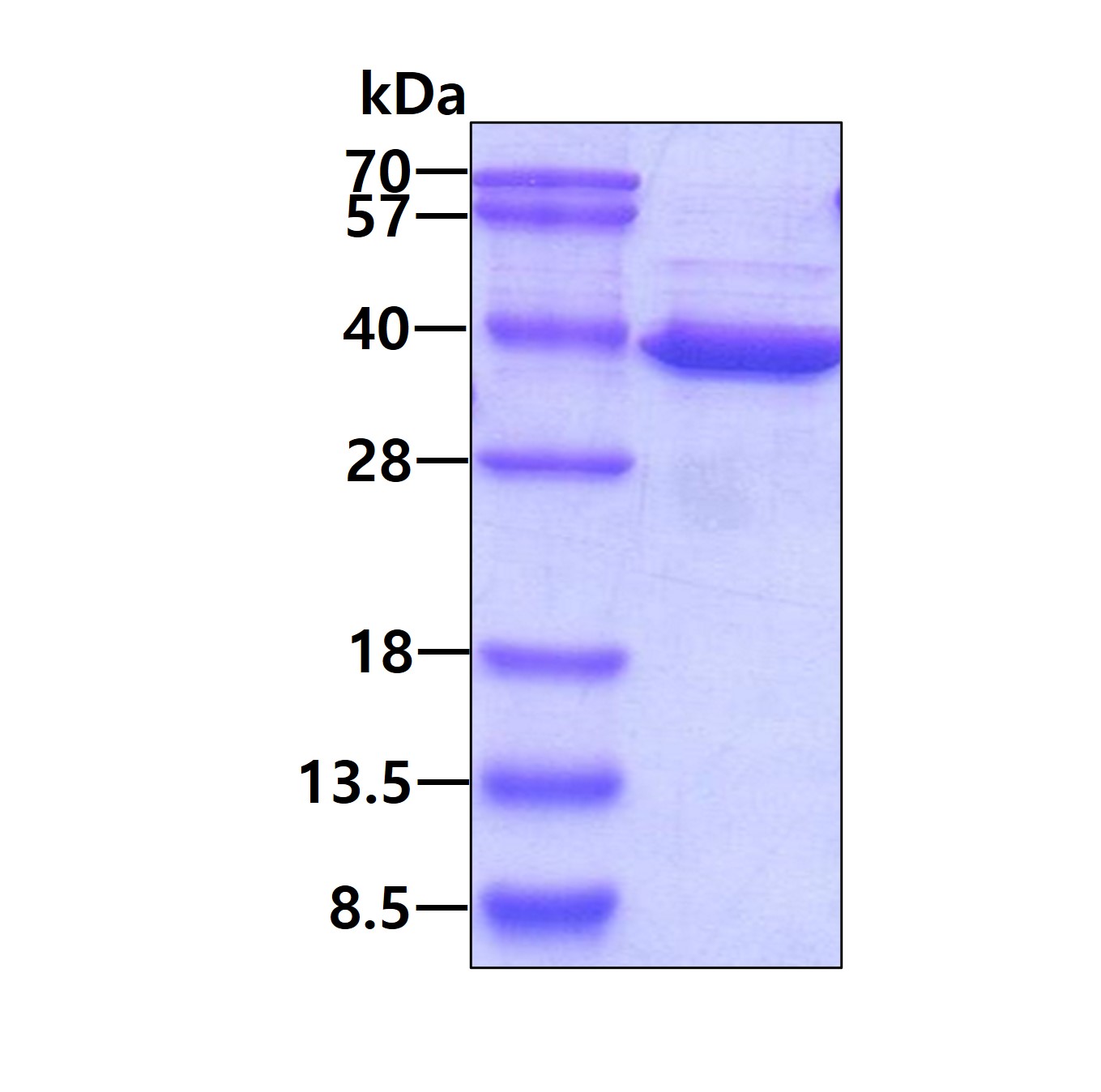
| Applications | SDS-PAGE/Enzyme Activity |
| Host | E.coli |
| Note | STRICTLY FOR FURTHER SCIENTIFIC RESEARCH USE ONLY (RUO). MUST NOT TO BE USED IN DIAGNOSTIC OR THERAPEUTIC APPLICATIONS. |
Product Properties
| Concentration | 1 mg/mL |
| Formulation | Liquid in 25mM Tris-HCl buffer (pH 7.5) containing 2mM beta-mercaptoethanol, 1mM EDTA1mM DTT, 20% Glycerol |
| Storage Instruction | For short term storage, keep at +2C to +8C for up to 1 week. For long term storage, aliquot and store at-20C, and avoid repeat freeze-thaw cycles. |
| Endotoxin | < 1 EU per 1ug of protein (determined by LAL method) |
| Immunoreactivity | Specific activity is > 10, 000unit/mg, and is defined as the amount of enzyme that hydrolyze 1.0nmole of p-nitrophenyl phosphate (pNPP) per minute at pH 7.5 at 37C. |
Target Information
| Gene Symbol | PTPN1 |
| Gene ID | 5770 |
| Uniprot ID | PTN1_HUMAN |
| Accession Number | NP_002818.1 |
| Immunogen | Human |
| Immunogen Region | 1-321aa |
| Immunogen Sequence | MEMEKEFEQI DKSGSWAAIY QDIRHEASDF PCRVAKLPKN KNRNRYRDVS PFDHSRIKLH QEDNDYINAS LIKMEEAQRS YILTQGPLPN TCGHFWEMVW EQKSRGVVML NRVMEKGSLK CAQYWPQKEE KEMIFEDTNL KLTLISEDIK SYYTVRQLEL ENLTTQETRE ILHFHYTTWP DFGVPESPAS FLNFLFKVRE SGSLSPEHGP VVVHCSAGIG RSGTFCLA |
Additional Info
| Tissue Specificity | Expressed in keratinocytes (at protein level). |
| Post Translational Modifications | Oxidized on Cys-215.the Cys-SOH formed in response to redox signaling reacts with the alpha-amido of the following residue to form a sulfenamide cross-link, triggering a conformational change that inhibits substrate binding and activity. The active site can be restored by reduction. Ser-50 is the major site of phosphorylation as compared to Ser-242 and Ser-243. Activated by phosphorylation at Ser-50. S-nitrosylation of Cys-215 inactivates the enzyme activity. Sulfhydration at Cys-215 following endoplasmic reticulum stress inactivates the enzyme activity, promoting EIF2AK3/PERK activity. |
| Function | Tyrosine-protein phosphatase which acts as a regulator of endoplasmic reticulum unfolded protein response. Mediates dephosphorylation of EIF2AK3/PERK.inactivating the protein kinase activity of EIF2AK3/PERK. May play an important role in CKII- and p60c-src-induced signal transduction cascades. May regulate the EFNA5-EPHA3 signaling pathway which modulates cell reorganization and cell-cell repulsion. May also regulate the hepatocyte growth factor receptor signaling pathway through dephosphorylation of MET. |
| Protein Name | Tyrosine-Protein Phosphatase Non-Receptor Type 1Protein-Tyrosine Phosphatase 1bPtp-1b |
| Database Links | Reactome: R-HSA-354192Reactome: R-HSA-6807004Reactome: R-HSA-77387Reactome: R-HSA-877312Reactome: R-HSA-8849472Reactome: R-HSA-9022699Reactome: R-HSA-912694Reactome: R-HSA-982772Reactome: R-HSA-9860927 |
| Cellular Localisation | Endoplasmic Reticulum MembranePeripheral Membrane ProteinCytoplasmic SideInteracts With Epha3 At The Cell Membrane |
| Alternative Protein Names | Tyrosine-Protein Phosphatase Non-Receptor Type 1 proteinProtein-Tyrosine Phosphatase 1b proteinPtp-1b proteinPTPN1 proteinPTP1B protein |
Information sourced from Uniprot.org