

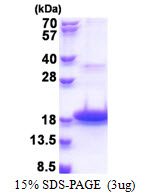

Human DEFB118 protein (Recombinant) (His-Tag) (STJP018553)
SPECIFICATIONS
HostE.coli
ImmunogenHuman
General Information
| Short Description | Recombinant-Human DEFB118-His-Tag protein was developed from e.coli and has a target region of His-Tag. For use in research applications. |
| Applications | SDS-PAGE |
| Host | E.coli |
| Note | STRICTLY FOR FURTHER SCIENTIFIC RESEARCH USE ONLY (RUO). MUST NOT TO BE USED IN DIAGNOSTIC OR THERAPEUTIC APPLICATIONS. |
Product Properties
| Concentration | 0.5 mg/mL |
| Formulation | Liquid in 20mM Tris-HCl buffer (pH 8.0) containing 0.15M NaCl, 20% Glycerol, 1mM DTT |
| Storage Instruction | For short term storage, keep at +2C to +8C for up to 1 week. For long term storage, aliquot and store at-20C, and avoid repeat freeze-thaw cycles. |
Target Information
| Gene Symbol | DEFB118 |
| Gene ID | 117285 |
| Uniprot ID | DB118_HUMAN |
| Accession Number | NP_473453 |
| Immunogen | Human |
| Immunogen Region | 21-123aa |
| Immunogen Sequence | MGSSHHHHHH SSGLVPRGSH MGSYSGEKKC WNRSGHCRKQ CKDGEAVKDT CKNLRACCIP SNEDHRRVPA TSPTPLSDST PGIIDDILTV RFTTDYFEVS SKKDMVEESE AGRGTETSLP NVHHSS |
Additional Info
| Tissue Specificity | High-level and epididymis-specific expression. Most abundant in the epithelium of the caput and present in the epididymis lumen and bound to sperm. Also expressed in pancreas. |
| Post Translational Modifications | The three-dimensional structure formed by the three intramolecular disulfide bridges is indispensable for antimicrobial activity. |
| Function | Host defense peptide that exhibits antimicrobial activity against both Gram-negative bacteria, such as E.coli and S.typhimurium, and Gram-positive bacteria, such as S.aureus and B.subtilis. Inhibits cell adhesion of E.coli on intestinal epithelial enterocytes. Causes rapid permeabilization of both the outer and inner membrane of E.coli, leading to morphological alterations on the bacterial surface. Binds to bacterial lipopolysaccharides (LPS) with high affinity, and may thereby be involved in immunoregulation through LPS neutralization. May contribute to epididymal innate immunity and protect the sperm against attack by microorganisms. |
| Protein Name | Defensin Beta 118Beta-Defensin 18Defb-18Epididymal Secretory Protein 13.6Esp13.6 |
| Database Links | Reactome: R-HSA-1461957Reactome: R-HSA-1461973 |
| Cellular Localisation | Secreted |
| Alternative Protein Names | Defensin Beta 118 proteinBeta-Defensin 18 proteinDefb-18 proteinEpididymal Secretory Protein 13.6 proteinEsp13.6 proteinDEFB118 proteinC20orf63 proteinDEFB18 proteinESC42 protein |
Information sourced from Uniprot.org