

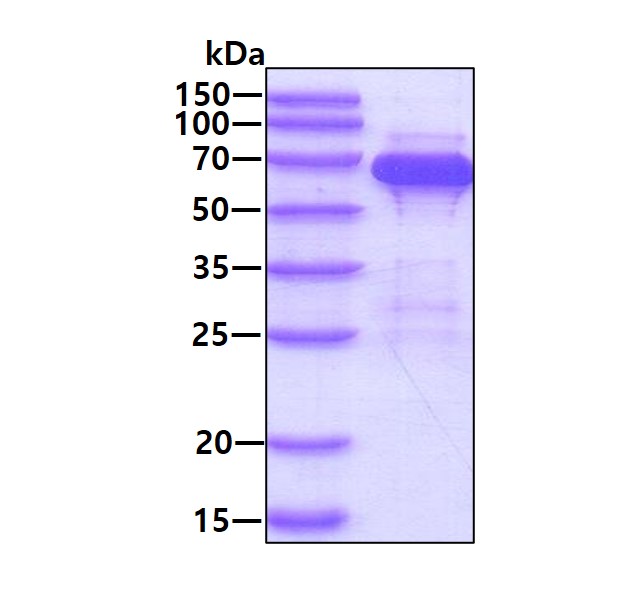

Human Cyclophilin-like 2/PPIL2 protein (Recombinant) (His-Tag) (STJP016639)
SPECIFICATIONS
HostE.coli
ImmunogenHuman
General Information
| Short Description | Recombinant-Human Cyclophilin-like 2/PPIL2-His-Tag protein was developed from e.coli and has a target region of His-Tag. For use in research applications. |
| Applications | SDS-PAGE/Enzyme Activity |
| Host | E.coli |
| Note | STRICTLY FOR FURTHER SCIENTIFIC RESEARCH USE ONLY (RUO). MUST NOT TO BE USED IN DIAGNOSTIC OR THERAPEUTIC APPLICATIONS. |
Product Properties
| Concentration | 0.5 mg/mL |
| Formulation | Liquid in 20mM Tris-HCl buffer (pH 8.0) containing 20% Glycerol, 0.1M NaCl |
| Storage Instruction | For short term storage, keep at +2C to +8C for up to 1 week. For long term storage, aliquot and store at-20C, and avoid repeat freeze-thaw cycles. |
| Immunoreactivity | Specific activity is > 290nmol/min/mg, and is defined as the amount of enzyme that cleaves 1umole of suc-AAPF-pNA per minute at 37C in Tris-Hcl pH8.0 using chymotrypsin.. |
Target Information
| Gene Symbol | PPIL2 |
| Gene ID | 23759 |
| Uniprot ID | PPIL2_HUMAN |
| Accession Number | NP_680481.1 |
| Immunogen | Human |
| Immunogen Region | 1-527aa |
| Immunogen Sequence |
Additional Info
| Tissue Specificity | Highest expression in thymus, pancreas and testis. Also detected in heart, placenta, lung, liver, skeletal muscle, kidney, spleen, prostate, ovary, small intestine and colon. Poorly detected in brain and leukocytes. Strong protein expression in lymph node (cortical, paracortical and medullar regions), thyroid (follicular epithelial cells), testis (developing spermatozoa), stomach (cells lining the gastric pit), pancreas, kidney (proximal and distal-tubule cells and collecting duct cells but not in glomeruli), endometrium and colon (goblet cells). Moderate protein expression in spleen, prostate (epithelium and squamous cell carcinomas), placenta and adrenal gland. Weak protein expression in liver, heart, breast, ovary, and lung. No protein expression in brain and bladder. High protein expression in most lymphomas and melanomas. |
| Function | Has a ubiquitin-protein ligase activity acting as an E3 ubiquitin protein ligase or as an ubiquitin-ubiquitin ligase promoting elongation of ubiquitin chains on substrates. By mediating 'Lys-48'-linked polyubiquitination of proteins could target them for proteasomal degradation. May also function as a chaperone, playing a role in transport to the cell membrane of BSG/Basigin for instance. Probable inactive PPIase with no peptidyl-prolyl cis-trans isomerase activity. As a component of the minor spliceosome, involved in the splicing of U12-type introns in pre-mRNAs (Probable). |
| Protein Name | Ring-Type E3 Ubiquitin-Protein Ligase Ppil2Cyc4Cyclophilin-60Cyclophilin-Like Protein Cyp-60Cyp60Hcyp-60Probable Inactive Peptidyl-Prolyl Cis-Trans Isomerase-Like 2PpiaseRotamase Ppil2 |
| Database Links | Reactome: R-HSA-210991Reactome: R-HSA-72163 |
| Cellular Localisation | NucleusMay Also Localize To The Cytoplasm And The Cell Membrane |
| Alternative Protein Names | Ring-Type E3 Ubiquitin-Protein Ligase Ppil2 proteinCyc4 proteinCyclophilin-60 proteinCyclophilin-Like Protein Cyp-60 proteinCyp60 proteinHcyp-60 proteinProbable Inactive Peptidyl-Prolyl Cis-Trans Isomerase-Like 2 proteinPpiase proteinRotamase Ppil2 proteinPPIL2 protein |
Information sourced from Uniprot.org