

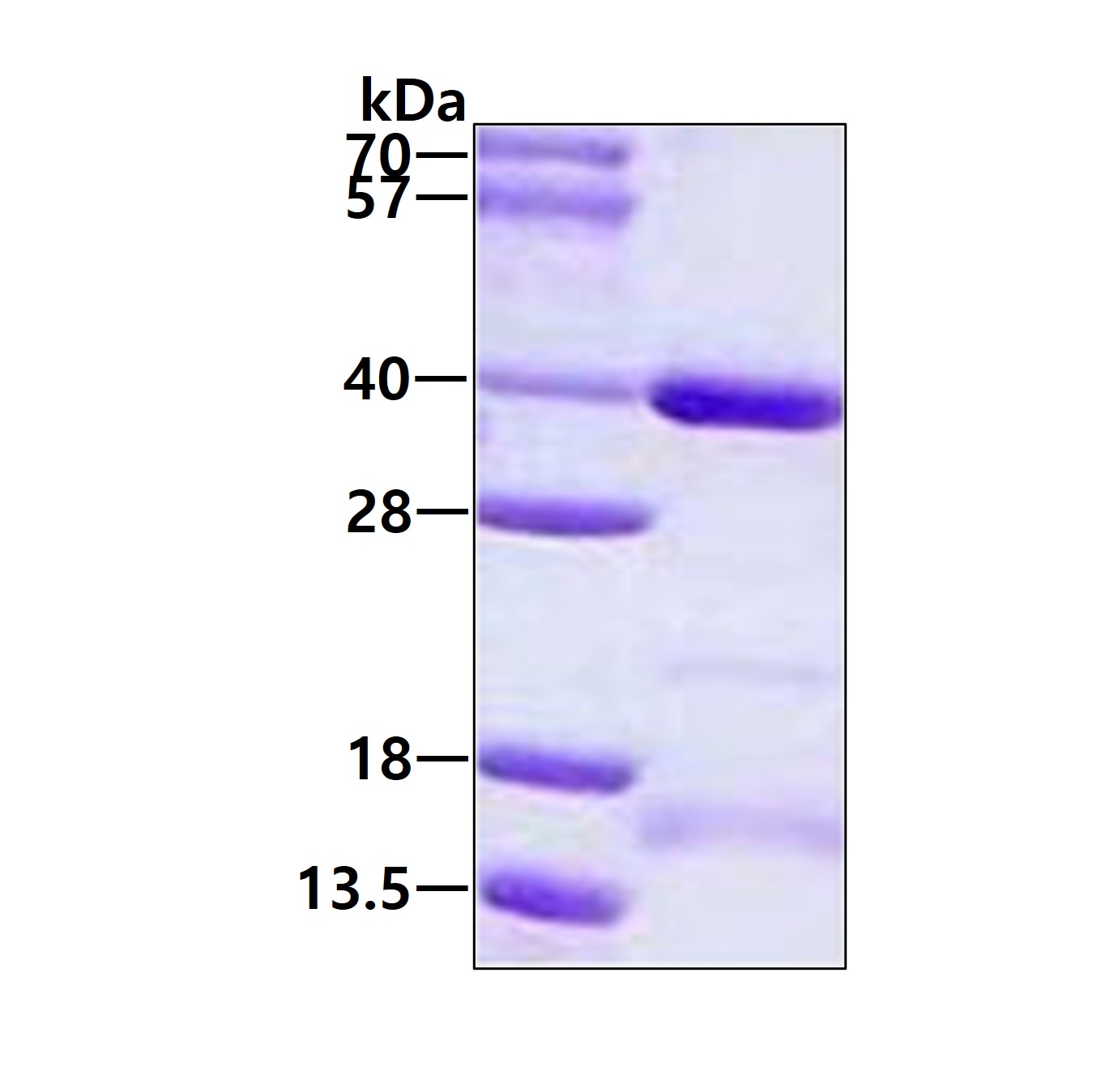

Human CCDC101/SGF29 protein (Recombinant) (His-Tag) (STJP017585)
SPECIFICATIONS
HostE.coli
ImmunogenHuman
General Information
| Short Description | Recombinant-Human CCDC101/SGF29-His-Tag protein was developed from e.coli and has a target region of His-Tag. For use in research applications. |
| Applications | SDS-PAGE |
| Host | E.coli |
| Note | STRICTLY FOR FURTHER SCIENTIFIC RESEARCH USE ONLY (RUO). MUST NOT TO BE USED IN DIAGNOSTIC OR THERAPEUTIC APPLICATIONS. |
Product Properties
| Concentration | 0.5 mg/mL |
| Formulation | Liquid in 20mM Tris-HCl buffer (pH 8.0) containing 1mM DTT, 10% Glycerol, 0.1M NaCl |
| Storage Instruction | For short term storage, keep at +2C to +8C for up to 1 week. For long term storage, aliquot and store at-20C, and avoid repeat freeze-thaw cycles. |
Target Information
| Gene Symbol | SGF29 |
| Gene ID | 112869 |
| Uniprot ID | SGF29_HUMAN |
| Accession Number | NP_612423 |
| Immunogen | Human |
| Immunogen Region | 1-293aa |
| Immunogen Sequence |
Additional Info
| Function | Chromatin reader component of some histone acetyltransferase (HAT) SAGA-type complexes like the TFTC-HAT, ATAC or STAGA complexes. SGF29 specifically recognizes and binds methylated 'Lys-4' of histone H3 (H3K4me), with a preference for trimethylated form (H3K4me3). In the SAGA-type complexes, SGF29 is required to recruit complexes to H3K4me. Involved in the response to endoplasmic reticulum (ER) stress by recruiting the SAGA complex to H3K4me, thereby promoting histone H3 acetylation and cell survival. Also binds non-histone proteins that are methylated on Lys residues: specifically recognizes and binds CGAS monomethylated on 'Lys-506'. |
| Protein Name | Saga-Associated Factor 29Coiled-Coil Domain-Containing Protein 101Saga Complex-Associated Factor 29 |
| Database Links | Reactome: R-HSA-3214847Reactome: R-HSA-9772755 |
| Cellular Localisation | Nucleus |
| Alternative Protein Names | Saga-Associated Factor 29 proteinCoiled-Coil Domain-Containing Protein 101 proteinSaga Complex-Associated Factor 29 proteinSGF29 proteinCCDC101 protein |
Information sourced from Uniprot.org