

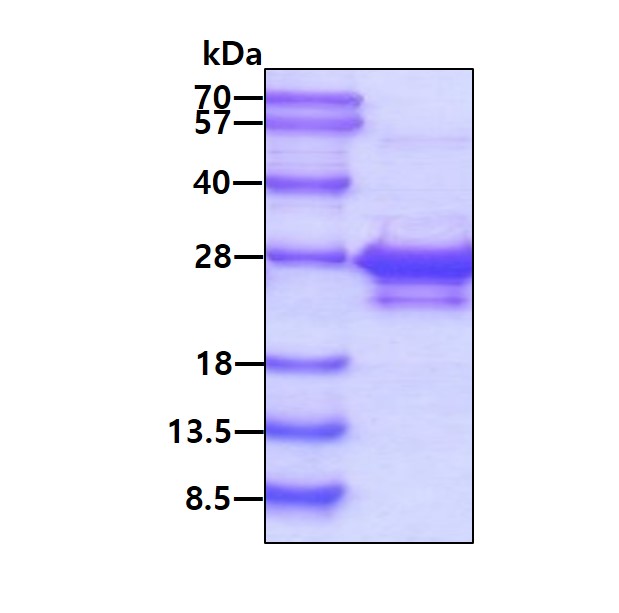

Human ASF1A protein (Recombinant) (His-Tag) (STJP016443)
SPECIFICATIONS
HostE.coli
ImmunogenHuman
General Information
| Short Description | Recombinant-Human ASF1A-His-Tag protein was developed from e.coli and has a target region of His-Tag. For use in research applications. |
| Applications | SDS-PAGE |
| Host | E.coli |
| Note | STRICTLY FOR FURTHER SCIENTIFIC RESEARCH USE ONLY (RUO). MUST NOT TO BE USED IN DIAGNOSTIC OR THERAPEUTIC APPLICATIONS. |
Product Properties
| Concentration | 1 mg/mL |
| Formulation | Liquid in 20mM Tris-HCl buffer (pH 8.0) containing 1mM DTT, 10% Glycerol |
| Storage Instruction | For short term storage, keep at +2C to +8C for up to 1 week. For long term storage, aliquot and store at-20C, and avoid repeat freeze-thaw cycles. |
| Endotoxin | < 1 EU per 1ug of protein (determined by LAL method) |
Target Information
| Gene Symbol | ASF1A |
| Gene ID | 25842 |
| Uniprot ID | ASF1A_HUMAN |
| Accession Number | NP_054753.1 |
| Immunogen | Human |
| Immunogen Region | 1-204aa |
| Immunogen Sequence |
Additional Info
| Tissue Specificity | Ubiquitously expressed. |
| Post Translational Modifications | Phosphorylated by TLK1 and TLK2. Highly phosphorylated in S-phase and at lower levels in M-phase. TLK2-mediated phosphorylation at Ser-192 prevents proteasome-dependent degradation. Phosphorylation at Ser-192 by PRKDC in response to DNA damage promotes the histone chaperone activity and ability to replace histones at double-strand breaks (DSBs) at stalled or collapsed replication forks, leading to RAD51 recruitment. |
| Function | Histone chaperone that facilitates histone deposition and histone exchange and removal during nucleosome assembly and disassembly. Cooperates with chromatin assembly factor 1 (CAF-1) to promote replication-dependent chromatin assembly and with HIRA to promote replication-independent chromatin assembly. Promotes homologous recombination-mediated repair of double-strand breaks (DSBs) at stalled or collapsed replication forks: acts by mediating histone replacement at DSBs, leading to recruitment of the MMS22L-TONSL complex and subsequent loading of RAD51. Also involved in the nuclear import of the histone H3-H4 dimer together with importin-4 (IPO4): specifically recognizes and binds newly synthesized histones with the monomethylation of H3 'Lys-9' and acetylation at 'Lys-14' (H3K9me1K14ac) marks, and diacetylation at 'Lys-5' and 'Lys-12' of H4 (H4K5K12ac) marks in the cytosol. Required for the formation of senescence-associated heterochromatin foci (SAHF) and efficient senescence-associated cell cycle exit. |
| Protein Name | Histone Chaperone Asf1aAnti-Silencing Function Protein 1 Homolog AHasf1Hasf1aCcg1-Interacting Factor ACiaHcia |
| Database Links | Reactome: R-HSA-2559584 |
| Cellular Localisation | NucleusChromosome |
| Alternative Protein Names | Histone Chaperone Asf1a proteinAnti-Silencing Function Protein 1 Homolog A proteinHasf1 proteinHasf1a proteinCcg1-Interacting Factor A proteinCia proteinHcia proteinASF1A proteinCGI-98 proteinHSPC146 protein |
Information sourced from Uniprot.org