
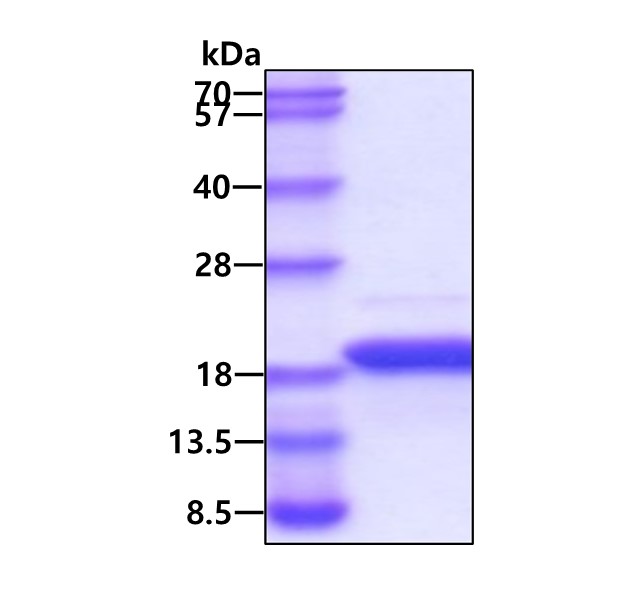

Human 4E-BP1/EIF4EBP1 protein (Recombinant) (His-Tag) (STJP016521)
SPECIFICATIONS
HostE.coli
ImmunogenHuman
General Information
| Short Description | Recombinant-Human 4E-BP1/EIF4EBP1-His-Tag protein was developed from e.coli and has a target region of His-Tag. For use in research applications. |
| Applications | SDS-PAGE |
| Host | E.coli |
| Note | STRICTLY FOR FURTHER SCIENTIFIC RESEARCH USE ONLY (RUO). MUST NOT TO BE USED IN DIAGNOSTIC OR THERAPEUTIC APPLICATIONS. |
Product Properties
| Concentration | 1 mg/mL |
| Formulation | Liquid in phosphate-Buffered Saline (pH 7.4) containing 10% Glycerol |
| Storage Instruction | For short term storage, keep at +2C to +8C for up to 1 week. For long term storage, aliquot and store at-20C, and avoid repeat freeze-thaw cycles. |
Target Information
| Gene Symbol | EIF4EBP1 |
| Gene ID | 1978 |
| Uniprot ID | 4EBP1_HUMAN |
| Accession Number | NP_004086.1 |
| Immunogen | Human |
| Immunogen Region | 1-118aa |
| Immunogen Sequence |
Additional Info
| Post Translational Modifications | Phosphorylated on serine and threonine residues in response to insulin, EGF and PDGF. Phosphorylation at Thr-37, Thr-46, Ser-65 and Thr-70, corresponding to the hyperphosphorylated form, is regulated by mTORC1 and abolishes binding to EIF4E. Ubiquitinated: when eIF4E levels are low, hypophosphorylated form is ubiquitinated by the BCR(KLHL25) complex, leading to its degradation and serving as a homeostatic mechanism to maintain translation and prevent eIF4E inhibition when eIF4E levels are low. Not ubiquitinated when hyperphosphorylated (at Thr-37, Thr-46, Ser-65 and Thr-70) or associated with eIF4E. |
| Function | Repressor of translation initiation that regulates EIF4E activity by preventing its assembly into the eIF4F complex: hypophosphorylated form competes with EIF4G1/EIF4G3 and strongly binds to EIF4E, leading to repress translation. In contrast, hyperphosphorylated form dissociates from EIF4E, allowing interaction between EIF4G1/EIF4G3 and EIF4E, leading to initiation of translation. Mediates the regulation of protein translation by hormones, growth factors and other stimuli that signal through the MAP kinase and mTORC1 pathways. |
| Protein Name | Eukaryotic Translation Initiation Factor 4e-Binding Protein 14e-Bp1Eif4e-Binding Protein 1Phosphorylated Heat- And Acid-Stable Protein Regulated By Insulin 1Phas-I |
| Database Links | Reactome: R-HSA-166208Reactome: R-HSA-72662 |
| Cellular Localisation | CytoplasmNucleusLocalization To The Nucleus Is Unaffected By Phosphorylation Status |
| Alternative Protein Names | Eukaryotic Translation Initiation Factor 4e-Binding Protein 1 protein4e-Bp1 proteinEif4e-Binding Protein 1 proteinPhosphorylated Heat- And Acid-Stable Protein Regulated By Insulin 1 proteinPhas-I proteinEIF4EBP1 protein |
Information sourced from Uniprot.org