

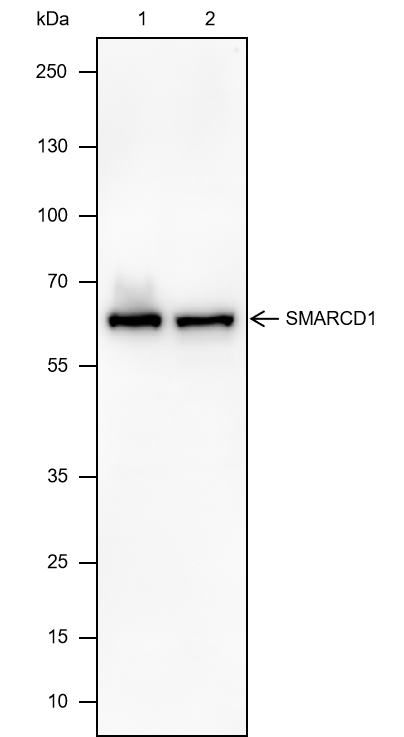

Anti-SMARCD1 antibody [R07-5D-8] (STJA0033752)
SPECIFICATIONS
ClonalityMonoclonal
HostRabbit
ConjugationUnconjugated
IsotypeIgGk
ImmunogenPeptide
General Information
| Short Description | Rabbit monoclonal anti-SMARCD1 for use in WB in Human and Mouse samples. Datasheet included with dilution recommendations, and related reagents. |
| Applications | WB |
| Host | Rabbit |
| Reactivity | Human/Mouse |
| Note | STRICTLY FOR FURTHER SCIENTIFIC RESEARCH USE ONLY (RUO). MUST NOT TO BE USED IN DIAGNOSTIC OR THERAPEUTIC APPLICATIONS. |
Product Properties
| Clonality | Monoclonal |
| Clone ID | R07-5D-8 |
| Isotype | IgGk |
| Conjugation | Unconjugated |
| Purification | Protein A |
| Dilution Range | WB 1:500-1:1000 |
| Formulation | Liquid in PBS, Glycerol and BSA |
| Storage Instruction | Store at-20°C. Avoid freeze/thaw cycles. |
Target Information
| Gene Symbol | SMARCD1 |
| Gene ID | 6602 |
| Uniprot ID | SMRD1_HUMAN |
| Immunogen | Peptide |
Additional Info
| Tissue Specificity | Expressed in all tissues tested, including brain, heart, kidney, liver, lung, muscle, pancreas and placenta. |
| Function | Involved in transcriptional activation and repression of select genes by chromatin remodeling (alteration of DNA-nucleosome topology). Component of SWI/SNF chromatin remodeling complexes that carry out key enzymatic activities, changing chromatin structure by altering DNA-histone contacts within a nucleosome in an ATP-dependent manner. Belongs to the neural progenitors-specific chromatin remodeling complex (npBAF complex) and the neuron-specific chromatin remodeling complex (nBAF complex). During neural development a switch from a stem/progenitor to a postmitotic chromatin remodeling mechanism occurs as neurons exit the cell cycle and become committed to their adult state. The transition from proliferating neural stem/progenitor cells to postmitotic neurons requires a switch in subunit composition of the npBAF and nBAF complexes. As neural progenitors exit mitosis and differentiate into neurons, npBAF complexes which contain ACTL6A/BAF53A and PHF10/BAF45A, are exchanged for homologous alternative ACTL6B/BAF53B and DPF1/BAF45B or DPF3/BAF45C subunits in neuron-specific complexes (nBAF). The npBAF complex is essential for the self-renewal/proliferative capacity of the multipotent neural stem cells. The nBAF complex along with CREST plays a role regulating the activity of genes essential for dendrite growth. Has a strong influence on vitamin D-mediated transcriptional activity from an enhancer vitamin D receptor element (VDRE). May be a link between mammalian SWI-SNF-like chromatin remodeling complexes and the vitamin D receptor (VDR) heterodimer. Mediates critical interactions between nuclear receptors and the BRG1/SMARCA4 chromatin-remodeling complex for transactivation. Interacts with AKIRIN2. |
| Protein Name | Swi/Snf-Related Matrix-Associated Actin-Dependent Regulator Of Chromatin Subfamily D Member 160 Kda Brg-1/Brm-Associated Factor Subunit ABrg1-Associated Factor 60aBaf60aSwi/Snf Complex 60 Kda Subunit |
| Database Links | Reactome: R-HSA-3214858Reactome: R-HSA-8939243Reactome: R-HSA-9824585Reactome: R-HSA-9845323 |
| Cellular Localisation | Nucleus |
| Alternative Antibody Names | Anti-Swi/Snf-Related Matrix-Associated Actin-Dependent Regulator Of Chromatin Subfamily D Member 1 antibodyAnti-60 Kda Brg-1/Brm-Associated Factor Subunit A antibodyAnti-Brg1-Associated Factor 60a antibodyAnti-Baf60a antibodyAnti-Swi/Snf Complex 60 Kda Subunit antibodyAnti-SMARCD1 antibodyAnti-BAF60A antibody |
Information sourced from Uniprot.org