
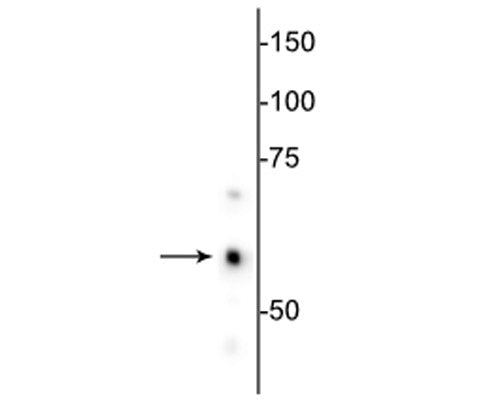
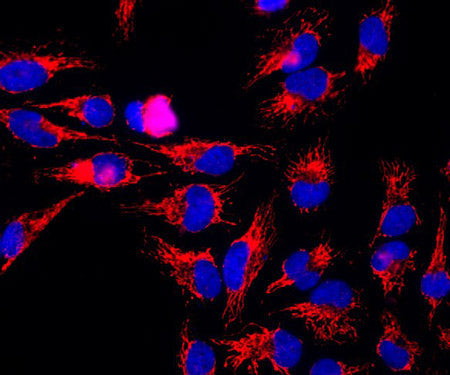

Anti-HSPD1 antibody (Full-Length) [1C7] (STJA0003845)
SPECIFICATIONS
ClonalityMonoclonal
HostMouse
ConjugationUnconjugated
IsotypeIgG1
ImmunogenRecombinant full length human HSP60 protein.
General Information
| Short Description | Mouse monoclonal anti-Hsp60 (Full-Length) for use in WB, IHC and ICC in Human, Mouse, Rat, Bovine, Canine, Feline, Goat, Guinea Pig, Hamster, Horse, Non-Human Primates, Rabbit, Sheep and Zebrafish samples. Datasheet included with dilution recommendat |
| Applications | WB/IHC/ICC |
| Host | Mouse |
| Reactivity | Human/Mouse/Rat/Bovine/Canine/Feline/Goat/Guinea Pig/Hamster/Horse/Non-Human Primates/Rabbit/Sheep/Zebrafish |
| Note | STRICTLY FOR FURTHER SCIENTIFIC RESEARCH USE ONLY (RUO). MUST NOT TO BE USED IN DIAGNOSTIC OR THERAPEUTIC APPLICATIONS. |
Product Properties
| Clonality | Monoclonal |
| Clone ID | 1C7 |
| Isotype | IgG1 |
| Conjugation | Unconjugated |
| Purification | This antibody was protein g purified culture from supernatant. |
| Dilution Range | WB 1:1000IHC 1:1000-1:5000ICC 1:500-1:5000 |
| Formulation | 100 ul in PBS + 50% Glycerol and 5 mM Sodium Azide |
| Storage Instruction | Store at-20°C for up to 1 year from the date of receipt, and avoid repeat freeze-thaw cycles. |
Target Information
| Gene Symbol | HSPD1 |
| Gene ID | 3329 |
| Uniprot ID | CH60_HUMAN |
| Immunogen | Recombinant full length human HSP60 protein. |
| Immunogen Region | Full-Length |
Additional Info
| Function | Chaperonin implicated in mitochondrial protein import and macromolecular assembly. Together with Hsp10, facilitates the correct folding of imported proteins. May also prevent misfolding and promote the refolding and proper assembly of unfolded polypeptides generated under stress conditions in the mitochondrial matrix. The functional units of these chaperonins consist of heptameric rings of the large subunit Hsp60, which function as a back-to-back double ring. In a cyclic reaction, Hsp60 ring complexes bind one unfolded substrate protein per ring, followed by the binding of ATP and association with 2 heptameric rings of the co-chaperonin Hsp10. This leads to sequestration of the substrate protein in the inner cavity of Hsp60 where, for a certain period of time, it can fold undisturbed by other cell components. Synchronous hydrolysis of ATP in all Hsp60 subunits results in the dissociation of the chaperonin rings and the release of ADP and the folded substrate protein (Probable). |
| Protein Name | 60 Kda Heat Shock Protein - Mitochondrial60 Kda ChaperoninChaperonin 60Cpn60Heat Shock Protein 60Hsp-60Hsp60Heat Shock Protein Family D Member 1Hucha60Mitochondrial Matrix Protein P1P60 Lymphocyte Protein |
| Database Links | Reactome: R-HSA-1268020Reactome: R-HSA-8869496Reactome: R-HSA-9837999Reactome: R-HSA-9841251 |
| Cellular Localisation | Mitochondrion Matrix |
| Alternative Antibody Names | Anti-60 Kda Heat Shock Protein - Mitochondrial antibodyAnti-60 Kda Chaperonin antibodyAnti-Chaperonin 60 antibodyAnti-Cpn60 antibodyAnti-Heat Shock Protein 60 antibodyAnti-Hsp-60 antibodyAnti-Hsp60 antibodyAnti-Heat Shock Protein Family D Member 1 antibodyAnti-Hucha60 antibodyAnti-Mitochondrial Matrix Protein P1 antibodyAnti-P60 Lymphocyte Protein antibodyAnti-HSPD1 antibodyAnti-HSP60 antibody |
Information sourced from Uniprot.org