


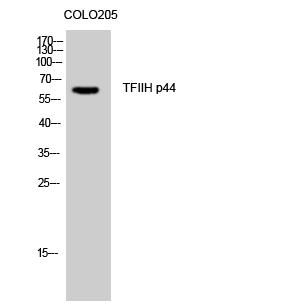
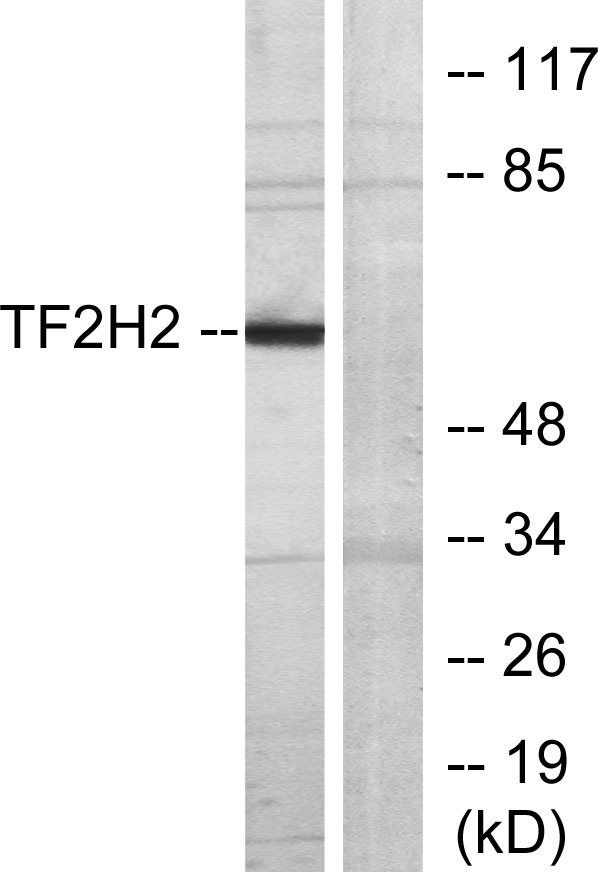
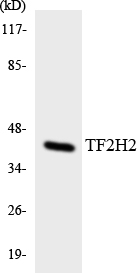
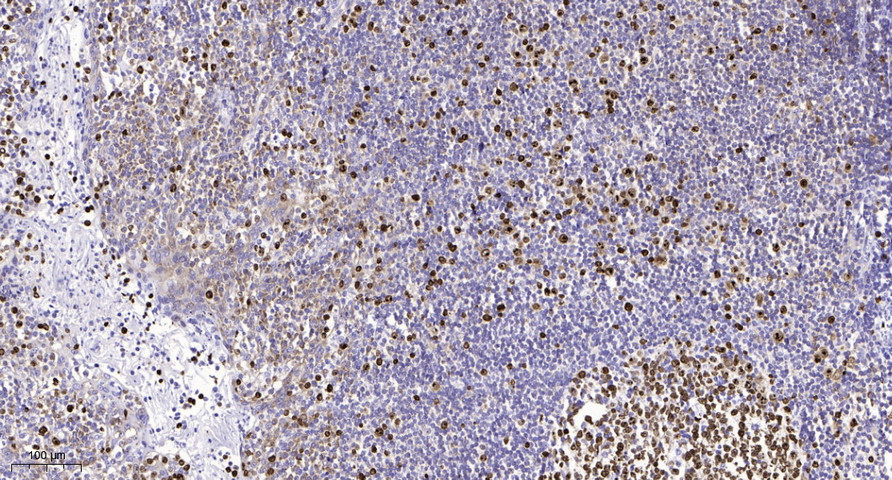

Anti-GTF2H2 antibody (1-50 aa) (STJ95982)
SPECIFICATIONS
ClonalityPolyclonal
HostRabbit
ConjugationUnconjugated
IsotypeIgG
ImmunogenThe antiserum was produced against synthesized peptide derived from the human TF2H2 at the amino acid range 1-50
General Information
| Short Description | Rabbit polyclonal anti-General transcription factor IIH subunit 2 (1-50 aa) for use in WB, IHC, IF and ELISA in Human, Mouse and Rat samples. Datasheet included with dilution recommendations, and related reagents. |
| Applications | WB/IHC/IF/ELISA |
| Host | Rabbit |
| Reactivity | Human/Mouse/Rat |
| Note | STRICTLY FOR FURTHER SCIENTIFIC RESEARCH USE ONLY (RUO). MUST NOT TO BE USED IN DIAGNOSTIC OR THERAPEUTIC APPLICATIONS. |
Product Properties
| Clonality | Polyclonal |
| Isotype | IgG |
| Conjugation | Unconjugated |
| Concentration | 1 mg/mL |
| Purification | The antibody was affinity-purified from rabbit antiserum by affinity-chromatography using epitope-specific immunogen. |
| Dilution Range | WB 1:500-1:2000IHC 1:100-1:300IF 1:200-1:1000ELISA 1:40000 |
| Formulation | Liquid in PBS containing 50% Glycerol, 0.5% BSA and 0.02% Sodium Azide. |
| Storage Instruction | Store at-20°C for up to 1 year from the date of receipt, and avoid repeat freeze-thaw cycles. |
Target Information
| Gene Symbol | GTF2H2 |
| Gene ID | 2966 |
| Uniprot ID | TF2H2_HUMAN |
| Immunogen | The antiserum was produced against synthesized peptide derived from the human TF2H2 at the amino acid range 1-50 |
| Immunogen Region | 1-50 aa |
| Specificity | TFIIH p44 Polyclonal Antibody detects endogenous levels of TFIIH p44 protein. |
Additional Info
| Function | Component of the general transcription and DNA repair factor IIH (TFIIH) core complex, which is involved in general and transcription-coupled nucleotide excision repair (NER) of damaged DNA and, when complexed to CAK, in RNA transcription by RNA polymerase II. In NER, TFIIH acts by opening DNA around the lesion to allow the excision of the damaged oligonucleotide and its replacement by a new DNA fragment. In transcription, TFIIH has an essential role in transcription initiation. When the pre-initiation complex (PIC) has been established, TFIIH is required for promoter opening and promoter escape. Phosphorylation of the C-terminal tail (CTD) of the largest subunit of RNA polymerase II by the kinase module CAK controls the initiation of transcription. The N-terminus of GTF2H2 interacts with and regulates XPD whereas an intact C-terminus is required for a successful escape of RNAP II form the promoter. |
| Protein Name | General Transcription Factor Iih Subunit 2Basic Transcription Factor 2 44 Kda SubunitBtf2 P44General Transcription Factor Iih Polypeptide 2Tfiih Basal Transcription Factor Complex P44 Subunit |
| Database Links | Reactome: R-HSA-112382Reactome: R-HSA-113418Reactome: R-HSA-167152Reactome: R-HSA-167158Reactome: R-HSA-167160Reactome: R-HSA-167161Reactome: R-HSA-167162Reactome: R-HSA-167172Reactome: R-HSA-167200Reactome: R-HSA-167246Reactome: R-HSA-427413Reactome: R-HSA-5696395Reactome: R-HSA-5696400Reactome: R-HSA-674695Reactome: R-HSA-6781823Reactome: R-HSA-6781827Reactome: R-HSA-6782135Reactome: R-HSA-6782210Reactome: R-HSA-6796648Reactome: R-HSA-72086Reactome: R-HSA-73762Reactome: R-HSA-73772Reactome: R-HSA-73776Reactome: R-HSA-73779Reactome: R-HSA-73863Reactome: R-HSA-75953Reactome: R-HSA-75955Reactome: R-HSA-76042Reactome: R-HSA-77075 |
| Cellular Localisation | Nucleus |
| Alternative Antibody Names | Anti-General Transcription Factor Iih Subunit 2 antibodyAnti-Basic Transcription Factor 2 44 Kda Subunit antibodyAnti-Btf2 P44 antibodyAnti-General Transcription Factor Iih Polypeptide 2 antibodyAnti-Tfiih Basal Transcription Factor Complex P44 Subunit antibodyAnti-GTF2H2 antibodyAnti-BTF2P44 antibody |
Information sourced from Uniprot.org