


Anti-GRP94 antibody [R04-2F-3] (STJA0033094)
SPECIFICATIONS
ClonalityMonoclonal
HostMouse
ConjugationUnconjugated
IsotypeIgG1k
ImmunogenPeptide
General Information
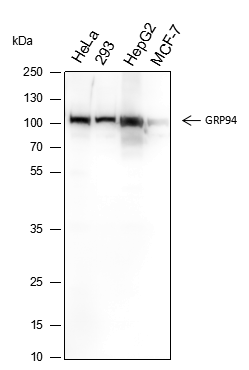
| Short Description | Mouse monoclonal anti-GRP94 for use in WB in Human samples. Datasheet included with dilution recommendations, and related reagents. |
| Applications | WB |
| Host | Mouse |
| Reactivity | Human |
| Note | STRICTLY FOR FURTHER SCIENTIFIC RESEARCH USE ONLY (RUO). MUST NOT TO BE USED IN DIAGNOSTIC OR THERAPEUTIC APPLICATIONS. |
Product Properties
| Clonality | Monoclonal |
| Clone ID | R04-2F-3 |
| Isotype | IgG1k |
| Conjugation | Unconjugated |
| Purification | Protein G |
| Dilution Range | WB 1:500-1:1000 |
| Formulation | Liquid in PBS, Glycerol and BSA |
| Storage Instruction | Store at-20°C. Avoid freeze/thaw cycles. |
Target Information
| Gene Symbol | HSP90B1 |
| Gene ID | 7184 |
| Uniprot ID | ENPL_HUMAN |
| Immunogen | Peptide |
Additional Info
| Post Translational Modifications | Phosphorylated by CK2. N-glycosylated cotranslationally at Asn-217 by STT3A-containing OST-A complex: this glycosylation is constitutive. In response to various stress, 5 additional facultative sites (Asn-62, Asn-107, Asn-445, Asn-481 and Asn-502) can be glycosylated post-translationally by STT3B-containing OST-B complex, leading to a hyperglycosylated form that is degraded by the ER-associated degradation (ERAD) pathway. In normal conditions, the OST-A complex together with CCDC134 prevent glycosylation at facultative sites during protein folding, thereby preventing hyperglycosylation. Mechanistically, nascent HSP90B1 is tethered during translation to a specialized CCDC134-containing translocon that forms a microenvironment for its folding, in which STT3A associates with the SRT pseudosubstrate motif, and prevents access to facultative glycosylation sites until folding is completed, rendering its facultative sites inaccessible to the OST-B complex. |
| Function | ATP-dependent chaperone involved in the processing of proteins in the endoplasmic reticulum, regulating their transport. Together with MESD, acts as a modulator of the Wnt pathway by promoting the folding of LRP6, a coreceptor of the canonical Wnt pathway. When associated with CNPY3, required for proper folding of Toll-like receptors. Promotes folding and trafficking of TLR4 to the cell surface. May participate in the unfolding of cytosolic leaderless cargos (lacking the secretion signal sequence) such as the interleukin 1/IL-1 to facilitate their translocation into the ERGIC (endoplasmic reticulum-Golgi intermediate compartment) and secretion.the translocation process is mediated by the cargo receptor TMED10. |
| Protein Name | Endoplasmin94 Kda Glucose-Regulated ProteinGrp-94Heat Shock Protein 90 Kda Beta Member 1Heat Shock Protein Family C Member 4Tumor Rejection Antigen 1Gp96 Homolog |
| Database Links | Reactome: R-HSA-1679131Reactome: R-HSA-3000480Reactome: R-HSA-381183Reactome: R-HSA-381426Reactome: R-HSA-6785807Reactome: R-HSA-8957275 |
| Cellular Localisation | Endoplasmic Reticulum LumenSarcoplasmic Reticulum LumenMelanosomeIdentified By Mass Spectrometry In Melanosome Fractions From Stage I To Stage Iv |
| Alternative Antibody Names | Anti-Endoplasmin antibodyAnti-94 Kda Glucose-Regulated Protein antibodyAnti-Grp-94 antibodyAnti-Heat Shock Protein 90 Kda Beta Member 1 antibodyAnti-Heat Shock Protein Family C Member 4 antibodyAnti-Tumor Rejection Antigen 1 antibodyAnti-Gp96 Homolog antibodyAnti-HSP90B1 antibodyAnti-GRP94 antibodyAnti-HSPC4 antibodyAnti-TRA1 antibody |
Information sourced from Uniprot.org