
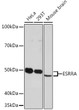


Anti-ESRRA antibody (1-100) [S1MR] (STJ11102011)
SPECIFICATIONS
ClonalityMonoclonal
HostRabbit
ConjugationUnconjugated
IsotypeIgG
General Information
| Short Description | Rabbit monoclonal Estrogen Related Receptor alpha (1-100) antibody for use in WB and ELISA in human and mouse samples. Datasheet included with dilution recommendations, and related reagents. |
| Applications | WB/ELISA |
| Host | Rabbit |
| Reactivity | Human/Mouse |
| Note | STRICTLY FOR FURTHER SCIENTIFIC RESEARCH USE ONLY (RUO). MUST NOT TO BE USED IN DIAGNOSTIC OR THERAPEUTIC APPLICATIONS. |
Product Properties
| Clonality | Monoclonal |
| Clone ID | S1MR |
| Isotype | IgG |
| Conjugation | Unconjugated |
| Concentration | Lot specific |
| Purification | Affinity purification |
| Dilution Range | WB:1:500-1:1000ELISA:Recommended starting concentration is 1 Mu g/mL. Please optimize the concentration based on your specific assay requirements. |
| Formulation | PBS with 0.02% Sodium Azide, 0.05% BSA, 50% Glycerol, pH 7.3. |
| Storage Instruction | Store at-20°C for up to 1 year from the date of receipt, and avoid repeat freeze-thaw cycles. |
Target Information
| Gene Symbol | ESRRA |
| Gene ID | 2101 |
| Uniprot ID | ERR1_HUMAN |
| Immunogen Region | 1-100 |
| Immunogen Sequence | MSSQVVGIEPLYIKAEPASP DSPKGSSETETEPPVALAPG PAPTRCLPGHKEEEDGEGAG PGEQGGGKLVLSSLPKRLCL VCGDVASGYHYGVASCEACK |
| Specificity | A synthetic peptide corresponding to a sequence within amino acids 1-100 of human ESRRA (P11474). |
Additional Info
| Post Translational Modifications | Phosphorylation on Ser-19 enhances sumoylation on Lys-14 increasing repression of transcriptional activity. Sumoylated with SUMO2. Main site is Lys-14 which is enhanced by phosphorylation on Ser-19, cofactor activation, and by interaction with PIAS4. Sumoylation enhances repression of transcriptional activity, but has no effect on subcellular location nor on DNA binding. Reversibly acetylated. Acetylation by PCAF/KAT2 at Lys-129, Lys-138, Lys-160 and Lys-162 and PCAF/KAT2 decreases transcriptional activity probably by inhibiting DNA-binding activity.deacetylation involves SIRT1 and HDAC8 and increases DNA-binding. |
| Function | Binds to an ERR-alpha response element (ERRE) containing a single consensus half-site, 5'-TNAAGGTCA-3'. Can bind to the medium-chain acyl coenzyme A dehydrogenase (MCAD) response element NRRE-1 and may act as an important regulator of MCAD promoter. Binds to the C1 region of the lactoferrin gene promoter. Requires dimerization and the coactivator, PGC-1A, for full activity. The ERRalpha/PGC1alpha complex is a regulator of energy metabolism. Induces the expression of PERM1 in the skeletal muscle. |
| Protein Name | Steroid Hormone Receptor Err1Estrogen Receptor-Like 1Estrogen-Related Receptor AlphaErr-AlphaNuclear Receptor Subfamily 3 Group B Member 1 |
| Database Links | Reactome: R-HSA-1989781Reactome: R-HSA-2151201Reactome: R-HSA-383280Reactome: R-HSA-8939902 |
| Cellular Localisation | NucleusCytoplasmCo-Localizes To The Cytoplasm Only In Presence Of Mapk15 |
| Alternative Antibody Names | Anti-Steroid Hormone Receptor Err1 antibodyAnti-Estrogen Receptor-Like 1 antibodyAnti-Estrogen-Related Receptor Alpha antibodyAnti-Err-Alpha antibodyAnti-Nuclear Receptor Subfamily 3 Group B Member 1 antibodyAnti-ESRRA antibodyAnti-ERR1 antibodyAnti-ESRL1 antibodyAnti-NR3B1 antibody |
Information sourced from Uniprot.org