
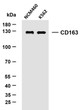
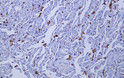


Anti-CD163 antibody (1-100 aa) [ABT-CD163] (STJ196804)
SPECIFICATIONS
ClonalityMonoclonal
HostMouse
ConjugationUnconjugated
IsotypeIgG1k
ImmunogenSynthesized peptide derived from the human CD163 at the amino acid range 1-100
General Information
| Short Description | Mouse monoclonal anti-Scavenger receptor cysteine-rich type 1 protein M130 (1-100 aa) for use in IHC and IF in Human, Mouse and Rat samples. Datasheet included with dilution recommendations, and related reagents. |
| Applications | IHC/IF |
| Host | Mouse |
| Reactivity | Human/Mouse/Rat |
| Note | STRICTLY FOR FURTHER SCIENTIFIC RESEARCH USE ONLY (RUO). MUST NOT TO BE USED IN DIAGNOSTIC OR THERAPEUTIC APPLICATIONS. |
Product Properties
| Clonality | Monoclonal |
| Clone ID | ABT-CD163 |
| Isotype | IgG1k |
| Conjugation | Unconjugated |
| Purification | The antibody was affinity-purified from mouse ascites by affinity-chromatography using specific immunogen. |
| Dilution Range | IHC-P 1:100-500IF 1:50-200 |
| Formulation | Liquid in PBS containing 50% Glycerol, 0.5% BSA and 0.02% Sodium Azide. |
| Storage Instruction | Store at-20°C for up to 1 year from the date of receipt, and avoid repeat freeze-thaw cycles. |
Target Information
| Gene Symbol | CD163 |
| Gene ID | 9332 |
| Uniprot ID | C163A_HUMAN |
| Immunogen | Synthesized peptide derived from the human CD163 at the amino acid range 1-100 |
| Immunogen Region | 1-100 aa |
| Specificity | This antibody detects endogenous levels of human CD163. Heat-induced epitope retrieval (HIER) TRIS-EDTA of pH8.0 was highly recommended as antigen repair method in paraffin section |
Additional Info
| Post Translational Modifications | A soluble form (sCD163) is produced by proteolytic shedding which can be induced by lipopolysaccharide, phorbol ester and Fc region of immunoglobulin gamma. This cleavage is dependent on protein kinase C and tyrosine kinases and can be blocked by protease inhibitors. The shedding is inhibited by the tissue inhibitor of metalloproteinase TIMP3, and thus probably induced by membrane-bound metalloproteinases ADAMs. Phosphorylated. |
| Function | Acute phase-regulated receptor involved in clearance and endocytosis of hemoglobin/haptoglobin complexes by macrophages and may thereby protect tissues from free hemoglobin-mediated oxidative damage. May play a role in the uptake and recycling of iron, via endocytosis of hemoglobin/haptoglobin and subsequent breakdown of heme. Binds hemoglobin/haptoglobin complexes in a calcium-dependent and pH-dependent manner. Exhibits a higher affinity for complexes of hemoglobin and multimeric haptoglobin of HP*1F phenotype than for complexes of hemoglobin and dimeric haptoglobin of HP*1S phenotype. Induces a cascade of intracellular signals that involves tyrosine kinase-dependent calcium mobilization, inositol triphosphate production and secretion of IL6 and CSF1. Isoform 3 exhibits the higher capacity for ligand endocytosis and the more pronounced surface expression when expressed in cells. After shedding, the soluble form (sCD163) may play an anti-inflammatory role, and may be a valuable diagnostic parameter for monitoring macrophage activation in inflammatory conditions. |
| Protein Name | Scavenger Receptor Cysteine-Rich Type 1 Protein M130Hemoglobin Scavenger ReceptorCd Antigen Cd163 Cleaved Into - Soluble Cd163Scd163 |
| Database Links | Reactome: R-HSA-2168880Reactome: R-HSA-9662834 |
| Cellular Localisation | Soluble Cd163: SecretedCell MembraneSingle-Pass Type I Membrane ProteinIsoform 1 And Isoform 2 Show A Lower Surface Expression When Expressed In Cells |
| Alternative Antibody Names | Anti-Scavenger Receptor Cysteine-Rich Type 1 Protein M130 antibodyAnti-Hemoglobin Scavenger Receptor antibodyAnti-Cd Antigen Cd163 Cleaved Into - Soluble Cd163 antibodyAnti-Scd163 antibodyAnti-CD163 antibodyAnti-M130 antibody |
Information sourced from Uniprot.org