
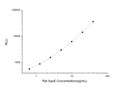


Rat ApoE (Apolipoprotein E) CLIA Kit for Quantitative Detection
SPECIFICATIONS
General Information
| Short Description | This rat ApoE kit is a highly sensitive in-vitro chemiluminescent immunoassay for the measurement of trace amounts of analytes in serum, plasma and other biological fluids. |
| Applications | CLIA |
| Reactivity | Rat |
| Sensitivity | 0.38ng/mL |
| Detection Limit | 0.63~40ng/mL |
| Note | FOR SCIENTIFIC EDUCATIONAL RESEARCH USE ONLY (RUO). MUST NOT BE USED IN DIAGNOSTIC OR OTHER MEDICAL APPLICATIONS. |
Product Properties
| Storage Instruction | If unopened the kit may be stored at 2-8°C for up to 1 month. If the kit will not be used within 1 month, store the components separately, according to the component table in the manual. |
| Assay Time | 3.5h |
| Detection | Chemiluminescence |
Target Information
| Gene Symbol | Apoe |
| Gene ID | 25728 |
| Uniprot ID | APOE_RAT |
| Specificity | This kit recognizes Rat ApoE in samples. No significant cross-reactivity or interference between Rat ApoE and analogues was observed. |
| Sample Type | Serum, plasma and other biological fluids |
Additional Info
| Post Translational Modifications | APOE exists as multiple glycosylated and sialylated glycoforms within cells and in plasma. The extent of glycosylation and sialylation are tissue and context specific. Glycated in plasma VLDL. Phosphorylated by FAM20C in the extracellular medium. |
| Function | APOE is an apolipoprotein, a protein associating with lipid particles, that mainly functions in lipoprotein-mediated lipid transport between organs via the plasma and interstitial fluids. APOE is a core component of plasma lipoproteins and is involved in their production, conversion and clearance. Apolipoproteins are amphipathic molecules that interact both with lipids of the lipoprotein particle core and the aqueous environment of the plasma. As such, APOE associates with chylomicrons, chylomicron remnants, very low density lipoproteins (VLDL) and intermediate density lipoproteins (IDL) but shows a preferential binding to high-density lipoproteins (HDL). It also binds a wide range of cellular receptors including the LDL receptor/LDLR and the very low-density lipoprotein receptor/VLDLR that mediate the cellular uptake of the APOE-containing lipoprotein particles. Finally, APOE also has a heparin-binding activity and binds heparan-sulfate proteoglycans on the surface of cells, a property that supports the capture and the receptor-mediated uptake of APOE-containing lipoproteins by cells. |
| Protein Name | Apolipoprotein EApo-E |
| Database Links | Reactome: R-RNO-3000480Reactome: -RNO-381426Reactome: -RNO-8957275Reactome: -RNO-8963888Reactome: -RNO-8963901Reactome: -RNO-8964026Reactome: -RNO-8964058Reactome: -RNO-975634 |
| Cellular Localisation | SecretedExtracellular SpaceExtracellular MatrixExtracellular VesicleEndosomeMultivesicular BodyIn The PlasmaApoe Is Associated With ChylomicronsChylomicrons RemnantsVldlLdl And Hdl LipoproteinsLipid Poor Oligomeric Apoe Is Associated With The Extracellular Matrix In A Calcium- And Heparan-Sulfate Proteoglycans-Dependent MannerLipidation Induces The Release From The Extracellular MatrixColocalizes With Cd63 And Pmel At Exosomes And In Intraluminal Vesicles Within Multivesicular Endosomes |
| Alternative CLIA Names | Apolipoprotein E CLIA kitApo-E CLIA kitApoe CLIA kit |
| Specificity | This kit recognizes Rat ApoE in samples. No significant cross-reactivity or interference between Rat ApoE and analogues was observed. |
| Reproducibility | Both intra-CV and inter-CV are |
Information sourced from Uniprot.org
| Item | Specifications | Storage |
|---|---|---|
| Micro CLIA Plate (Dismountable) | 96T: 8 wells ×12 strips strips | -20℃, 6 months |
| Reference Standard | 96T: 2 vials 48T: 1 vial | -20℃, 6 months |
| Concentrated Biotinylated Detection Ab (100×) | 96T: 1 vial, 120 μL 60 μL | -20℃, 6 months |
| Concentrated HRP Conjugate (100×) | 96T: 1 vial, 120 μL 60 μL | -20℃ (Protect from light), 6 months |
| Reference Standard & Sample Diluent | 1 vial, 20 mL | 2-8°C, 6 months |
| Biotinylated Detection Ab Diluent | 1 vial, 14 mL | 2-8°C, 6 months |
| HRP Conjugate Diluent | 1 vial, 14 mL | 2-8°C, 6 months |
| Concentrated Wash Buffer (25×) | 1 vial, 30 mL | 2-8°C, 6 months |
| Substrate Reagent A | 1 vial, 5 mL | 2-8℃ (Protect from light) |
| Substrate Reagent B | 1 vial, 5 mL | 2-8℃ (Protect from light) |
| Plate Sealer | 5 pieces | |
| Manual | 1 copy | |
| Certificate of Analysis | 1 copy |
| Sample Type | Range (%) | Average Recovery (%) |
|---|---|---|
| Serum(n=8) | 95-107 | 100 |
| EDTA plasma(n=8) | 93-103 | 98 |
| Cell culture media(n=8) | 94-105 | 99 |
| Intra-assay Precision | Intra-assay Precision | Intra-assay Precision | Inter-assay Precision | Inter-assay Precision | Inter-assay Precision | |
|---|---|---|---|---|---|---|
| Sample | 1.00 | 2.00 | 3.00 | 1.00 | 2.00 | 3.00 |
| n | 20.00 | 20.00 | 20.00 | 20.00 | 20.00 | 20.00 |
| Mean (ng/mL) | 1.97 | 4.67 | 13.90 | 1.95 | 4.51 | 13.23 |
| Standard deviation | 0.18 | 0.42 | 1.19 | 0.17 | 0.46 | 1.16 |
| CV (%) | 9.14 | 8.99 | 8.56 | 8.72 | 10.20 | 8.77 |