

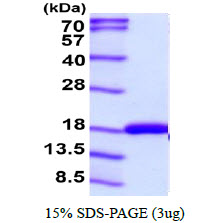

Mouse Elongin B protein (Recombinant) (His-Tag) (STJP019394)
SPECIFICATIONS
HostE.coli
ImmunogenMouse
General Information
| Short Description | Recombinant-Mouse Elongin B-His-Tag protein was developed from e.coli and has a target region of His-Tag. For use in research applications. |
| Applications | SDS-PAGE |
| Host | E.coli |
| Note | STRICTLY FOR FURTHER SCIENTIFIC RESEARCH USE ONLY (RUO). MUST NOT TO BE USED IN DIAGNOSTIC OR THERAPEUTIC APPLICATIONS. |
Product Properties
| Concentration | 1 mg/mL |
| Formulation | Liquid in phosphate-Buffered Saline (pH 7.4) containing 1mM DTT, 10% Glycerol |
| Storage Instruction | For short term storage, keep at +2C to +8C for up to 1 week. For long term storage, aliquot and store at-20C, and avoid repeat freeze-thaw cycles. |
Target Information
| Gene Symbol | Elob |
| Gene ID | 67673 |
| Uniprot ID | ELOB_MOUSE |
| Accession Number | NP_080581 |
| Immunogen | Mouse |
| Immunogen Region | 1-118aa |
| Immunogen Sequence | MGSSHHHHHH SSGLVPRGSH MGSMDVFLMI RRHKTTIFTD AKESSTVFEL KRIVEGILKR PPEEQRLYKD DQLLDDGKTL GECGFTSQTA RPQAPATVGL AFRADDTFEA LRIEPFSSPP ELPDVMKPQD SGGSANEQAV Q |
Additional Info
| Function | SIII, also known as elongin, is a general transcription elongation factor that increases the RNA polymerase II transcription elongation past template-encoded arresting sites. Subunit A is transcriptionally active and its transcription activity is strongly enhanced by binding to the dimeric complex of the SIII regulatory subunits B and C (elongin BC complex). In embryonic stem cells, the elongin BC complex is recruited by EPOP to Polycomb group (PcG) target genes in order generate genomic region that display both active and repressive chromatin properties, an important feature of pluripotent stem cells. Core component of multiple cullin-2 and cullin-5-RING E3 ubiquitin-protein ligase complexes (ECS complexes), which mediate the ubiquitination of target proteins. By binding to BC-box motifs it seems to link target recruitment subunits, like VHL and members of the SOCS box family, to Cullin/RBX1 modules that activate E2 ubiquitination enzymes. Component the von Hippel-Lindau ubiquitination complex CBC(VHL). A number of ECS complexes (containing either KLHDC2, KLHDC3, KLHDC10, APPBP2, FEM1A, FEM1B or FEM1C as substrate-recognition component) are part of the DesCEND (destruction via C-end degrons) pathway, which recognizes a C-degron located at the extreme C terminus of target proteins, leading to their ubiquitination and degradation. The ECS(ASB9) complex mediates ubiquitination and degradation of CKB. As part of a multisubunit ubiquitin ligase complex, polyubiquitinates monoubiquitinated POLR2A. ECS(LRR1) ubiquitinates MCM7 and promotes CMG replisome disassembly by VCP and chromatin extraction during S-phase. As part of the ECS(RAB40C) complex, mediates ANKRD28 ubiquitination and degradation, thereby inhibiting protein phosphatase 6 (PP6) complex activity and focal adhesion assembly during cell migration. |
| Protein Name | Elongin-BElobElongin 18 Kda SubunitRna Polymerase Ii Transcription Factor Siii Subunit BSiii P18Transcription Elongation Factor B Polypeptide 2 |
| Database Links | Reactome: R-MMU-112382Reactome: -MMU-1234176Reactome: -MMU-674695Reactome: -MMU-6796648Reactome: -MMU-75955Reactome: -MMU-8951664Reactome: -MMU-9705462Reactome: -MMU-983168 |
| Cellular Localisation | Nucleus |
| Alternative Protein Names | Elongin-B proteinElob proteinElongin 18 Kda Subunit proteinRna Polymerase Ii Transcription Factor Siii Subunit B proteinSiii P18 proteinTranscription Elongation Factor B Polypeptide 2 proteinElob proteinTceb2 protein |
Information sourced from Uniprot.org