

Human YY1 protein (Recombinant) (His-Tag) (STJP018948)
SPECIFICATIONS
HostE.coli
ImmunogenHuman
General Information
| Short Description | Recombinant-Human YY1-His-Tag protein was developed from e.coli and has a target region of His-Tag. For use in research applications. |
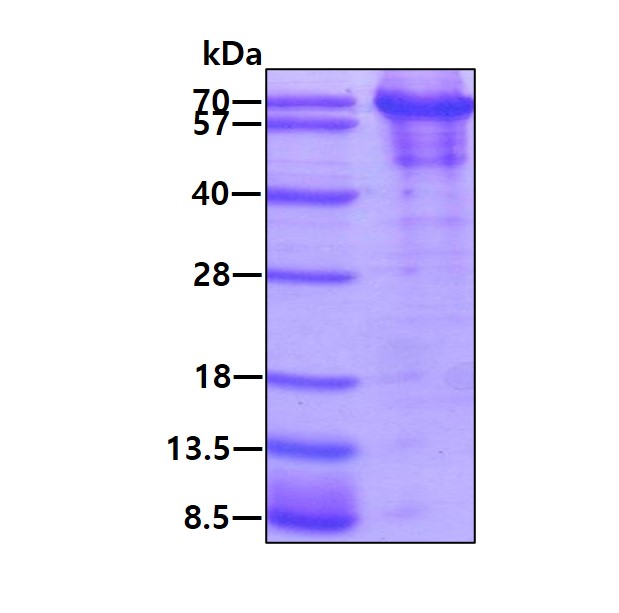
| Applications | SDS-PAGE |
| Host | E.coli |
| Note | STRICTLY FOR FURTHER SCIENTIFIC RESEARCH USE ONLY (RUO). MUST NOT TO BE USED IN DIAGNOSTIC OR THERAPEUTIC APPLICATIONS. |
Product Properties
| Concentration | 0.25 mg/mL |
| Formulation | Liquid in phosphate-Buffered Saline (pH 7.4) containing 20% Glycerol, 1mM DTT |
| Storage Instruction | For short term storage, keep at +2C to +8C for up to 1 week. For long term storage, aliquot and store at-20C, and avoid repeat freeze-thaw cycles. |
Target Information
| Gene Symbol | YY1 |
| Gene ID | 7528 |
| Uniprot ID | TYY1_HUMAN |
| Accession Number | NP_003394.1 |
| Immunogen | Human |
| Immunogen Region | 1-414aa |
| Immunogen Sequence |
Additional Info
| Post Translational Modifications | Phosphorylation at Ser-118 by CK2 prevents proteolytic cleavage by caspase-7 (CASP7) during apoptosis. Proteolytically cleaved by caspase-7 (CASP7) in response to apoptosis. Phosphorylation at Ser-118 protects against proteolytic cleavage. Transiently poly-ADP-ribosylated by PARP1 upon DNA damage, with the effect of decreasing affinity of YY1 to its cognate DNA binding sites. Ubiquitinated. |
| Function | Multifunctional transcription factor that exhibits positive and negative control on a large number of cellular and viral genes by binding to sites overlapping the transcription start site. Binds to the consensus sequence 5'-CCGCCATNTT-3'.some genes have been shown to contain a longer binding motif allowing enhanced binding.the initial CG dinucleotide can be methylated greatly reducing the binding affinity. The effect on transcription regulation is depending upon the context in which it binds and diverse mechanisms of action include direct activation or repression, indirect activation or repression via cofactor recruitment, or activation or repression by disruption of binding sites or conformational DNA changes. Its activity is regulated by transcription factors and cytoplasmic proteins that have been shown to abrogate or completely inhibit YY1-mediated activation or repression. For example, it acts as a repressor in absence of adenovirus E1A protein but as an activator in its presence. Acts synergistically with the SMAD1 and SMAD4 in bone morphogenetic protein (BMP)-mediated cardiac-specific gene expression. Binds to SMAD binding elements (SBEs) (5'-GTCT/AGAC-3') within BMP response element (BMPRE) of cardiac activating regions. May play an important role in development and differentiation. Proposed to recruit the PRC2/EED-EZH2 complex to target genes that are transcriptional repressed. Involved in DNA repair. In vitro, binds to DNA recombination intermediate structures (Holliday junctions). Plays a role in regulating enhancer activation. Recruits the PR-DUB complex to specific gene-regulatory regions. Proposed core component of the chromatin remodeling INO80 complex which is involved in transcriptional regulation, DNA replication and probably DNA repair.proposed to target the INO80 complex to YY1-responsive elements. |
| Protein Name | Transcriptional Repressor Protein Yy1Delta Transcription FactorIno80 Complex Subunit SNf-E1Yin And Yang 1Yy-1 |
| Database Links | Reactome: R-HSA-5617472Reactome: R-HSA-5689603Reactome: R-HSA-5696394Reactome: R-HSA-8866910Reactome: R-HSA-9018519 |
| Cellular Localisation | Nucleus MatrixAssociated With The Nuclear Matrix |
| Alternative Protein Names | Transcriptional Repressor Protein Yy1 proteinDelta Transcription Factor proteinIno80 Complex Subunit S proteinNf-E1 proteinYin And Yang 1 proteinYy-1 proteinYY1 proteinINO80S protein |
Information sourced from Uniprot.org