

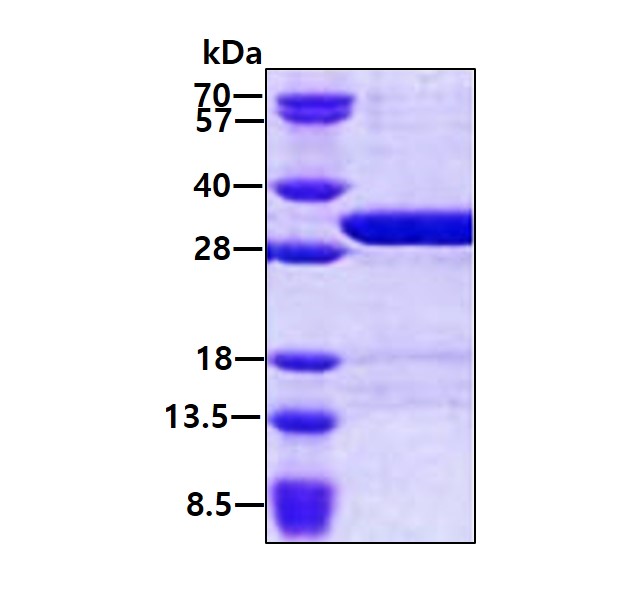

Human USP15 protein (Recombinant) (His-Tag) (STJP018342)
SPECIFICATIONS
HostE.coli
ImmunogenHuman
General Information
| Short Description | Recombinant-Human USP15-His-Tag protein was developed from e.coli and has a target region of His-Tag. For use in research applications. |
| Applications | SDS-PAGE |
| Host | E.coli |
| Note | STRICTLY FOR FURTHER SCIENTIFIC RESEARCH USE ONLY (RUO). MUST NOT TO BE USED IN DIAGNOSTIC OR THERAPEUTIC APPLICATIONS. |
Product Properties
| Concentration | 0.5 mg/mL |
| Formulation | Liquid in 20mM Tris-HCl buffer (pH 8.0) containing 0.15M NaCl, 10% Glycerol, 1mM DTT |
| Storage Instruction | For short term storage, keep at +2C to +8C for up to 1 week. For long term storage, aliquot and store at-20C, and avoid repeat freeze-thaw cycles. |
Target Information
| Gene Symbol | USP15 |
| Gene ID | 9958 |
| Uniprot ID | UBP15_HUMAN |
| Accession Number | NP_001239008 |
| Immunogen | Human |
| Immunogen Region | 1-235aa |
| Immunogen Sequence |
Additional Info
| Tissue Specificity | Expressed in skeletal muscle, kidney, heart, placenta, liver, thymus, lung, and ovary, with little or no expression in other tissues. |
| Post Translational Modifications | Phosphorylated. Phosphorylation protects against ubiquitination and subsequent degradation by the proteasome. Ubiquitinated, leading to degradation by the proteasome. |
| Function | Hydrolase that removes conjugated ubiquitin from target proteins and regulates various pathways such as the TGF-beta receptor signaling, NF-kappa-B and RNF41/NRDP1-PRKN pathways. Acts as a key regulator of TGF-beta receptor signaling pathway, but the precise mechanism is still unclear: according to a report, acts by promoting deubiquitination of monoubiquitinated R-SMADs (SMAD1, SMAD2 and/or SMAD3), thereby alleviating inhibition of R-SMADs and promoting activation of TGF-beta target genes. According to another reports, regulates the TGF-beta receptor signaling pathway by mediating deubiquitination and stabilization of TGFBR1, leading to an enhanced TGF-beta signal. Able to mediate deubiquitination of monoubiquitinated substrates, 'Lys-27'-, 'Lys-48'- and 'Lys-63'-linked polyubiquitin chains. May also regulate gene expression and/or DNA repair through the deubiquitination of histone H2B. Acts as an inhibitor of mitophagy by counteracting the action of parkin (PRKN): hydrolyzes cleavage of 'Lys-48'- and 'Lys-63'-linked polyubiquitin chains attached by parkin on target proteins such as MFN2, thereby reducing parkin's ability to drive mitophagy. Acts as an associated component of COP9 signalosome complex (CSN) and regulates different pathways via this association: regulates NF-kappa-B by mediating deubiquitination of NFKBIA and deubiquitinates substrates bound to VCP. Involved in endosome organization by mediating deubiquitination of SQSTM1: ubiquitinated SQSTM1 forms a molecular bridge that restrains cognate vesicles in the perinuclear region and its deubiquitination releases target vesicles for fast transport into the cell periphery. Acts as a negative regulator of antifungal immunity by mediating 'Lys-27'-linked deubiquitination of CARD9, thereby inactivating CARD9. (Microbial infection) Protects APC and human papillomavirus type 16 protein E6 against degradation via the ubiquitin proteasome pathway. |
| Protein Name | Ubiquitin Carboxyl-Terminal Hydrolase 15Deubiquitinating Enzyme 15Ubiquitin Thioesterase 15Ubiquitin-Specific-Processing Protease 15Unph-2Unph4 |
| Database Links | Reactome: R-HSA-2173788Reactome: R-HSA-5689603Reactome: R-HSA-5689880 |
| Cellular Localisation | CytoplasmNucleusMitochondrion |
| Alternative Protein Names | Ubiquitin Carboxyl-Terminal Hydrolase 15 proteinDeubiquitinating Enzyme 15 proteinUbiquitin Thioesterase 15 proteinUbiquitin-Specific-Processing Protease 15 proteinUnph-2 proteinUnph4 proteinUSP15 proteinKIAA0529 protein |
Information sourced from Uniprot.org