

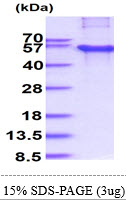

Human CREB3L2 protein (Recombinant) (His-Tag) (STJP019010)
SPECIFICATIONS
HostE.coli
ImmunogenHuman
General Information
| Short Description | Recombinant-Human CREB3L2-His-Tag protein was developed from e.coli and has a target region of His-Tag. For use in research applications. |
| Applications | SDS-PAGE |
| Host | E.coli |
| Note | STRICTLY FOR FURTHER SCIENTIFIC RESEARCH USE ONLY (RUO). MUST NOT TO BE USED IN DIAGNOSTIC OR THERAPEUTIC APPLICATIONS. |
Product Properties
| Concentration | 0.25 mg/mL |
| Formulation | Liquid in 20mM Tris-HCl buffer (pH 8.0) containing 50% Glycerol, 1mM DTT, 0.2M NaCl |
| Storage Instruction | For short term storage, keep at +2C to +8C for up to 1 week. For long term storage, aliquot and store at-20C, and avoid repeat freeze-thaw cycles. |
Target Information
| Gene Symbol | CREB3L2 |
| Gene ID | 64764 |
| Uniprot ID | CR3L2_HUMAN |
| Accession Number | AAI10814 |
| Immunogen | Human |
| Immunogen Region | 1-378aa |
| Immunogen Sequence | MGSSHHHHHH SSGLVPRGSH MGSMEVLESG EQGVLQWDRK LSELSEPGDG EALMYHTHFS ELLDEFSQNV LGQLLNDPFL SEKSVSMEVE PSPTSPAPLI QAEHSYSLCE EPRAQSPFTH ITSDSFNDDE VESEKWYLST DFPSTSIKTE PITDEPPPGL VPSVTLTITA ISTPLEKEEP PLEMNTGVDS SCQTIIPKIK LEPHEVDQFL NFSPKEAPVD HLHLPPTP |
Additional Info
| Tissue Specificity | Widely expressed with highest levels in placenta, lung, spleen and intestine, and lowest levels in heart, brain, skeletal muscle, thymus, colon and leukocytes. In fetal tissues, the weakest expression is detected in brain and heart. |
| Post Translational Modifications | Upon ER stress, translocated to the Golgi apparatus, where it is processed by regulated intramembrane proteolysis (RIP) to release the cytosol-facing N-terminal transcription factor domain. The cleavage is performed sequentially by site-1 and site-2 proteases (S1P/MBTPS1 and S2P/MBTPS2). N-glycosylated. Ubiquitinated by HRD1/SYVN1.undergoes 'Lys-48'-linked ubiquitination, followed by rapid proteasomal degradation under normal conditions. Upon ER stress, SYVN1 E3 ubiquitin-protein ligase dissociates from its substrate, ubiquitination does not occur and CREB3L2 is stabilized. |
| Function | Transcription factor involved in unfolded protein response (UPR). In the absence of endoplasmic reticulum (ER) stress, inserted into ER membranes, with N-terminal DNA-binding and transcription activation domains oriented toward the cytosolic face of the membrane. In response to ER stress, transported to the Golgi, where it is cleaved in a site-specific manner by resident proteases S1P/MBTPS1 and S2P/MBTPS2. The released N-terminal cytosolic domain is translocated to the nucleus to effect transcription of specific target genes. Plays a critical role in chondrogenesis by activating the transcription of SEC23A, which promotes the transport and secretion of cartilage matrix proteins, and possibly that of ER biogenesis-related genes. In a neuroblastoma cell line, protects cells from ER stress-induced death. In vitro activates transcription of target genes via direct binding to the CRE site. |
| Protein Name | Cyclic Amp-Responsive Element-Binding Protein 3-Like Protein 2Camp-Responsive Element-Binding Protein 3-Like Protein 2Bbf2 Human Homolog On Chromosome 7 Cleaved Into - Processed Cyclic Amp-Responsive Element-Binding Protein 3-Like Protein 2 |
| Database Links | Reactome: R-HSA-8874211 |
| Cellular Localisation | Endoplasmic Reticulum MembraneSingle-Pass Type Ii Membrane ProteinEr Membrane Resident ProteinUpon Er StressTranslocated To The Golgi Apparatus Where It Is CleavedThe Cytosolic N-Terminal Fragment (Processed Cyclic Amp-Responsive Element-Binding Protein 3-Like Protein 1) Is Transported Into The NucleusProcessed Cyclic Amp-Responsive Element-Binding Protein 3-Like Protein 2: NucleusTranslocated Into The Nucleus |
| Alternative Protein Names | Cyclic Amp-Responsive Element-Binding Protein 3-Like Protein 2 proteinCamp-Responsive Element-Binding Protein 3-Like Protein 2 proteinBbf2 Human Homolog On Chromosome 7 Cleaved Into - Processed Cyclic Amp-Responsive Element-Binding Protein 3-Like Protein 2 proteinCREB3L2 proteinBBF2H7 protein |
Information sourced from Uniprot.org