

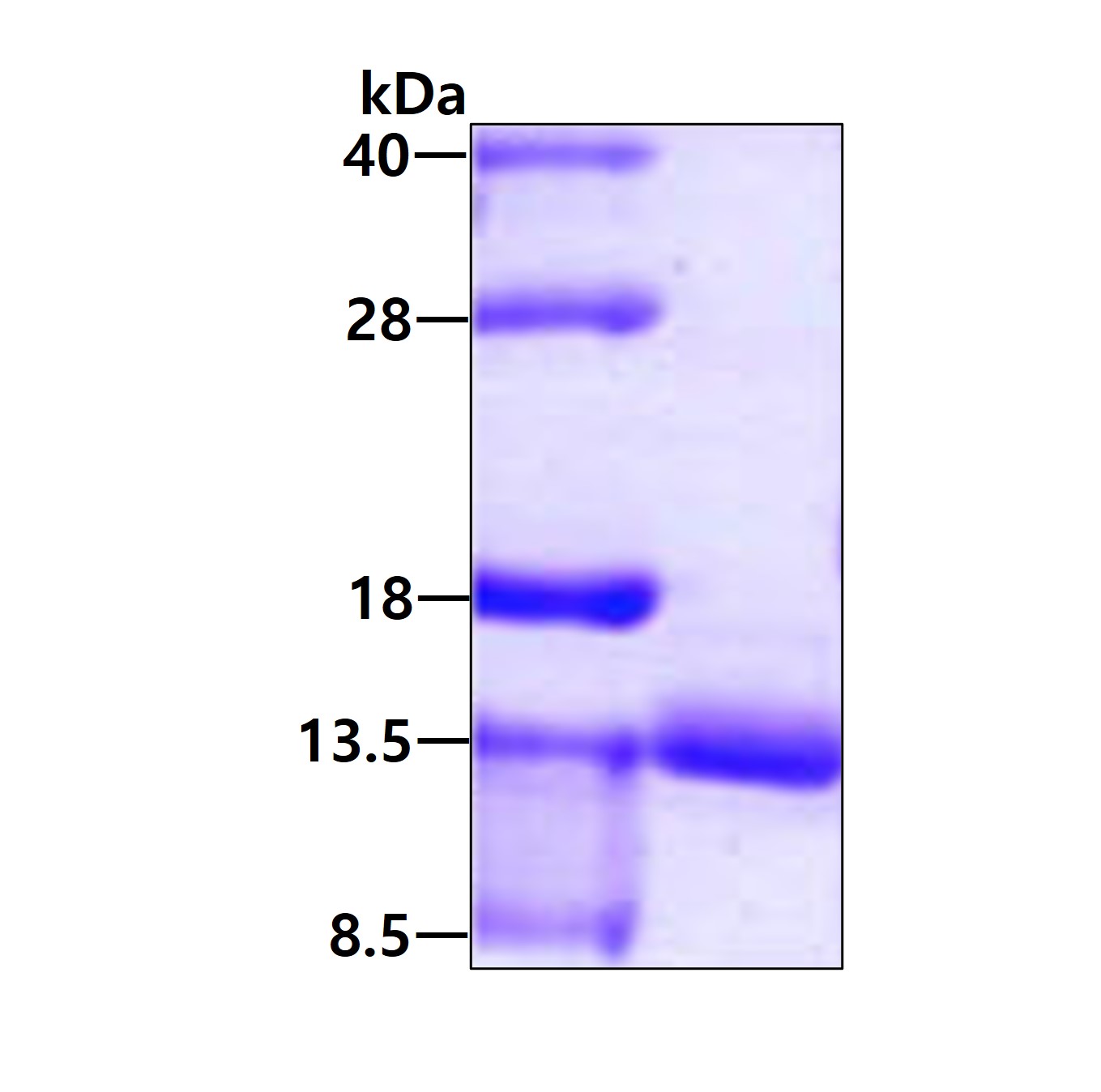

Human URM1 protein (Recombinant) (His-Tag) (STJP017131)
SPECIFICATIONS
HostE.coli
ImmunogenHuman
General Information
| Short Description | Recombinant-Human URM1-His-Tag protein was developed from e.coli and has a target region of His-Tag. For use in research applications. |
| Applications | SDS-PAGE |
| Host | E.coli |
| Note | STRICTLY FOR FURTHER SCIENTIFIC RESEARCH USE ONLY (RUO). MUST NOT TO BE USED IN DIAGNOSTIC OR THERAPEUTIC APPLICATIONS. |
Product Properties
| Concentration | 1 mg/mL |
| Formulation | Liquid in 20mM Tris-HCl buffer (pH 8.0) containing 10% Glycerol, 1mM DTT |
| Storage Instruction | For short term storage, keep at +2C to +8C for up to 1 week. For long term storage, aliquot and store at-20C, and avoid repeat freeze-thaw cycles. |
Target Information
| Gene Symbol | URM1 |
| Gene ID | 81605 |
| Uniprot ID | URM1_HUMAN |
| Accession Number | NP_112176 |
| Immunogen | Human |
| Immunogen Region | 1-101aa |
| Immunogen Sequence |
Additional Info
| Post Translational Modifications | C-terminal thiocarboxylation occurs in 2 steps, it is first acyl-adenylated (-COAMP) via the hesA/moeB/thiF part of MOCS3, then thiocarboxylated (-COSH) via the rhodanese domain of MOCS3. |
| Function | Acts as a sulfur carrier required for 2-thiolation of mcm(5)S(2)U at tRNA wobble positions of cytosolic tRNA(Lys), tRNA(Glu) and tRNA(Gln). Serves as sulfur donor in tRNA 2-thiolation reaction by being thiocarboxylated (-COSH) at its C-terminus by MOCS3. The sulfur is then transferred to tRNA to form 2-thiolation of mcm(5)S(2)U. Also acts as a ubiquitin-like protein (UBL) that is covalently conjugated via an isopeptide bond to lysine residues of target proteins such as MOCS3, ATPBD3, CTU2, USP15 and CAS. The thiocarboxylated form serves as substrate for conjugation and oxidative stress specifically induces the formation of UBL-protein conjugates. |
| Protein Name | Ubiquitin-Related Modifier 1 |
| Database Links | Reactome: R-HSA-6782315 |
| Cellular Localisation | Cytoplasm |
| Alternative Protein Names | Ubiquitin-Related Modifier 1 proteinURM1 proteinC9orf74 protein |
Information sourced from Uniprot.org