

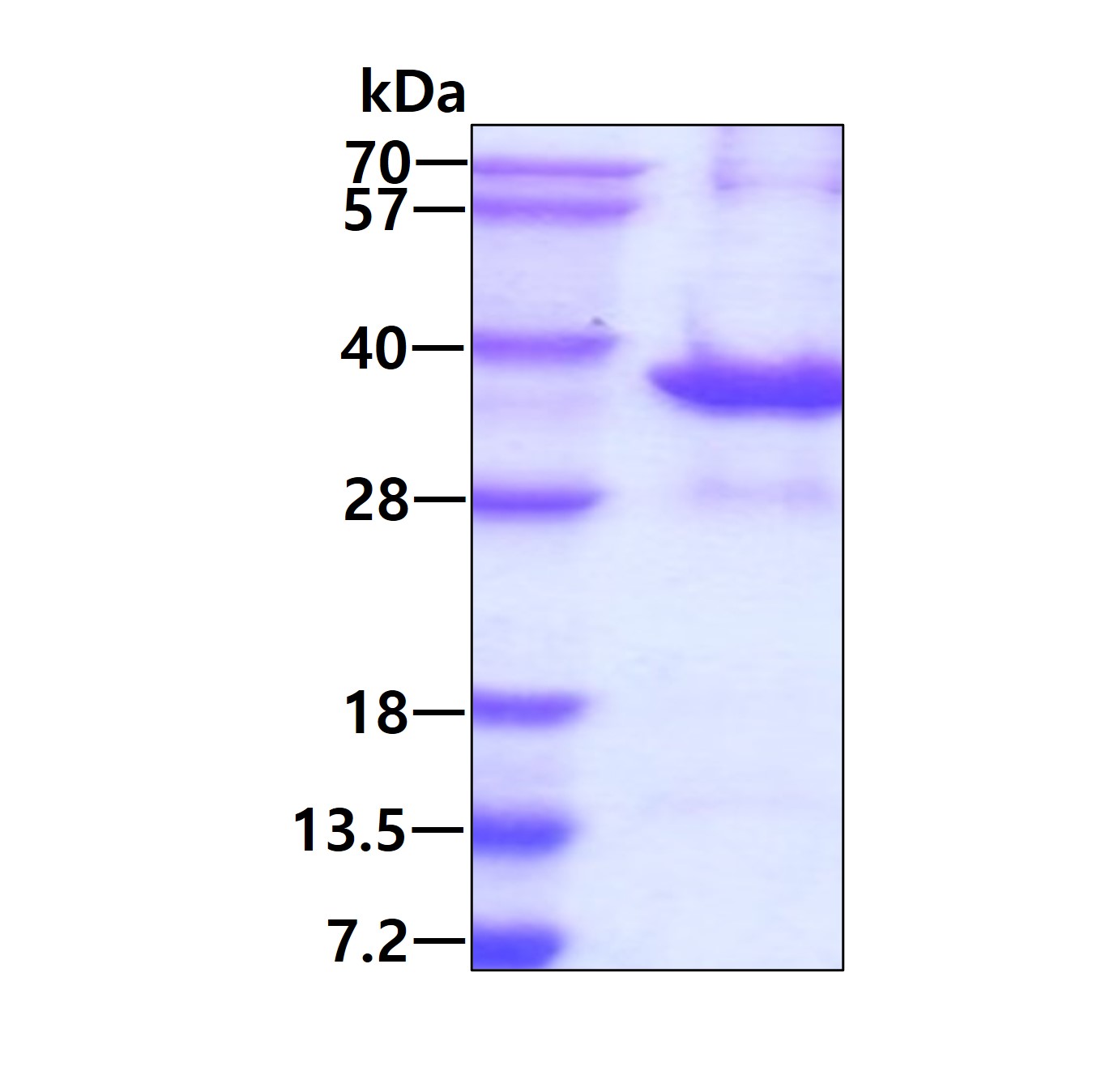

Human Tollip protein (Recombinant) (His-Tag) (STJP017202)
SPECIFICATIONS
HostE.coli
ImmunogenHuman
General Information
| Short Description | Recombinant-Human Tollip-His-Tag protein was developed from e.coli and has a target region of His-Tag. For use in research applications. |
| Applications | SDS-PAGE |
| Host | E.coli |
| Note | STRICTLY FOR FURTHER SCIENTIFIC RESEARCH USE ONLY (RUO). MUST NOT TO BE USED IN DIAGNOSTIC OR THERAPEUTIC APPLICATIONS. |
Product Properties
| Concentration | 0.25 mg/mL |
| Formulation | Liquid in 20mM Tris-HCl buffer (pH 8.0) containing 40% Glycerol, 0.2M NaCl, 2mM DTT |
| Storage Instruction | For short term storage, keep at +2C to +8C for up to 1 week. For long term storage, aliquot and store at-20C, and avoid repeat freeze-thaw cycles. |
Target Information
| Gene Symbol | TOLLIP |
| Gene ID | 54472 |
| Uniprot ID | TOLIP_HUMAN |
| Accession Number | NP_061882.2 |
| Immunogen | Human |
| Immunogen Region | 1-274aa |
| Immunogen Sequence |
Additional Info
| Post Translational Modifications | Phosphorylated by IRAK1 upon stimulation by IL-1 or microbial products. |
| Function | Component of the signaling pathway of IL-1 and Toll-like receptors. Inhibits cell activation by microbial products. Recruits IRAK1 to the IL-1 receptor complex. Inhibits IRAK1 phosphorylation and kinase activity. Connects the ubiquitin pathway to autophagy by functioning as a ubiquitin-ATG8 family adapter and thus mediating autophagic clearance of ubiquitin conjugates. The TOLLIP-dependent selective autophagy pathway plays an important role in clearance of cytotoxic polyQ proteins aggregates. In a complex with TOM1, recruits ubiquitin-conjugated proteins onto early endosomes. Binds to phosphatidylinositol 3-phosphate (PtdIns(3)P). |
| Protein Name | Toll-Interacting Protein |
| Database Links | Reactome: R-HSA-6798695Reactome: R-HSA-9020702 |
| Cellular Localisation | CytoplasmEndosomeEarly EndosomeLocalized To Endo/Exosomal Vesicles |
| Alternative Protein Names | Toll-Interacting Protein proteinTOLLIP protein |
Information sourced from Uniprot.org