
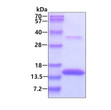


Human Thioredoxin-1 protein (Recombinant) (His-Tag) (STJP016670)
SPECIFICATIONS
HostE.coli
ImmunogenHuman
General Information
| Short Description | Recombinant-Human Thioredoxin-1-His-Tag protein was developed from e.coli and has a target region of His-Tag. For use in research applications. |
| Applications | SDS-PAGE/Enzyme Activity |
| Host | E.coli |
| Note | STRICTLY FOR FURTHER SCIENTIFIC RESEARCH USE ONLY (RUO). MUST NOT TO BE USED IN DIAGNOSTIC OR THERAPEUTIC APPLICATIONS. |
Product Properties
| Concentration | 1 mg/mL |
| Formulation | Liquid in phosphate-Buffered Saline (pH 7.4) |
| Storage Instruction | For short term storage, keep at +2C to +8C for up to 1 week. For long term storage, aliquot and store at-20C, and avoid repeat freeze-thaw cycles. |
| Immunoreactivity | Specific activity is >100 A650/cm/min/mg, obtained by measuring the increase of insulin precipitation in absorbance at 650 nm resulting from the reduction of insulin. |
Target Information
| Gene Symbol | TXN |
| Gene ID | 7295 |
| Uniprot ID | THIO_HUMAN |
| Accession Number | NP_003320 |
| Immunogen | Human |
| Immunogen Region | 1-105aa |
| Immunogen Sequence |
Additional Info
| Post Translational Modifications | In the fully reduced protein, both Cys-69 and Cys-73 are nitrosylated in response to nitric oxide (NO). When two disulfide bonds are present in the protein, only Cys-73 is nitrosylated. Cys-73 can serve as donor for nitrosylation of target proteins. In case of infection, ubiquitinated by S.typhimurium protein slrP, leading to its degradation. |
| Function | Participates in various redox reactions through the reversible oxidation of its active center dithiol to a disulfide and catalyzes dithiol-disulfide exchange reactions. Plays a role in the reversible S-nitrosylation of cysteine residues in target proteins, and thereby contributes to the response to intracellular nitric oxide. Nitrosylates the active site Cys of CASP3 in response to nitric oxide (NO), and thereby inhibits caspase-3 activity. Induces the FOS/JUN AP-1 DNA-binding activity in ionizing radiation (IR) cells through its oxidation/reduction status and stimulates AP-1 transcriptional activity. ADF augments the expression of the interleukin-2 receptor TAC (IL2R/P55). |
| Protein Name | ThioredoxinTrxAtl-Derived FactorAdfSurface-Associated Sulphydryl ProteinSaspAllergen Hom S Trx |
| Database Links | Reactome: R-HSA-2559580Reactome: R-HSA-3299685Reactome: R-HSA-499943Reactome: R-HSA-5628897Reactome: R-HSA-5676934Reactome: R-HSA-844456Reactome: R-HSA-9617629Reactome: R-HSA-9660826Reactome: R-HSA-9818027 |
| Cellular Localisation | NucleusCytoplasmSecretedTranslocates From The Cytoplasm Into The Nucleus After Phorbol 12-Myristate 13-Acetate Induction (Pma)Predominantly In The Cytoplasm In Non Irradiated CellsRadiation Induces Translocation Of Trx From The Cytoplasm To The NucleusSecreted By A Leaderless Secretory Pathway |
| Alternative Protein Names | Thioredoxin proteinTrx proteinAtl-Derived Factor proteinAdf proteinSurface-Associated Sulphydryl Protein proteinSasp proteinAllergen Hom S Trx proteinTXN proteinTRDX proteinTRX proteinTRX1 protein |
Information sourced from Uniprot.org