

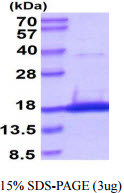

Human SNAPIN protein (Recombinant) (His-Tag) (STJP019763)
SPECIFICATIONS
HostE.coli
ImmunogenHuman
General Information
| Short Description | Recombinant-Human SNAPIN-His-Tag protein was developed from e.coli and has a target region of His-Tag. For use in research applications. |
| Applications | SDS-PAGE |
| Host | E.coli |
| Note | STRICTLY FOR FURTHER SCIENTIFIC RESEARCH USE ONLY (RUO). MUST NOT TO BE USED IN DIAGNOSTIC OR THERAPEUTIC APPLICATIONS. |
Product Properties
| Concentration | 0.5 mg/mL |
| Formulation | Liquid in 20mM Tris-HCl buffer (pH 8.0) containing 5mM DTT, 2mM EDTA, 0.2 M NaCl2, 40% Glycerol |
| Storage Instruction | For short term storage, keep at +2C to +8C for up to 1 week. For long term storage, aliquot and store at-20C, and avoid repeat freeze-thaw cycles. |
Target Information
| Gene Symbol | SNAPIN |
| Gene ID | 23557 |
| Uniprot ID | SNAPN_HUMAN |
| Accession Number | NP_036569 |
| Immunogen | Human |
| Immunogen Region | 1-136aa |
| Immunogen Sequence | MGSSHHHHHH SSGLVPRGSH MAGAGSAAVS GAGTPVAGPT GRDLFAEGLL EFLRPAVQQL DSHVHAVRES QVELREQIDN LATELCRINE DQKVALDLDP YVKKLLNARR RVVLVNNILQ NAQERLRRLN HSVAKETARR RAMLDSGIYP PGSPGK |
Additional Info
| Tissue Specificity | Expressed in male germ cells of adult testis (at protein level). |
| Post Translational Modifications | Phosphorylated by CSNK1D/CK1. Phosphorylated by PKD, phosphorylation controls SNAPIN protein stability. |
| Function | Component of the BLOC-1 complex, a complex that is required for normal biogenesis of lysosome-related organelles (LRO), such as platelet dense granules and melanosomes. In concert with the AP-3 complex, the BLOC-1 complex is required to target membrane protein cargos into vesicles assembled at cell bodies for delivery into neurites and nerve terminals. The BLOC-1 complex, in association with SNARE proteins, is also proposed to be involved in neurite extension. Plays a role in intracellular vesicle trafficking and synaptic vesicle recycling. May modulate a step between vesicle priming, fusion and calcium-dependent neurotransmitter release through its ability to potentiate the interaction of synaptotagmin with the SNAREs and the plasma-membrane-associated protein SNAP25. Its phosphorylation state influences exocytotic protein interactions and may regulate synaptic vesicle exocytosis. May also have a role in the mechanisms of SNARE-mediated membrane fusion in non-neuronal cells. As part of the BORC complex may play a role in lysosomes movement and localization at the cell periphery. Associated with the cytosolic face of lysosomes, the BORC complex may recruit ARL8B and couple lysosomes to microtubule plus-end-directed kinesin motor. |
| Protein Name | Snare-Associated Protein SnapinBiogenesis Of Lysosome-Related Organelles Complex 1 Subunit 7Bloc-1 Subunit 7Synaptosomal-Associated Protein 25-Binding ProteinSnap-Associated Protein |
| Database Links | Reactome: R-HSA-432722 |
| Cellular Localisation | MembranePeripheral Membrane ProteinCytoplasmic SideCytoplasmCytosolPerinuclear RegionGolgi Apparatus MembraneLysosome MembraneCytoplasmic VesicleSecretory VesicleSynaptic Vesicle MembraneColocalizes With Nanos1 And Pum2 In The Perinuclear Region Of Germ Cells |
| Alternative Protein Names | Snare-Associated Protein Snapin proteinBiogenesis Of Lysosome-Related Organelles Complex 1 Subunit 7 proteinBloc-1 Subunit 7 proteinSynaptosomal-Associated Protein 25-Binding Protein proteinSnap-Associated Protein proteinSNAPIN proteinBLOC1S7 proteinSNAP25BP proteinSNAPAP protein |
Information sourced from Uniprot.org