

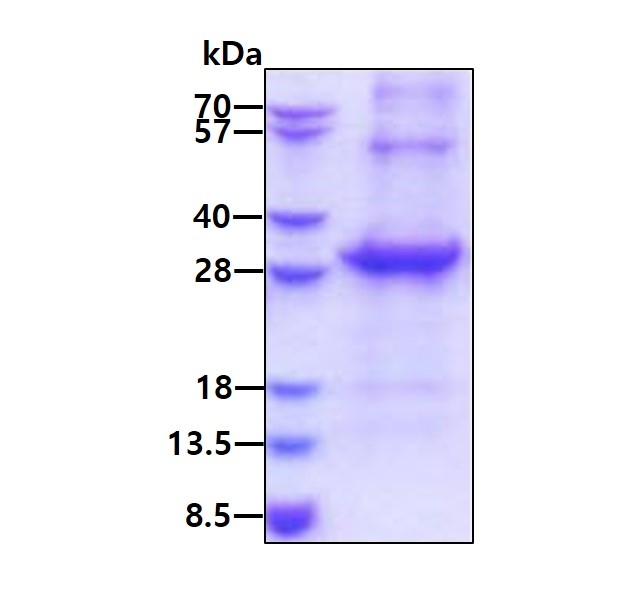

Human Siglec-3/CD33 protein (Recombinant) (His-Tag) (STJP018683)
SPECIFICATIONS
HostE.coli
ImmunogenHuman
General Information
| Short Description | Recombinant-Human Siglec-3/CD33-His-Tag protein was developed from e.coli and has a target region of His-Tag. For use in research applications. |
| Applications | SDS-PAGE/Denatured |
| Host | E.coli |
| Note | STRICTLY FOR FURTHER SCIENTIFIC RESEARCH USE ONLY (RUO). MUST NOT TO BE USED IN DIAGNOSTIC OR THERAPEUTIC APPLICATIONS. |
Product Properties
| Concentration | 1 mg/mL |
| Formulation | Liquid in 20mM Tris-HCl buffer (pH 8.0) containing 0.4M urea, 10% Glycerol |
| Storage Instruction | For short term storage, keep at +2C to +8C for up to 1 week. For long term storage, aliquot and store at-20C, and avoid repeat freeze-thaw cycles. |
Target Information
| Gene Symbol | CD33 |
| Gene ID | 945 |
| Uniprot ID | CD33_HUMAN |
| Accession Number | AAH28152 |
| Immunogen | Human |
| Immunogen Region | 18-259aa |
| Immunogen Sequence |
Additional Info
| Tissue Specificity | Monocytic/myeloid lineage cells. In the brain, CD33 is mainly expressed on microglial cells. |
| Post Translational Modifications | Glycosylated. Glycosylation at Asn-100 is critical for regulating ligand recognition. Phosphorylation of Tyr-340 is involved in binding to PTPN6 and PTPN11. Phosphorylation of Tyr-358 is involved in binding to PTPN6. LCK phosphorylates Tyr-340 efficiently and Tyr-358 to a lesser extent. |
| Function | Sialic-acid-binding immunoglobulin-like lectin (Siglec) that plays a role in mediating cell-cell interactions and in maintaining immune cells in a resting state. Preferentially recognizes and binds alpha-2,3- and more avidly alpha-2,6-linked sialic acid-bearing glycans. Upon engagement of ligands such as C1q or syalylated glycoproteins, two immunoreceptor tyrosine-based inhibitory motifs (ITIMs) located in CD33 cytoplasmic tail are phosphorylated by Src-like kinases such as LCK. These phosphorylations provide docking sites for the recruitment and activation of protein-tyrosine phosphatases PTPN6/SHP-1 and PTPN11/SHP-2. In turn, these phosphatases regulate downstream pathways through dephosphorylation of signaling molecules. One of the repressive effect of CD33 on monocyte activation requires phosphoinositide 3-kinase/PI3K. |
| Protein Name | Myeloid Cell Surface Antigen Cd33Sialic Acid-Binding Ig-Like Lectin 3Siglec-3Gp67Cd Antigen Cd33 |
| Database Links | Reactome: R-HSA-198933Reactome: R-HSA-6798695 |
| Cellular Localisation | Isoform Cd33m: Cell MembraneSingle-Pass Type I Membrane ProteinIsoform Cd33m: PeroxisomeCd33m Isoform Does Not Localize To Cell Surfaces But Instead Accumulates In Peroxisomes |
| Alternative Protein Names | Myeloid Cell Surface Antigen Cd33 proteinSialic Acid-Binding Ig-Like Lectin 3 proteinSiglec-3 proteinGp67 proteinCd Antigen Cd33 proteinCD33 proteinSIGLEC3 protein |
Information sourced from Uniprot.org