

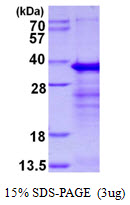

Human RYBP protein (Recombinant) (His-Tag) (STJP017710)
SPECIFICATIONS
HostE.coli
ImmunogenHuman
General Information
| Short Description | Recombinant-Human RYBP-His-Tag protein was developed from e.coli and has a target region of His-Tag. For use in research applications. |
| Applications | SDS-PAGE |
| Host | E.coli |
| Note | STRICTLY FOR FURTHER SCIENTIFIC RESEARCH USE ONLY (RUO). MUST NOT TO BE USED IN DIAGNOSTIC OR THERAPEUTIC APPLICATIONS. |
Product Properties
| Concentration | 0.5 mg/mL |
| Formulation | Liquid in 20mM Tris-HCl buffer (pH 8.0) containing 20% Glycerol, 1mM DTT, 100mM NaCl |
| Storage Instruction | For short term storage, keep at +2C to +8C for up to 1 week. For long term storage, aliquot and store at-20C, and avoid repeat freeze-thaw cycles. |
Target Information
| Gene Symbol | RYBP |
| Gene ID | 23429 |
| Uniprot ID | RYBP_HUMAN |
| Accession Number | NP_036366 |
| Immunogen | Human |
| Immunogen Region | 1-228aa |
| Immunogen Sequence | MGSSHHHHHH SSGLVPRGSH MGSHMTMGDK KSPTRPKRQA KPAADEGFWD CSVCTFRNSA EAFKCSICDV RKGTSTRKPR INSQLVAQQV AQQYATPPPP KKEKKEKVEK QDKEKPEKDK EISPSVTKKN TNKKTKPKSD ILKDPPSEAN SIQSANATTK TSETNHTSRP RLKNVDRSTA QQLAVTVGNV TVIITDFKEK TRSSSTSSST VTSSAGSEQQ NQSSSGSE |
Additional Info
| Tissue Specificity | Down-regulated in breast cancer tissues and in several breast cancer cell lines (at protein level). Widely expressed with highest levels in lymphoid tissues and placenta. |
| Post Translational Modifications | Monoubiquitinated. |
| Function | Component of a Polycomb group (PcG) multiprotein PRC1-like complex, a complex class required to maintain the transcriptionally repressive state of many genes, including Hox genes, throughout development. PcG PRC1-like complex acts via chromatin remodeling and modification of histones.it mediates monoubiquitination of histone H2A 'Lys-119', rendering chromatin heritably changed in its expressibility. Component of a PRC1-like complex that mediates monoubiquitination of histone H2A 'Lys-119' on the X chromosome and is required for normal silencing of one copy of the X chromosome in XX females. May stimulate ubiquitination of histone H2A 'Lys-119' by recruiting the complex to target sites. Inhibits ubiquitination and subsequent degradation of TP53, and thereby plays a role in regulating transcription of TP53 target genes. May also regulate the ubiquitin-mediated proteasomal degradation of other proteins like FANK1 to regulate apoptosis. May be implicated in the regulation of the transcription as a repressor of the transcriptional activity of E4TF1. May bind to DNA. May play a role in the repression of tumor growth and metastasis in breast cancer by down-regulating SRRM3. |
| Protein Name | Ring1 And Yy1-Binding ProteinApoptin-Associating Protein 1Apap-1Death Effector Domain-Associated FactorDed-Associated FactorYy1 And E4tf1-Associated Factor 1 |
| Database Links | Reactome: R-HSA-8939243Reactome: R-HSA-8953750 |
| Cellular Localisation | NucleusCytoplasmNucleoplasmPrimarily Found In The NucleusDetected In A Punctate Pattern Likely To Represent Polycomb Group (Pcg) Bodies |
| Alternative Protein Names | Ring1 And Yy1-Binding Protein proteinApoptin-Associating Protein 1 proteinApap-1 proteinDeath Effector Domain-Associated Factor proteinDed-Associated Factor proteinYy1 And E4tf1-Associated Factor 1 proteinRYBP proteinDEDAF proteinYEAF1 protein |
Information sourced from Uniprot.org