

Human RUNX3/CBFA3 protein (Recombinant) (His-Tag) (STJP016716)
SPECIFICATIONS
HostE.coli
ImmunogenHuman
General Information
| Short Description | Recombinant-Human RUNX3/CBFA3-His-Tag protein was developed from e.coli and has a target region of His-Tag. For use in research applications. |
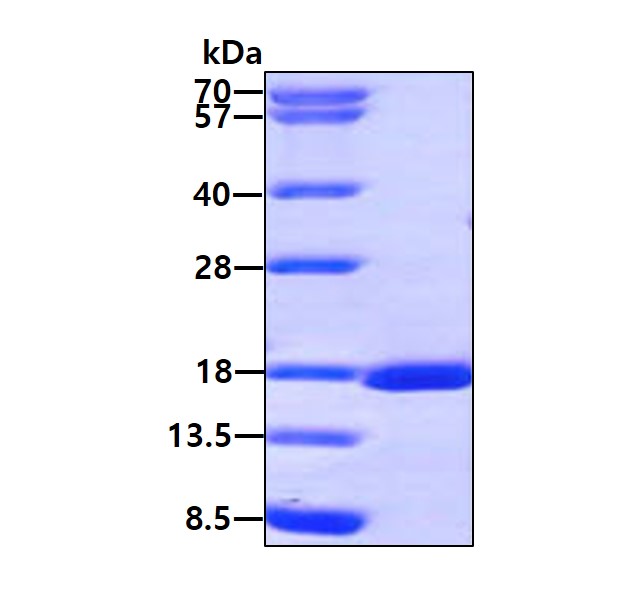
| Applications | SDS-PAGE |
| Host | E.coli |
| Note | STRICTLY FOR FURTHER SCIENTIFIC RESEARCH USE ONLY (RUO). MUST NOT TO BE USED IN DIAGNOSTIC OR THERAPEUTIC APPLICATIONS. |
Product Properties
| Concentration | 0.5 mg/mL |
| Formulation | Liquid in 20mM Tris-HCl buffer (pH 8.0) containing 20% Glycerol, 0.1M NaCl, 1mM DTT |
| Storage Instruction | For short term storage, keep at +2C to +8C for up to 1 week. For long term storage, aliquot and store at-20C, and avoid repeat freeze-thaw cycles. |
Target Information
| Gene Symbol | RUNX3 |
| Gene ID | 864 |
| Uniprot ID | RUNX3_HUMAN |
| Accession Number | NP_004341 |
| Immunogen | Human |
| Immunogen Region | 53-186aa |
| Immunogen Sequence |
Additional Info
| Tissue Specificity | Expressed in gastric cancer tissues (at protein level). |
| Post Translational Modifications | Phosphorylated on tyrosine residues by SRC. Phosphorylated by LCK and FYN. |
| Function | Forms the heterodimeric complex core-binding factor (CBF) with CBFB. RUNX members modulate the transcription of their target genes through recognizing the core consensus binding sequence 5'-TGTGGT-3', or very rarely, 5'-TGCGGT-3', within their regulatory regions via their runt domain, while CBFB is a non-DNA-binding regulatory subunit that allosterically enhances the sequence-specific DNA-binding capacity of RUNX. The heterodimers bind to the core site of a number of enhancers and promoters, including murine leukemia virus, polyomavirus enhancer, T-cell receptor enhancers, LCK, IL3 and GM-CSF promoters. May be involved in the control of cellular proliferation and/or differentiation. In association with ZFHX3, up-regulates CDKN1A promoter activity following TGF-beta stimulation. CBF complexes repress ZBTB7B transcription factor during cytotoxic (CD8+) T cell development. They bind to RUNX-binding sequence within the ZBTB7B locus acting as transcriptional silencer and allowing for cytotoxic T cell differentiation. CBF complexes binding to the transcriptional silencer is essential for recruitment of nuclear protein complexes that catalyze epigenetic modifications to establish epigenetic ZBTB7B silencing. Necessary for the development and survival of sensory neurons expressing parvalbumin. |
| Protein Name | Runt-Related Transcription Factor 3Acute Myeloid Leukemia 2 ProteinCore-Binding Factor Subunit Alpha-3Cbf-Alpha-3Oncogene Aml-2Polyomavirus Enhancer-Binding Protein 2 Alpha C SubunitPea2-Alpha CPebp2-Alpha CSl3-3 Enhancer Factor 1 Alpha C SubunitSl3/Akv Core-Binding Factor Alpha C Subunit |
| Database Links | Reactome: R-HSA-4411364Reactome: R-HSA-8941855Reactome: R-HSA-8941856Reactome: R-HSA-8941858Reactome: R-HSA-8949275Reactome: R-HSA-8951430Reactome: R-HSA-8951671Reactome: R-HSA-8951911Reactome: R-HSA-8951936Reactome: R-HSA-8952158 |
| Cellular Localisation | NucleusCytoplasmThe Tyrosine Phosphorylated Form Localizes To The CytoplasmTranslocates From The Cytoplasm To The Nucleus Following Tgf-Beta Stimulation |
| Alternative Protein Names | Runt-Related Transcription Factor 3 proteinAcute Myeloid Leukemia 2 Protein proteinCore-Binding Factor Subunit Alpha-3 proteinCbf-Alpha-3 proteinOncogene Aml-2 proteinPolyomavirus Enhancer-Binding Protein 2 Alpha C Subunit proteinPea2-Alpha C proteinPebp2-Alpha C proteinSl3-3 Enhancer Factor 1 Alpha C Subunit proteinSl3/Akv Core-Binding Factor Alpha C Subunit proteinRUNX3 proteinAML2 proteinCBFA3 proteinPEBP2A3 protein |
Information sourced from Uniprot.org