

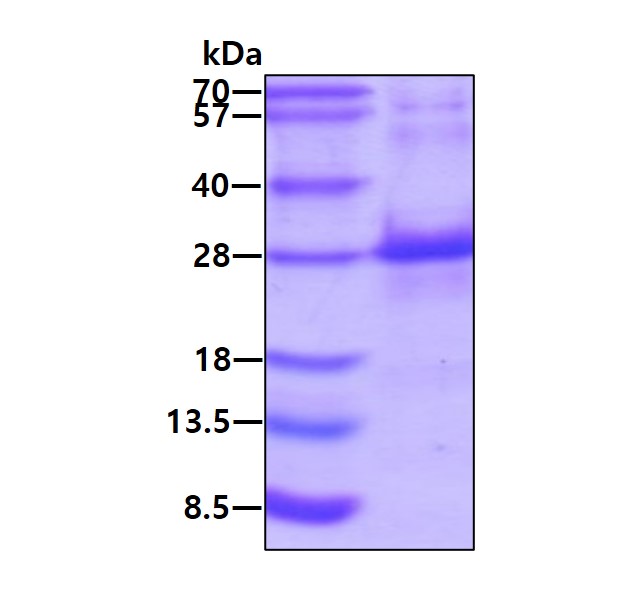

Human RhoB protein (Recombinant) (His-Tag) (STJP017191)
SPECIFICATIONS
HostE.coli
ImmunogenHuman
General Information
| Short Description | Recombinant-Human RhoB-His-Tag protein was developed from e.coli and has a target region of His-Tag. For use in research applications. |
| Applications | SDS-PAGE |
| Host | E.coli |
| Note | STRICTLY FOR FURTHER SCIENTIFIC RESEARCH USE ONLY (RUO). MUST NOT TO BE USED IN DIAGNOSTIC OR THERAPEUTIC APPLICATIONS. |
Product Properties
| Concentration | 0.25 mg/mL |
| Formulation | Liquid in 20mM Tris-HCl buffer (pH 8.0) containing 2mM DTT, 20% Glycerol, 0.2mM NaCl |
| Storage Instruction | For short term storage, keep at +2C to +8C for up to 1 week. For long term storage, aliquot and store at-20C, and avoid repeat freeze-thaw cycles. |
Target Information
| Gene Symbol | RHOB |
| Gene ID | 388 |
| Uniprot ID | RHOB_HUMAN |
| Accession Number | NP_004031.1 |
| Immunogen | Human |
| Immunogen Region | 1-193aa |
| Immunogen Sequence |
Additional Info
| Post Translational Modifications | Prenylation specifies the subcellular location of RHOB. The farnesylated form is localized to the plasma membrane while the geranylgeranylated form is localized to the endosome. (Microbial infection) Glycosylated at Tyr-34 by Photorhabdus asymbiotica toxin PAU_02230. Mono-O-GlcNAcylation by PAU_02230 inhibits downstream signaling by an impaired interaction with diverse regulator and effector proteins of Rho and leads to actin disassembly. (Microbial infection) Glucosylated at Thr-37 by C.difficile toxins TcdA and TcdB in the colonic epithelium. Monoglucosylation completely prevents the recognition of the downstream effector, blocking the GTPases in their inactive form, leading to actin cytoskeleton disruption. |
| Function | Mediates apoptosis in neoplastically transformed cells after DNA damage. Not essential for development but affects cell adhesion and growth factor signaling in transformed cells. Plays a negative role in tumorigenesis as deletion causes tumor formation. Involved in intracellular protein trafficking of a number of proteins. Targets PKN1 to endosomes and is involved in trafficking of the EGF receptor from late endosomes to lysosomes. Also required for stability and nuclear trafficking of AKT1/AKT which promotes endothelial cell survival during vascular development. Serves as a microtubule-dependent signal that is required for the myosin contractile ring formation during cell cycle cytokinesis. Required for genotoxic stress-induced cell death in breast cancer cells. |
| Protein Name | Rho-Related Gtp-Binding Protein RhobRho Cdna Clone 6H6 |
| Database Links | Reactome: R-HSA-114604Reactome: R-HSA-416482Reactome: R-HSA-416572Reactome: R-HSA-5625740Reactome: R-HSA-5625900Reactome: R-HSA-5627117Reactome: R-HSA-5663220Reactome: R-HSA-5666185Reactome: R-HSA-9013026 |
| Cellular Localisation | Late Endosome MembraneLipid-AnchorCell MembraneNucleusCleavage FurrowLate Endosomal Membrane (Geranylgeranylated Form)Plasma Membrane (Farnesylated Form)Also Detected At The Nuclear Margin And In The NucleusTranslocates To The Equatorial Region Before Furrow Formation In A Ect2-Dependent Manner |
| Alternative Protein Names | Rho-Related Gtp-Binding Protein Rhob proteinRho Cdna Clone 6 proteinH6 proteinRHOB proteinARH6 proteinARHB protein |
Information sourced from Uniprot.org