
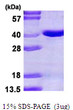
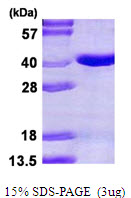

Human PIR-B protein (Recombinant) (His-Tag) (STJP017536)
SPECIFICATIONS
HostE.coli
ImmunogenHuman
General Information
| Short Description | Recombinant-Human PIR-B-His-Tag protein was developed from e.coli and has a target region of His-Tag. For use in research applications. |
| Applications | SDS-PAGE |
| Host | E.coli |
| Note | STRICTLY FOR FURTHER SCIENTIFIC RESEARCH USE ONLY (RUO). MUST NOT TO BE USED IN DIAGNOSTIC OR THERAPEUTIC APPLICATIONS. |
Product Properties
| Concentration | 1 mg/mL |
| Formulation | Liquid in 20mM Tris-HCl buffer (pH 8.0) containing 20% Glycerol, 0.1M NaCl, 1mM DTT |
| Storage Instruction | For short term storage, keep at +2C to +8C for up to 1 week. For long term storage, aliquot and store at-20C, and avoid repeat freeze-thaw cycles. |
Target Information
| Gene Symbol | PIR |
| Gene ID | 8544 |
| Uniprot ID | PIR_HUMAN |
| Accession Number | NP_001018119 |
| Immunogen | Human |
| Immunogen Region | 1-290aa |
| Immunogen Sequence |
Additional Info
| Tissue Specificity | Highly expressed in a subset of melanomas. Detected at very low levels in most tissues (at protein level). Expressed in all tissues, with highest level of expression in heart and liver. |
| Function | Transcriptional coregulator of NF-kappa-B which facilitates binding of NF-kappa-B proteins to target kappa-B genes in a redox-state-dependent manner. May be required for efficient terminal myeloid maturation of hematopoietic cells. Has quercetin 2,3-dioxygenase activity (in vitro). |
| Protein Name | PirinProbable Quercetin 2 -3-Dioxygenase PirProbable Quercetinase |
| Database Links | Reactome: R-HSA-8935690 |
| Cellular Localisation | NucleusCytoplasmPredominantly Localized In Dot-Like Subnuclear StructuresCytoplasmic Localization Of Pir Seems To Positively Correlate With Melanoma Progression |
| Alternative Protein Names | Pirin proteinProbable Quercetin 2 -3-Dioxygenase Pir proteinProbable Quercetinase proteinPIR protein |
Information sourced from Uniprot.org