

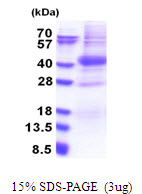

Human PIM2 protein (Recombinant) (His-Tag) (STJP018795)
SPECIFICATIONS
HostE.coli
ImmunogenHuman
General Information
| Short Description | Recombinant-Human PIM2-His-Tag protein was developed from e.coli and has a target region of His-Tag. For use in research applications. |
| Applications | SDS-PAGE |
| Host | E.coli |
| Note | STRICTLY FOR FURTHER SCIENTIFIC RESEARCH USE ONLY (RUO). MUST NOT TO BE USED IN DIAGNOSTIC OR THERAPEUTIC APPLICATIONS. |
Product Properties
| Concentration | 0.25 mg/mL |
| Formulation | Liquid in 20mM Tris-HCl buffer (pH 8.0) containing 0.1M NaCl, 10% Glycerol |
| Storage Instruction | For short term storage, keep at +2C to +8C for up to 1 week. For long term storage, aliquot and store at-20C, and avoid repeat freeze-thaw cycles. |
Target Information
| Gene Symbol | PIM2 |
| Gene ID | 11040 |
| Uniprot ID | PIM2_HUMAN |
| Accession Number | NP_006866 |
| Immunogen | Human |
| Immunogen Region | 1-311aa |
| Immunogen Sequence |
Additional Info
| Tissue Specificity | Highly expressed in hematopoietic tissues, in leukemic and lymphoma cell lines, testis, small intestine, colon and colorectal adenocarcinoma cells. Weakly expressed in normal liver, but highly expressed in hepatocellular carcinoma tissues. |
| Post Translational Modifications | Autophosphorylated. |
| Function | Proto-oncogene with serine/threonine kinase activity involved in cell survival and cell proliferation. Exerts its oncogenic activity through: the regulation of MYC transcriptional activity, the regulation of cell cycle progression, the regulation of cap-dependent protein translation and through survival signaling by phosphorylation of a pro-apoptotic protein, BAD. Phosphorylation of MYC leads to an increase of MYC protein stability and thereby an increase transcriptional activity. The stabilization of MYC exerted by PIM2 might explain partly the strong synergism between these 2 oncogenes in tumorigenesis. Regulates cap-dependent protein translation in a mammalian target of rapamycin complex 1 (mTORC1)-independent manner and in parallel to the PI3K-Akt pathway. Mediates survival signaling through phosphorylation of BAD, which induces release of the anti-apoptotic protein Bcl-X(L)/BCL2L1. Promotes cell survival in response to a variety of proliferative signals via positive regulation of the I-kappa-B kinase/NF-kappa-B cascade.this process requires phosphorylation of MAP3K8/COT. Promotes growth factor-independent proliferation by phosphorylation of cell cycle factors such as CDKN1A and CDKN1B. Involved in the positive regulation of chondrocyte survival and autophagy in the epiphyseal growth plate. |
| Protein Name | Serine/Threonine-Protein Kinase Pim-2Pim-2h |
| Database Links | |
| Cellular Localisation | |
| Alternative Protein Names | Serine/Threonine-Protein Kinase Pim-2 proteinPim-2h proteinPIM2 protein |
Information sourced from Uniprot.org