
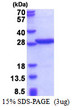
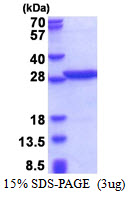

Human PABPN1 protein (Recombinant) (His-Tag) (STJP018600)
SPECIFICATIONS
HostE.coli
ImmunogenHuman
General Information
| Short Description | Recombinant-Human PABPN1-His-Tag protein was developed from e.coli and has a target region of His-Tag. For use in research applications. |
| Applications | SDS-PAGE/Denatured |
| Host | E.coli |
| Note | STRICTLY FOR FURTHER SCIENTIFIC RESEARCH USE ONLY (RUO). MUST NOT TO BE USED IN DIAGNOSTIC OR THERAPEUTIC APPLICATIONS. |
Product Properties
| Concentration | 1 mg/mL |
| Formulation | Liquid in 20mM Tris-HCl buffer (pH 8.0) containing 0.4M urea, 10% Glycerol |
| Storage Instruction | For short term storage, keep at +2C to +8C for up to 1 week. For long term storage, aliquot and store at-20C, and avoid repeat freeze-thaw cycles. |
Target Information
| Gene Symbol | PABPN1 |
| Gene ID | 8106 |
| Uniprot ID | PABP2_HUMAN |
| Accession Number | NP_004634 |
| Immunogen | Human |
| Immunogen Region | 119-306aa |
| Immunogen Sequence | MGSSHHHHHH SSGLVPRGSH MGSLEAIKAR VREMEEEAEK LKELQNEVEK QMNMSPPPGN AGPVIMSIEE KMEADARSIY VGNVDYGATA EELEAHFHGC GSVNRVTILC DKFSGHPKGF AYIEFSDKES VRTSLALDES LFRGRQIKVI PKRTNRPGIS TTDRGFPRAR YRARTTNYNS SRSRFYSGFN SRPRGRVYRG RARATSWYSP Y |
Additional Info
| Tissue Specificity | Ubiquitous. |
| Post Translational Modifications | Arginine dimethylation is asymmetric and involves PRMT1 and PRMT3. It does not influence the RNA binding properties. |
| Function | Involved in the 3'-end formation of mRNA precursors (pre-mRNA) by the addition of a poly(A) tail of 200-250 nt to the upstream cleavage product. Stimulates poly(A) polymerase (PAPOLA) conferring processivity on the poly(A) tail elongation reaction and also controls the poly(A) tail length. Increases the affinity of poly(A) polymerase for RNA. Is also present at various stages of mRNA metabolism including nucleocytoplasmic trafficking and nonsense-mediated decay (NMD) of mRNA. Cooperates with SKIP to synergistically activate E-box-mediated transcription through MYOD1 and may regulate the expression of muscle-specific genes. Binds to poly(A) and to poly(G) with high affinity. May protect the poly(A) tail from degradation. Subunit of the trimeric poly(A) tail exosome targeting (PAXT) complex, a complex that directs a subset of long and polyadenylated poly(A) RNAs for exosomal degradation. The RNA exosome is fundamental for the degradation of RNA in eukaryotic nuclei. Substrate targeting is facilitated by its cofactor MTREX, which links to RNA-binding protein adapters. |
| Protein Name | Polyadenylate-Binding Protein 2Pabp-2Poly(A-Binding Protein 2Nuclear Poly(A-Binding Protein 1Poly(A-Binding Protein IiPabiiPolyadenylate-Binding Nuclear Protein 1 |
| Database Links | Reactome: R-HSA-168315Reactome: R-HSA-72187Reactome: R-HSA-72203Reactome: R-HSA-73856Reactome: R-HSA-77595Reactome: R-HSA-9820865 |
| Cellular Localisation | NucleusCytoplasmNucleus SpeckleLocalized In Cytoplasmic Mrnp Granules Containing Untranslated MrnasShuttles Between The Nucleus And The Cytoplasm But Predominantly Found In The NucleusIts Nuclear Import May Involve The Nucleocytoplasmic Transport Receptor Transportin And A Ran-Gtp-Sensitive Import MechanismIs Exported To The Cytoplasm By A Carrier-Mediated Pathway That Is Independent Of Mrna TrafficColocalizes With Skip And Poly(A) Rna In Nuclear SpecklesIntranuclear Filamentous Inclusions Or 'Aggregates' Are Detected In The Myocytes Of PatientsThese Inclusions Contain Pabpn1UbiquitinSubunits Of The Proteasome And Poly(A) Rna |
| Alternative Protein Names | Polyadenylate-Binding Protein 2 proteinPabp-2 proteinPoly(A-Binding Protein 2 proteinNuclear Poly(A-Binding Protein 1 proteinPoly(A-Binding Protein Ii proteinPabii proteinPolyadenylate-Binding Nuclear Protein 1 proteinPABPN1 proteinPAB2 proteinPABP2 protein |
Information sourced from Uniprot.org