
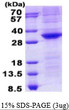
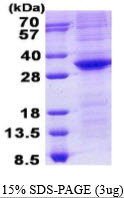

Human Oct-3/4 protein (Recombinant) (His-Tag) (STJP018055)
SPECIFICATIONS
HostE.coli
ImmunogenHuman
General Information
| Short Description | Recombinant-Human Oct-3/4-His-Tag protein was developed from e.coli and has a target region of His-Tag. For use in research applications. |
| Applications | SDS-PAGE/Denatured |
| Host | E.coli |
| Note | STRICTLY FOR FURTHER SCIENTIFIC RESEARCH USE ONLY (RUO). MUST NOT TO BE USED IN DIAGNOSTIC OR THERAPEUTIC APPLICATIONS. |
Product Properties
| Concentration | 0.5 mg/mL |
| Formulation | Liquid in 20mM Tris-HCl buffer (pH 8.0) containing 0.4M urea, 10% Glycerol |
| Storage Instruction | For short term storage, keep at +2C to +8C for up to 1 week. For long term storage, aliquot and store at-20C, and avoid repeat freeze-thaw cycles. |
Target Information
| Gene Symbol | POU5F1 |
| Gene ID | 5460 |
| Uniprot ID | PO5F1_HUMAN |
| Accession Number | NP_001272916 |
| Immunogen | Human |
| Immunogen Region | 1-265aa |
| Immunogen Sequence | MGSSHHHHHH SSGLVPRGSH MHFYRLFLGA TRRFLNPEWK GEIDNWCVYV LTSLLPFKIQ SQDIKALQKE LEQFAKLLKQ KRITLGYTQA DVGLTLGVLF GKVFSQTTIC RFEALQLSFK NMCKLRPLLQ KWVEEADNNE NLQEICKAET LVQARKRKRT SIENRVRGNL ENLFLQCPKP TLQQISHIAQ QLGLEKDVVR VWFCNRRQKG KRSSSDYAQR EDFEAAGS |
Additional Info
| Tissue Specificity | Expressed in developing brain. Highest levels found in specific cell layers of the cortex, the olfactory bulb, the hippocampus and the cerebellum. Low levels of expression in adult tissues. |
| Post Translational Modifications | Sumoylation enhances the protein stability, DNA binding and transactivation activity. Sumoylation is required for enhanced YES1 expression. Ubiquitinated.undergoes 'Lys-63'-linked polyubiquitination by WWP2 leading to proteasomal degradation. ERK1/2-mediated phosphorylation at Ser-111 promotes nuclear exclusion and proteasomal degradation. Phosphorylation at Thr-235 and Ser-236 decrease DNA-binding and alters ability to activate transcription. |
| Function | Transcription factor that binds to the octamer motif (5'-ATTTGCAT-3'). Forms a trimeric complex with SOX2 or SOX15 on DNA and controls the expression of a number of genes involved in embryonic development such as YES1, FGF4, UTF1 and ZFP206. Critical for early embryogenesis and for embryonic stem cell pluripotency. |
| Protein Name | Pou Domain - Class 5 - Transcription Factor 1Octamer-Binding Protein 3Oct-3Octamer-Binding Protein 4Oct-4Octamer-Binding Transcription Factor 3Otf-3 |
| Database Links | Reactome: R-HSA-2892245Reactome: R-HSA-2892247Reactome: R-HSA-452723Reactome: R-HSA-9754189Reactome: R-HSA-9823739Reactome: R-HSA-9827857Reactome: R-HSA-9834899 |
| Cellular Localisation | CytoplasmNucleusExpressed In A Diffuse And Slightly Punctuate PatternColocalizes With Mapk8 And Mapk9 In The Nucleus |
| Alternative Protein Names | Pou Domain - Class 5 - Transcription Factor 1 proteinOctamer-Binding Protein 3 proteinOct-3 proteinOctamer-Binding Protein 4 proteinOct-4 proteinOctamer-Binding Transcription Factor 3 proteinOtf-3 proteinPOU5F1 proteinOCT3 proteinOCT4 proteinOTF3 protein |
Information sourced from Uniprot.org