

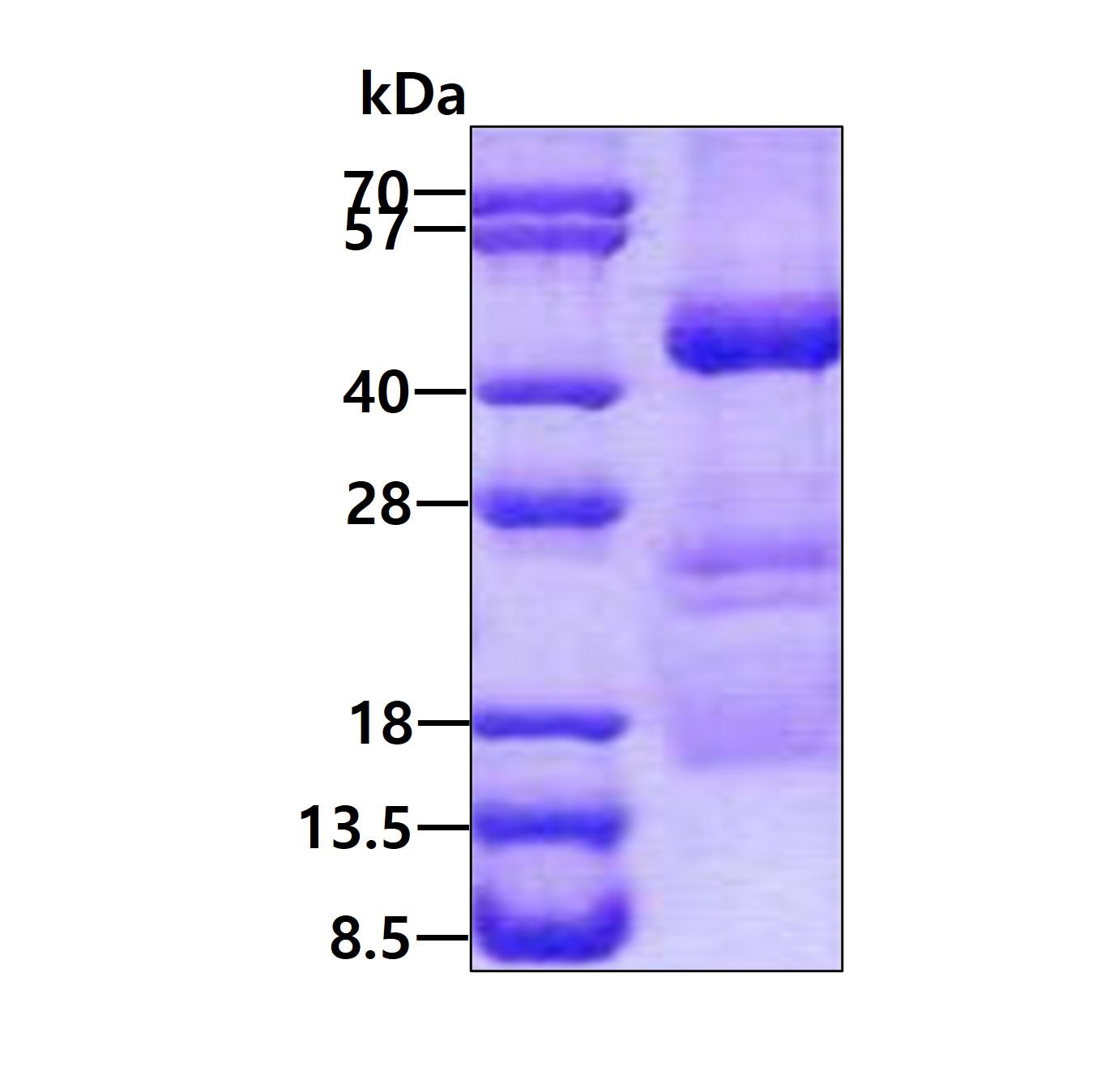

Human OBFC1 protein (Recombinant) (His-Tag) (STJP018042)
SPECIFICATIONS
HostE.coli
ImmunogenHuman
General Information
| Short Description | Recombinant-Human OBFC1-His-Tag protein was developed from e.coli and has a target region of His-Tag. For use in research applications. |
| Applications | SDS-PAGE |
| Host | E.coli |
| Note | STRICTLY FOR FURTHER SCIENTIFIC RESEARCH USE ONLY (RUO). MUST NOT TO BE USED IN DIAGNOSTIC OR THERAPEUTIC APPLICATIONS. |
Product Properties
| Concentration | 0.5 mg/mL |
| Formulation | Liquid in 20mM Tris-HCl buffer (pH 8.0) containing 0.15M NaCl, 20% Glycerol, 1mM DTT |
| Storage Instruction | For short term storage, keep at +2C to +8C for up to 1 week. For long term storage, aliquot and store at-20C, and avoid repeat freeze-thaw cycles. |
Target Information
| Gene Symbol | STN1 |
| Gene ID | 79991 |
| Uniprot ID | STN1_HUMAN |
| Accession Number | NP_079204.1 |
| Immunogen | Human |
| Immunogen Region | 1-368aa |
| Immunogen Sequence |
Additional Info
| Function | Component of the CST complex proposed to act as a specialized replication factor promoting DNA replication under conditions of replication stress or natural replication barriers such as the telomere duplex. The CST complex binds single-stranded DNA with high affinity in a sequence-independent manner, while isolated subunits bind DNA with low affinity by themselves. Initially the CST complex has been proposed to protect telomeres from DNA degradation. However, the CST complex has been shown to be involved in several aspects of telomere replication. The CST complex inhibits telomerase and is involved in telomere length homeostasis.it is proposed to bind to newly telomerase-synthesized 3' overhangs and to terminate telomerase action implicating the association with the ACD:POT1 complex thus interfering with its telomerase stimulation activity. The CST complex is also proposed to be involved in fill-in synthesis of the telomeric C-strand probably implicating recruitment and activation of DNA polymerase alpha. The CST complex facilitates recovery from many forms of exogenous DNA damage.seems to be involved in the re-initiation of DNA replication at repaired forks and/or dormant origins. Required for efficicient replication of the duplex region of the telomere. Promotes efficient replication of lagging-strand telomeres. Promotes general replication start following replication-fork stalling implicating new origin firing. May be in involved in C-strand fill-in during late S/G2 phase independent of its role in telomere duplex replication. Component of the CST complex, a complex that binds to single-stranded DNA and is required to protect telomeres from DNA degradation. The CST complex binds single-stranded DNA with high affinity in a sequence-independent manner, while isolated subunits bind DNA with low affinity by themselves. In addition to telomere protection, the CST complex has probably a more general role in DNA metabolism at non-telomeric sites. |
| Protein Name | Cst Complex Subunit Stn1Oligonucleotide/Oligosaccharide-Binding Fold-Containing Protein 1Suppressor Of Cdc Thirteen Homolog |
| Database Links | Reactome: R-HSA-174411Reactome: R-HSA-174430 |
| Cellular Localisation | NucleusChromosomeTelomere |
| Alternative Protein Names | Cst Complex Subunit Stn1 proteinOligonucleotide/Oligosaccharide-Binding Fold-Containing Protein 1 proteinSuppressor Of Cdc Thirteen Homolog proteinSTN1 proteinOBFC1 protein |
Information sourced from Uniprot.org