
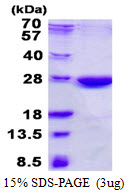

Human NHEJ1 protein (Recombinant) (His-Tag) (STJP017793)
SPECIFICATIONS
HostE.coli
ImmunogenHuman
General Information
| Short Description | Recombinant-Human NHEJ1-His-Tag protein was developed from e.coli and has a target region of His-Tag. For use in research applications. |
| Applications | SDS-PAGE |
| Host | E.coli |
| Note | STRICTLY FOR FURTHER SCIENTIFIC RESEARCH USE ONLY (RUO). MUST NOT TO BE USED IN DIAGNOSTIC OR THERAPEUTIC APPLICATIONS. |
Product Properties
| Concentration | 0.5 mg/mL |
| Formulation | Liquid in 20mM Tris-HCl buffer (pH 8.0) containing 0.1M NaCl, 20% Glycerol, 1mM DTT |
| Storage Instruction | For short term storage, keep at +2C to +8C for up to 1 week. For long term storage, aliquot and store at-20C, and avoid repeat freeze-thaw cycles. |
Target Information
| Gene Symbol | NHEJ1 |
| Gene ID | 79840 |
| Uniprot ID | NHEJ1_HUMAN |
| Accession Number | NP_079058 |
| Immunogen | Human |
| Immunogen Region | 1-224aa |
| Immunogen Sequence | MGSSHHHHHH SSGLVPRGSH MGSMEELEQG LLMQPWAWLQ LAENSLLAKV FITKQGYALL VSDLQQVWHE QVDTSVVSQR AKELNKRLTA PPAAFLCHLD NLLRPLLKDA AHPSEATFSC DCVADALILR VRSELSGLPF YWNFHCMLAS PSLVSQHLIR PLMGMSLALQ CQVRELATLL HMKDLEIQDY QESGATLIRD RLKTEPFEEN SFLEQFMIEK LPEACSIG |
Additional Info
| Tissue Specificity | Ubiquitously expressed. |
| Post Translational Modifications | Phosphorylated by PRKDC at the C-terminus in response to DNA damage. Phosphorylations by PRKDC at the C-terminus of XRCC4 and NHEJ1/XLF are highly redundant and regulate ability of the XRCC4-NHEJ1/XLF subcomplex to bridge DNA. Phosphorylation does not prevent interaction with XRCC4 but disrupts ability to bridge DNA and promotes detachment from DNA. |
| Function | DNA repair protein involved in DNA non-homologous end joining (NHEJ).it is required for double-strand break (DSB) repair and V(D)J recombination and is also involved in telomere maintenance. Plays a key role in NHEJ by promoting the ligation of various mismatched and non-cohesive ends. Together with PAXX, collaborates with DNA polymerase lambda (POLL) to promote joining of non-cohesive DNA ends. May act in concert with XRCC5-XRCC6 (Ku) to stimulate XRCC4-mediated joining of blunt ends and several types of mismatched ends that are non-complementary or partially complementary. In some studies, has been shown to associate with XRCC4 to form alternating helical filaments that bridge DNA and act like a bandage, holding together the broken DNA until it is repaired. Alternatively, it has also been shown that rather than forming filaments, a single NHEJ1 dimer interacts through both head domains with XRCC4 to promote the close alignment of DNA ends. The XRCC4-NHEJ1/XLF subcomplex binds to the DNA fragments of a DSB in a highly diffusive manner and robustly bridges two independent DNA molecules, holding the broken DNA fragments in close proximity to one other. The mobility of the bridges ensures that the ends remain accessible for further processing by other repair factors. Binds DNA in a length-dependent manner. |
| Protein Name | Non-Homologous End-Joining Factor 1Protein CernunnosXrcc4-Like Factor |
| Database Links | Reactome: R-HSA-5693571 |
| Cellular Localisation | NucleusChromosomeLocalizes To Site Of Double-Strand BreaksRecruitment Is Dependent On Xrcc5-Xrcc6 (Ku) Heterodimer |
| Alternative Protein Names | Non-Homologous End-Joining Factor 1 proteinProtein Cernunnos proteinXrcc4-Like Factor proteinNHEJ1 proteinXLF protein |
Information sourced from Uniprot.org