
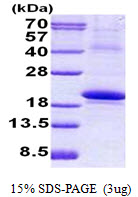

Human IL-18BP protein (Recombinant) (His-Tag) (STJP018047)
SPECIFICATIONS
HostE.coli
ImmunogenHuman
General Information
| Short Description | Recombinant-Human IL-18BP-His-Tag protein was developed from e.coli and has a target region of His-Tag. For use in research applications. |
| Applications | SDS-PAGE/Denatured |
| Host | E.coli |
| Note | STRICTLY FOR FURTHER SCIENTIFIC RESEARCH USE ONLY (RUO). MUST NOT TO BE USED IN DIAGNOSTIC OR THERAPEUTIC APPLICATIONS. |
Product Properties
| Concentration | 1 mg/mL |
| Formulation | Liquid in 20mM Tris-HCl buffer (pH 8.0) containing 0.4M uREA, 10% Glycerol |
| Storage Instruction | For short term storage, keep at +2C to +8C for up to 1 week. For long term storage, aliquot and store at-20C, and avoid repeat freeze-thaw cycles. |
Target Information
| Gene Symbol | IL18BP |
| Gene ID | 10068 |
| Uniprot ID | I18BP_HUMAN |
| Accession Number | NP_001138529 |
| Immunogen | Human |
| Immunogen Region | 31-194aa |
| Immunogen Sequence | MGSSHHHHHH SSGLVPRGSH MGSTPVSQTT TAATASVRST KDPCPSQPPV FPAAKQCPAL EVTWPEVEVP LNGTLSLSCV ACSRFPNFSI LYWLGNGSFI EHLPGRLWEG STSRERGSTG TQLCKALVLE QLTPALHSTN FSCVLVDPEQ VVQRHVVLAQ LWAGLRATLP PTQEALPSSH SSPQQQG |
Additional Info
| Tissue Specificity | Strongly expressed in heart, lung, placenta and spleen. |
| Post Translational Modifications | N- and O-glycosylated. O-glycosylated with core 1-like and core 2-like glycans. O-glycan heterogeneity at Ser-53: HexHexNAc (major) and Hex2HexNAc2 (minor). N-glycan heterogeneity at Asn-103: Hex5HexNAc4 (minor), dHex1Hex5HexNAc4 (major) and Hex6HexNAc5 (minor).N-glycan at Asn-147: dHex1Hex5HexNAc4. |
| Function | Isoform A binds to IL-18 and inhibits its activity. Functions as an inhibitor of the early TH1 cytokine response. |
| Protein Name | Interleukin-18-Binding ProteinIl-18bpTadekinig-Alfa |
| Database Links | Reactome: R-HSA-9008059Reactome: R-HSA-9012546 |
| Cellular Localisation | Secreted |
| Alternative Protein Names | Interleukin-18-Binding Protein proteinIl-18bp proteinTadekinig-Alfa proteinIL18BP protein |
Information sourced from Uniprot.org