

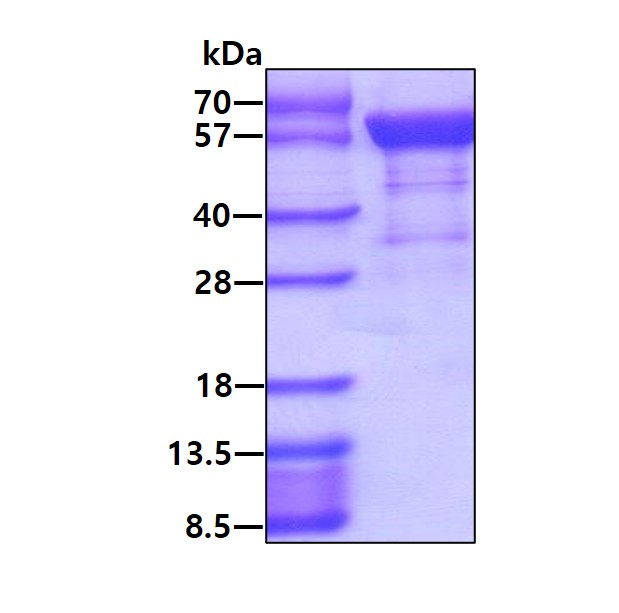

Human IFIT3 protein (Recombinant) (His-Tag) (STJP019185)
SPECIFICATIONS
HostE.coli
ImmunogenHuman
General Information
| Short Description | Recombinant-Human IFIT3-His-Tag protein was developed from e.coli and has a target region of His-Tag. For use in research applications. |
| Applications | SDS-PAGE |
| Host | E.coli |
| Note | STRICTLY FOR FURTHER SCIENTIFIC RESEARCH USE ONLY (RUO). MUST NOT TO BE USED IN DIAGNOSTIC OR THERAPEUTIC APPLICATIONS. |
Product Properties
| Concentration | 1 mg/mL |
| Formulation | Liquid in phosphate-Buffered Saline (pH 7.4) containing 20% Glycerol |
| Storage Instruction | For short term storage, keep at +2C to +8C for up to 1 week. For long term storage, aliquot and store at-20C, and avoid repeat freeze-thaw cycles. |
Target Information
| Gene Symbol | IFIT3 |
| Gene ID | 3437 |
| Uniprot ID | IFIT3_HUMAN |
| Accession Number | NP_001540 |
| Immunogen | Human |
| Immunogen Region | 1-490aa |
| Immunogen Sequence |
Additional Info
| Tissue Specificity | Expression significantly higher in peripheral blood mononuclear cells (PBMCs) and monocytes from systemic lupus erythematosus (SLE) patients than in those from healthy individuals (at protein level). Spleen, lung, leukocytes, lymph nodes, placenta, bone marrow and fetal liver. |
| Function | IFN-induced antiviral protein which acts as an inhibitor of cellular as well as viral processes, cell migration, proliferation, signaling, and viral replication. Enhances MAVS-mediated host antiviral responses by serving as an adapter bridging TBK1 to MAVS which leads to the activation of TBK1 and phosphorylation of IRF3 and phosphorylated IRF3 translocates into nucleus to promote antiviral gene transcription. Exhibits an antiproliferative activity via the up-regulation of cell cycle negative regulators CDKN1A/p21 and CDKN1B/p27. Normally, CDKN1B/p27 turnover is regulated by COPS5, which binds CDKN1B/p27 in the nucleus and exports it to the cytoplasm for ubiquitin-dependent degradation. IFIT3 sequesters COPS5 in the cytoplasm, thereby increasing nuclear CDKN1B/p27 protein levels. Up-regulates CDKN1A/p21 by down-regulating MYC, a repressor of CDKN1A/p21. Can negatively regulate the apoptotic effects of IFIT2. |
| Protein Name | Interferon-Induced Protein With Tetratricopeptide Repeats 3Ifit-3Cig49Isg-60Interferon-Induced 60 Kda ProteinIfi-60kInterferon-Induced Protein With Tetratricopeptide Repeats 4Ifit-4Retinoic Acid-Induced Gene G ProteinP60Rig-G |
| Database Links | Reactome: R-HSA-909733 |
| Cellular Localisation | CytoplasmMitochondrion |
| Alternative Protein Names | Interferon-Induced Protein With Tetratricopeptide Repeats 3 proteinIfit-3 proteinCig49 proteinIsg-60 proteinInterferon-Induced 60 Kda Protein proteinIfi-60k proteinInterferon-Induced Protein With Tetratricopeptide Repeats 4 proteinIfit-4 proteinRetinoic Acid-Induced Gene G Protein proteinP60 proteinRig-G proteinIFIT3 proteinCIG-49 proteinIFI60 proteinIFIT4 proteinISG60 protein |
Information sourced from Uniprot.org