

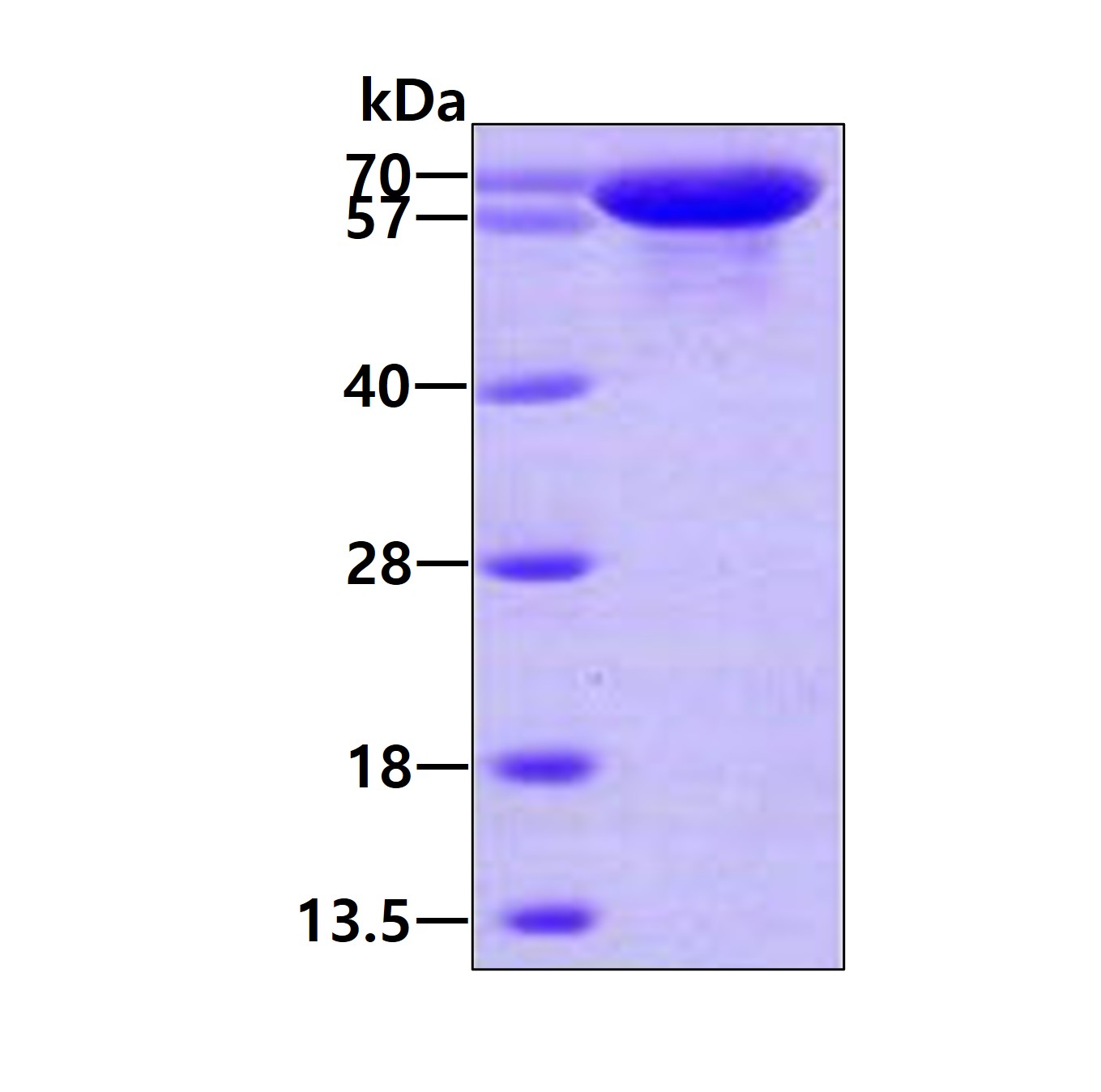

Human HSP70B/HSPA6 protein (Recombinant) (His-Tag) (STJP016570)
SPECIFICATIONS
HostE.coli
ImmunogenHuman
General Information
| Short Description | Recombinant-Human HSP70B/HSPA6-His-Tag protein was developed from e.coli and has a target region of His-Tag. For use in research applications. |
| Applications | SDS-PAGE |
| Host | E.coli |
| Note | STRICTLY FOR FURTHER SCIENTIFIC RESEARCH USE ONLY (RUO). MUST NOT TO BE USED IN DIAGNOSTIC OR THERAPEUTIC APPLICATIONS. |
Product Properties
| Concentration | 1 mg/mL |
| Formulation | Liquid in 20mM Tris-HCl buffer (pH 8.0) containing 100mM NaCl, 10% Glycerol |
| Storage Instruction | For short term storage, keep at +2C to +8C for up to 1 week. For long term storage, aliquot and store at-20C, and avoid repeat freeze-thaw cycles. |
Target Information
| Gene Symbol | HSPA6 |
| Gene ID | 3310 |
| Uniprot ID | HSP76_HUMAN |
| Accession Number | NP_002146 |
| Immunogen | Human |
| Immunogen Region | 1-643aa |
| Immunogen Sequence |
Additional Info
| Function | Molecular chaperone implicated in a wide variety of cellular processes, including protection of the proteome from stress, folding and transport of newly synthesized polypeptides, activation of proteolysis of misfolded proteins and the formation and dissociation of protein complexes. Plays a pivotal role in the protein quality control system, ensuring the correct folding of proteins, the re-folding of misfolded proteins and controlling the targeting of proteins for subsequent degradation. This is achieved through cycles of ATP binding, ATP hydrolysis and ADP release, mediated by co-chaperones. The affinity for polypeptides is regulated by its nucleotide bound state. In the ATP-bound form, it has a low affinity for substrate proteins. However, upon hydrolysis of the ATP to ADP, it undergoes a conformational change that increases its affinity for substrate proteins. It goes through repeated cycles of ATP hydrolysis and nucleotide exchange, which permits cycles of substrate binding and release. |
| Protein Name | Heat Shock 70 Kda Protein 6Heat Shock 70 Kda Protein B'Heat Shock Protein Family A Member 6 |
| Database Links | Reactome: R-HSA-3371453Reactome: R-HSA-6798695 |
| Cellular Localisation | |
| Alternative Protein Names | Heat Shock 70 Kda Protein 6 proteinHeat Shock 70 Kda Protein B' proteinHeat Shock Protein Family A Member 6 proteinHSPA6 proteinHSP70B' protein |
Information sourced from Uniprot.org