
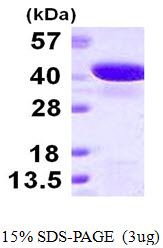

Human GIPC2 protein (Recombinant) (His-Tag) (STJP017523)
SPECIFICATIONS
HostE.coli
ImmunogenHuman
General Information
| Short Description | Recombinant-Human GIPC2-His-Tag protein was developed from e.coli and has a target region of His-Tag. For use in research applications. |
| Applications | SDS-PAGE |
| Host | E.coli |
| Note | STRICTLY FOR FURTHER SCIENTIFIC RESEARCH USE ONLY (RUO). MUST NOT TO BE USED IN DIAGNOSTIC OR THERAPEUTIC APPLICATIONS. |
Product Properties
| Concentration | 1 mg/mL |
| Formulation | Liquid in 20mM Tris-HCl buffer (pH 8.0) containing 1mM DTT, 30% Glycerol, 0.1M NaCl |
| Storage Instruction | For short term storage, keep at +2C to +8C for up to 1 week. For long term storage, aliquot and store at-20C, and avoid repeat freeze-thaw cycles. |
Target Information
| Gene Symbol | GIPC2 |
| Gene ID | 54810 |
| Uniprot ID | GIPC2_HUMAN |
| Accession Number | AAH36075 |
| Immunogen | Human |
| Immunogen Region | 1-315aa |
| Immunogen Sequence | MGSSHHHHHH SSGLVPRGSH MGSHMPLKLR GKKKAKSKET AGLVEGEPTG AGGGSLSASR APARRLVFHA QLAHGSATGR VEGFSSIQEL YAQIAGAFEI SPSEILYCTL NTPKIDMERL LGGQLGLEDF IFAHVKGIEK EVNVYKSEDS LGLTITDNGV GYAFIKRIKD GGVIDSVKTI CVGDHIESIN GENIVGWRHY DVAKKLKELK KEELFTMKLI EPKKAFEI |
Additional Info
| Tissue Specificity | Expressed at highest levels in ascending colon and at moderate levels in adult kidney. Expressed at low levels in adult pancreas and at very low levels in adult liver. Expression is down-regulated in several primary tumors, such as kidney, colon and rectal tumors. |
| Protein Name | Pdz Domain-Containing Protein Gipc2 |
| Database Links | |
| Cellular Localisation | Cytoplasm |
| Alternative Protein Names | Pdz Domain-Containing Protein Gipc2 proteinGIPC2 protein |
Information sourced from Uniprot.org