

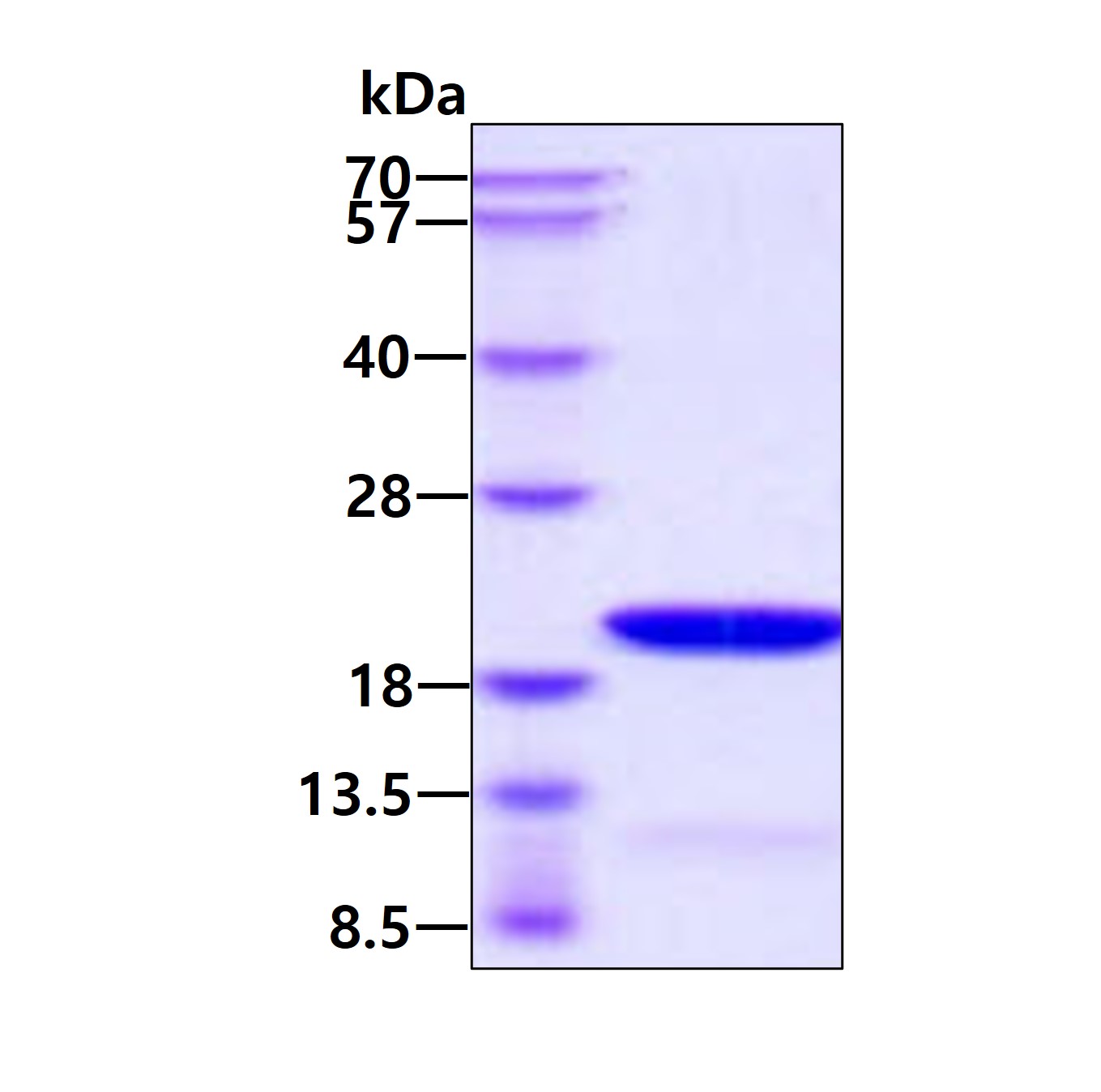

Human GABARAPL1 protein (Recombinant) (His-Tag) (STJP016970)
SPECIFICATIONS
HostE.coli
ImmunogenHuman
General Information
| Short Description | Recombinant-Human GABARAPL1-His-Tag protein was developed from e.coli and has a target region of His-Tag. For use in research applications. |
| Applications | SDS-PAGE |
| Host | E.coli |
| Note | STRICTLY FOR FURTHER SCIENTIFIC RESEARCH USE ONLY (RUO). MUST NOT TO BE USED IN DIAGNOSTIC OR THERAPEUTIC APPLICATIONS. |
Product Properties
| Concentration | 1 mg/mL |
| Formulation | Liquid in 20mM Tris-HCl buffer (pH 8.0) containing 10% Glycerol, 1mM DTT, 0.1M NaCl. |
| Storage Instruction | For short term storage, keep at +2C to +8C for up to 1 week. For long term storage, aliquot and store at-20C, and avoid repeat freeze-thaw cycles. |
Target Information
| Gene Symbol | GABARAPL1 |
| Gene ID | 23710 |
| Uniprot ID | GBRL1_HUMAN |
| Accession Number | NP_113600.1 |
| Immunogen | Human |
| Immunogen Region | 1-117aa |
| Immunogen Sequence |
Additional Info
| Tissue Specificity | Ubiquitous. Expressed at very high levels in the brain, heart, peripheral blood leukocytes, liver, kidney, placenta and skeletal muscle. Expressed at very low levels in thymus and small intestine. In the brain, expression is particularly intense in motoneurons in the embryo and in neurons involved in somatomotor and neuroendocrine functions in the adult, particularly in the substantia nigra pars compacta. |
| Post Translational Modifications | The precursor molecule is cleaved by ATG4 (ATG4A, ATG4B, ATG4C or ATG4D) to expose the glycine at the C-terminus and form the cytosolic form, GABARAPL1-I. The processed form is then activated by APG7L/ATG7, transferred to ATG3 and conjugated to phosphatidylethanolamine (PE) phospholipid to form the membrane-bound form, GABARAPL1-II. During non-canonical autophagy, the processed form is conjugated to phosphatidylserine (PS) phospholipid. ATG4 proteins also mediate the delipidation of PE-conjugated forms required for GABARAPL1 recycling when autophagosomes fuse with lysosomes. In addition, ATG4B and ATG4D mediate delipidation of ATG8 proteins conjugated to PS during non-canonical autophagy. ATG4B constitutes the major protein for proteolytic activation. ATG4D is the main enzyme for delipidation activity. (Microbial infection) The Legionella effector RavZ is a deconjugating enzyme that hydrolyzes the amide bond between the C-terminal glycine residue and an adjacent aromatic residue in ATG8 proteins conjugated to phosphatidylethanolamine (PE), producing an ATG8 protein that is resistant to reconjugation by the host machinery due to the cleavage of the reactive C-terminal glycine. RavZ is also able to mediate delipidation of ATG8 proteins conjugated to phosphatidylserine (PS). |
| Function | Ubiquitin-like modifier that increases cell-surface expression of kappa-type opioid receptor through facilitating anterograde intracellular trafficking of the receptor. Involved in formation of autophagosomal vacuoles. While LC3s are involved in elongation of the phagophore membrane, the GABARAP/GATE-16 subfamily is essential for a later stage in autophagosome maturation. Through its interaction with the reticulophagy receptor TEX264, participates in the remodeling of subdomains of the endoplasmic reticulum into autophagosomes upon nutrient stress, which then fuse with lysosomes for endoplasmic reticulum turnover. |
| Protein Name | Gamma-Aminobutyric Acid Receptor-Associated Protein-Like 1Early Estrogen-Regulated ProteinGaba(A Receptor-Associated Protein-Like 1Glandular Epithelial Cell Protein 1Gec-1 |
| Database Links | Reactome: R-HSA-1632852 |
| Cellular Localisation | Cytoplasmic VesicleAutophagosomeCytoplasmic Vesicle MembraneLipid-AnchorCytoplasmCytoskeletonEndoplasmic ReticulumGolgi Apparatus |
| Alternative Protein Names | Gamma-Aminobutyric Acid Receptor-Associated Protein-Like 1 proteinEarly Estrogen-Regulated Protein proteinGaba(A Receptor-Associated Protein-Like 1 proteinGlandular Epithelial Cell Protein 1 proteinGec-1 proteinGABARAPL1 proteinGEC1 protein |
Information sourced from Uniprot.org