

Human FLRT3 protein (Recombinant) (His-Tag) (STJP019545)
SPECIFICATIONS
HostHEK293 Cells
ImmunogenHuman
General Information
| Short Description | Recombinant-Human FLRT3-His-Tag protein was developed from hek293 cells and has a target region of His-Tag. For use in research applications. |
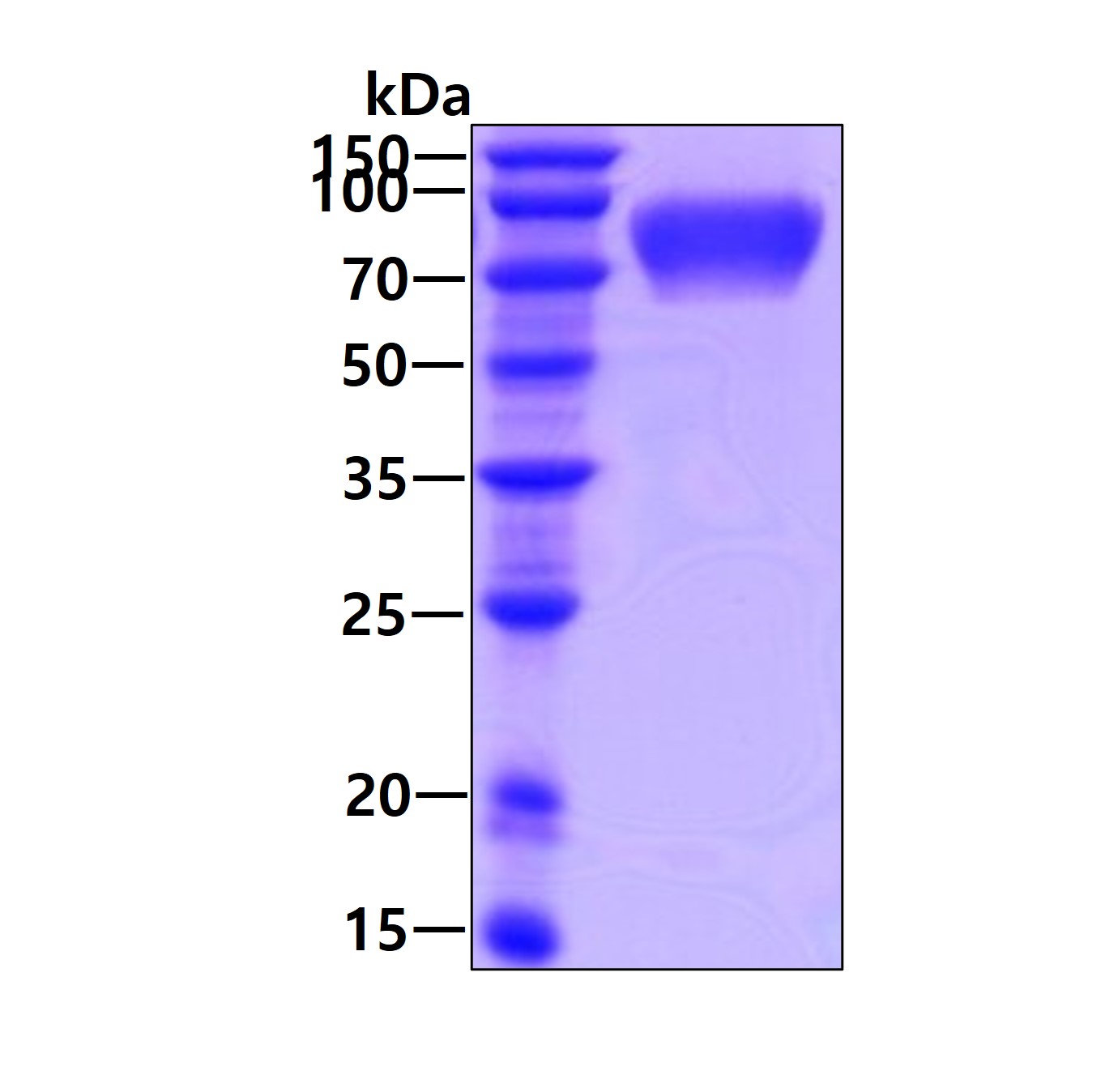
| Applications | SDS-PAGE/Bioactivity |
| Host | HEK293 Cells |
| Note | STRICTLY FOR FURTHER SCIENTIFIC RESEARCH USE ONLY (RUO). MUST NOT TO BE USED IN DIAGNOSTIC OR THERAPEUTIC APPLICATIONS. |
Product Properties
| Concentration | 0.25 mg/mL |
| Formulation | Liquid in phosphate-Buffered Saline (pH 7.4) containing 10% Glycerol |
| Storage Instruction | For short term storage, keep at +2C to +8C for up to 1 week. For long term storage, aliquot and store at-20C, and avoid repeat freeze-thaw cycles. |
| Endotoxin | < 1 EU per 1ug of protein (determined by LAL method) |
| Immunoreactivity | Measured by the ability of the immobilized protein to support the adhesion of Neuro-2a neuroblast cells. When cells are added to human FLRT3 coated plates 5 ug/ml. This effect is more to 40%. |
Target Information
| Gene Symbol | FLRT3 |
| Gene ID | 23767 |
| Uniprot ID | FLRT3_HUMAN |
| Accession Number | NP_037413.1 |
| Immunogen | Human |
| Immunogen Region | 29-528aa |
| Immunogen Sequence | KSCPSVCRCD AGFIYCNDRF LTSIPTGIPE DATTLYLQNN QINNAGIPSD LKNLLKVERI YLYHNSLDEF PTNLPKYVKE LHLQENNIRT ITYDSLSKIP YLEELHLDDN SVSAVSIEEG AFRDSNYLRL LFLSRNHLST IPWGLPRTIE ELRLDDNRIS TISSPSLQGL TSLKRLVLDG NLLNNHGLGD KVFFNLVNLT ELSLVRNSLT AAPVNLPGTN LRKLYLQD |
Additional Info
| Tissue Specificity | Expressed in kidney, brain, pancreas, skeletal muscle, lung, liver, placenta, and heart. |
| Post Translational Modifications | N-glycosylated. Proteolytic cleavage in the juxtamembrane region gives rise to a soluble ectodomain. Cleavage is probably effected by a metalloprotease. |
| Function | Functions in cell-cell adhesion, cell migration and axon guidance, exerting an attractive or repulsive role depending on its interaction partners. Plays a role in the spatial organization of brain neurons. Plays a role in vascular development in the retina. Plays a role in cell-cell adhesion via its interaction with ADGRL3 and probably also other latrophilins that are expressed at the surface of adjacent cells. Interaction with the intracellular domain of ROBO1 mediates axon attraction towards cells expressing NTN1. Mediates axon growth cone collapse and plays a repulsive role in neuron guidance via its interaction with UNC5B, and possibly also other UNC-5 family members. Promotes neurite outgrowth (in vitro). Mediates cell-cell contacts that promote an increase both in neurite number and in neurite length. Plays a role in the regulation of the density of glutamaergic synapses. Plays a role in fibroblast growth factor-mediated signaling cascades. Required for normal morphogenesis during embryonic development, but not for normal embryonic patterning. Required for normal ventral closure, headfold fusion and definitive endoderm migration during embryonic development. Required for the formation of a normal basement membrane and the maintenance of a normal anterior visceral endoderm during embryonic development. |
| Protein Name | Leucine-Rich Repeat Transmembrane Protein Flrt3Fibronectin-Like Domain-Containing Leucine-Rich Transmembrane Protein 3 |
| Database Links | Reactome: R-HSA-376176Reactome: R-HSA-5654687 |
| Cellular Localisation | Cell MembraneSingle-Pass Membrane ProteinPresynaptic Cell MembraneEndoplasmic Reticulum MembraneCell JunctionFocal AdhesionSecretedCell ProjectionAxonGrowth Cone MembraneDetected On Dendritic Punctae That Colocalize In Part With Glutamaergic SynapsesBut Not With Gabaergic SynapsesProteolytic Cleavage In The Juxtamembrane Region Gives Rise To A Shedded Ectodomain |
| Alternative Protein Names | Leucine-Rich Repeat Transmembrane Protein Flrt3 proteinFibronectin-Like Domain-Containing Leucine-Rich Transmembrane Protein 3 proteinFLRT3 proteinKIAA1469 proteinUNQ856 proteinPRO1865 protein |
Information sourced from Uniprot.org