

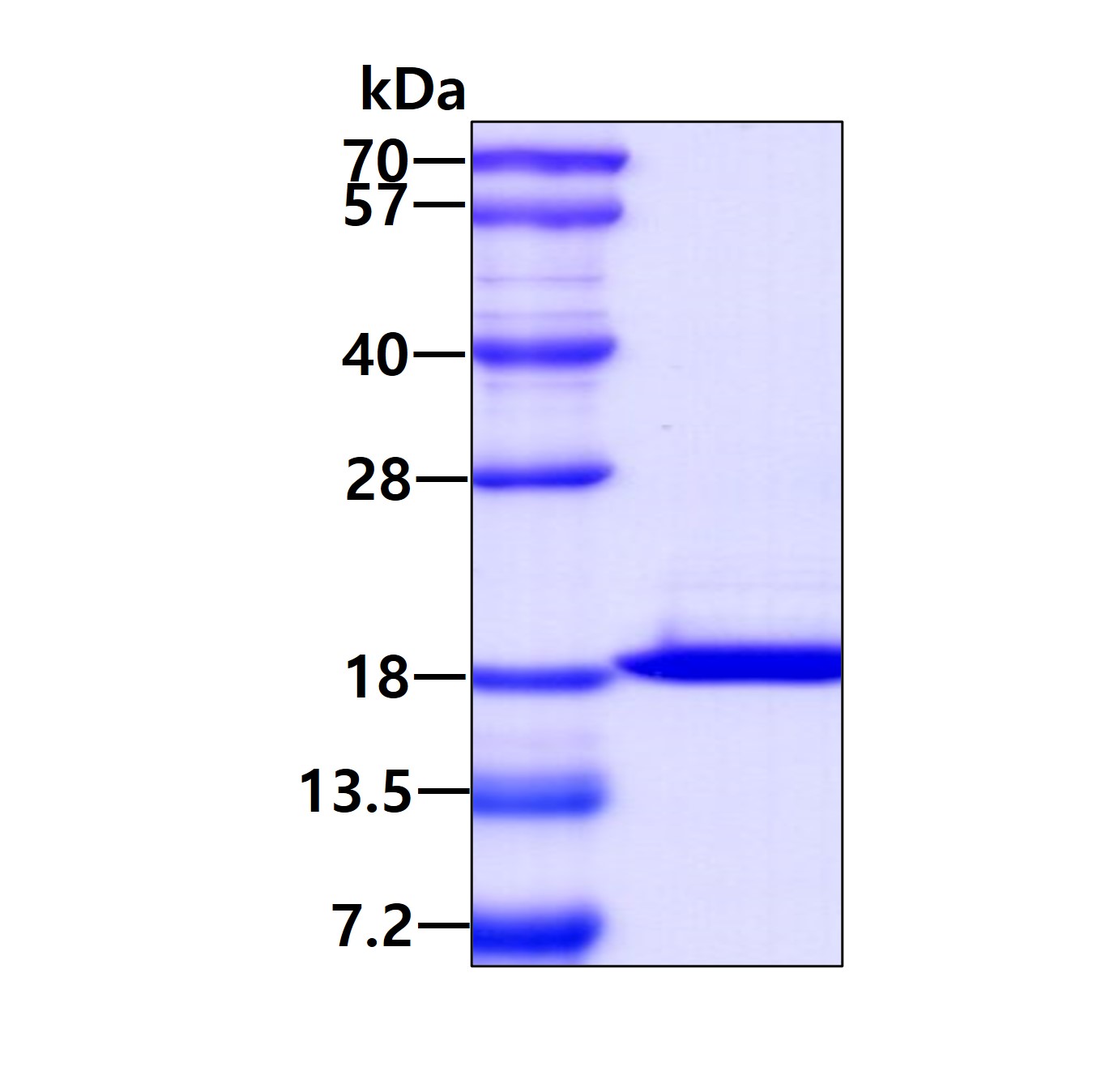

Human FHIT protein (Recombinant) (His-Tag) (STJP016703)
SPECIFICATIONS
HostE.coli
ImmunogenHuman
General Information
| Short Description | Recombinant-Human FHIT-His-Tag protein was developed from e.coli and has a target region of His-Tag. For use in research applications. |
| Applications | SDS-PAGE |
| Host | E.coli |
| Note | STRICTLY FOR FURTHER SCIENTIFIC RESEARCH USE ONLY (RUO). MUST NOT TO BE USED IN DIAGNOSTIC OR THERAPEUTIC APPLICATIONS. |
Product Properties
| Concentration | 1 mg/mL |
| Formulation | Liquid in 20mM Tris-HCl buffer (pH 8.0) containing 10% Glycerol |
| Storage Instruction | For short term storage, keep at +2C to +8C for up to 1 week. For long term storage, aliquot and store at-20C, and avoid repeat freeze-thaw cycles. |
Target Information
| Gene Symbol | FHIT |
| Gene ID | 2272 |
| Uniprot ID | FHIT_HUMAN |
| Accession Number | NP_002003 |
| Immunogen | Human |
| Immunogen Region | 1-147aa |
| Immunogen Sequence | MSFRFGQHLI KPSVVFLKTE LSFALVNRKP VVPGHVLVCP LRPVERFHDL RPDEVADLFQ TTQRVGTVVE KHFHGTSLTF SMQDGPEAGQ TVKHVHVHVL PRKAGDFHRN DSIYEELQKH DKEDFPASWR SEEEMAAEAA ALRVYFQ |
Additional Info
| Tissue Specificity | Low levels expressed in all tissues tested. Phospho-FHIT observed in liver and kidney, but not in brain and lung. Phospho-FHIT undetected in all tested human tumor cell lines. |
| Post Translational Modifications | Phosphorylation at Tyr-114 by SRC is required for induction of apoptosis. |
| Function | Possesses dinucleoside triphosphate hydrolase activity. Cleaves P(1)-P(3)-bis(5'-adenosyl) triphosphate (Ap3A) to yield AMP and ADP. Can also hydrolyze P(1)-P(4)-bis(5'-adenosyl) tetraphosphate (Ap4A), but has extremely low activity with ATP. Exhibits adenylylsulfatase activity, hydrolyzing adenosine 5'-phosphosulfate to yield AMP and sulfate. Exhibits adenosine 5'-monophosphoramidase activity, hydrolyzing purine nucleotide phosphoramidates with a single phosphate group such as adenosine 5'monophosphoramidate (AMP-NH2) to yield AMP and NH2. Exhibits adenylylsulfate-ammonia adenylyltransferase, catalyzing the ammonolysis of adenosine 5'-phosphosulfate resulting in the formation of adenosine 5'-phosphoramidate. Also catalyzes the ammonolysis of adenosine 5-phosphorofluoridate and diadenosine triphosphate. Modulates transcriptional activation by CTNNB1 and thereby contributes to regulate the expression of genes essential for cell proliferation and survival, such as CCND1 and BIRC5. Plays a role in the induction of apoptosis via SRC and AKT1 signaling pathways. Inhibits MDM2-mediated proteasomal degradation of p53/TP53 and thereby plays a role in p53/TP53-mediated apoptosis. Induction of apoptosis depends on the ability of FHIT to bind P(1)-P(3)-bis(5'-adenosyl) triphosphate or related compounds, but does not require its catalytic activity, it may in part come from the mitochondrial form, which sensitizes the low-affinity Ca(2+) transporters, enhancing mitochondrial calcium uptake. Functions as a tumor suppressor. |
| Protein Name | Bis(5'-Adenosyl-TriphosphataseAp3a HydrolaseAp3aaseAdenosine 5'-Monophosphoramidase FhitAdenylylsulfataseAdenylylsulfate-Ammonia AdenylyltransferaseDiadenosine 5' -5'''-P1 -P3-Triphosphate HydrolaseDinucleosidetriphosphataseFragile Histidine Triad Protein |
| Database Links | |
| Cellular Localisation | CytoplasmMitochondrionNucleus |
| Alternative Protein Names | Bis(5'-Adenosyl-Triphosphatase proteinAp3a Hydrolase proteinAp3aase proteinAdenosine 5'-Monophosphoramidase Fhit proteinAdenylylsulfatase proteinAdenylylsulfate-Ammonia Adenylyltransferase proteinDiadenosine 5' -5'''-P1 -P3-Triphosphate Hydrolase proteinDinucleosidetriphosphatase proteinFragile Histidine Triad Protein proteinFHIT protein |
Information sourced from Uniprot.org