

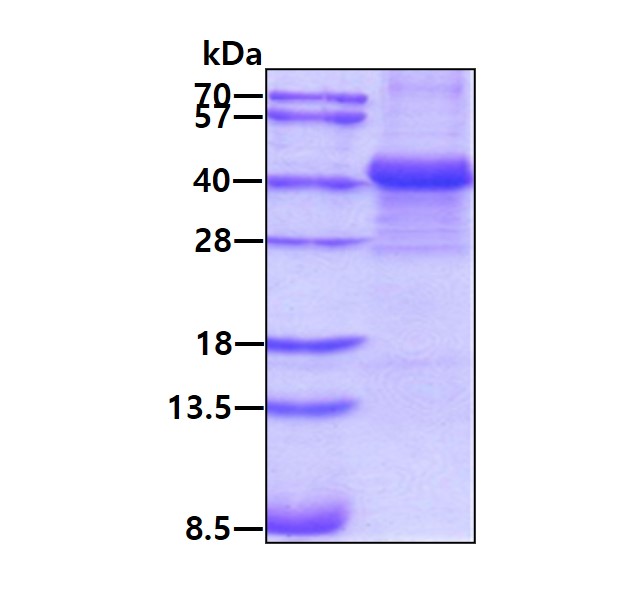

Human FGB protein (Recombinant) (His-Tag) (STJP019170)
SPECIFICATIONS
HostE.coli
ImmunogenHuman
General Information
| Short Description | Recombinant-Human FGB-His-Tag protein was developed from e.coli and has a target region of His-Tag. For use in research applications. |
| Applications | SDS-PAGE |
| Host | E.coli |
| Note | STRICTLY FOR FURTHER SCIENTIFIC RESEARCH USE ONLY (RUO). MUST NOT TO BE USED IN DIAGNOSTIC OR THERAPEUTIC APPLICATIONS. |
Product Properties
| Concentration | 1 mg/mL |
| Formulation | Liquid in 20mM Tris-HCl buffer (pH 8.0) containing 10% Glycerol |
| Storage Instruction | For short term storage, keep at +2C to +8C for up to 1 week. For long term storage, aliquot and store at-20C, and avoid repeat freeze-thaw cycles. |
Target Information
| Gene Symbol | FGB |
| Gene ID | 2244 |
| Uniprot ID | FIBB_HUMAN |
| Accession Number | NP_005132 |
| Immunogen | Human |
| Immunogen Region | 164-491aa |
| Immunogen Sequence |
Additional Info
| Tissue Specificity | Detected in blood plasma (at protein level). |
| Post Translational Modifications | Conversion of fibrinogen to fibrin is triggered by thrombin, which cleaves fibrinopeptides A and B from alpha and beta chains, and thus exposes the N-terminal polymerization sites responsible for the formation of the soft clot. The soft clot is converted into the hard clot by factor XIIIA which catalyzes the epsilon-(gamma-glutamyl)lysine cross-linking between gamma chains (stronger) and between alpha chains (weaker) of different monomers. |
| Function | Cleaved by the protease thrombin to yield monomers which, together with fibrinogen alpha (FGA) and fibrinogen gamma (FGG), polymerize to form an insoluble fibrin matrix. Fibrin has a major function in hemostasis as one of the primary components of blood clots. In addition, functions during the early stages of wound repair to stabilize the lesion and guide cell migration during re-epithelialization. Was originally thought to be essential for platelet aggregation, based on in vitro studies using anticoagulated blood. However subsequent studies have shown that it is not absolutely required for thrombus formation in vivo. Enhances expression of SELP in activated platelets. Maternal fibrinogen is essential for successful pregnancy. Fibrin deposition is also associated with infection, where it protects against IFNG-mediated hemorrhage. May also facilitate the antibacterial immune response via both innate and T-cell mediated pathways. |
| Protein Name | Fibrinogen Beta Chain Cleaved Into - Fibrinopeptide B - Fibrinogen Beta Chain |
| Database Links | Reactome: R-HSA-114608Reactome: R-HSA-1236974Reactome: R-HSA-140875Reactome: R-HSA-166058Reactome: R-HSA-216083Reactome: R-HSA-354192Reactome: R-HSA-354194Reactome: R-HSA-372708Reactome: R-HSA-5602498Reactome: R-HSA-5603041Reactome: R-HSA-5674135Reactome: R-HSA-5686938Reactome: R-HSA-6802946Reactome: R-HSA-6802948Reactome: R-HSA-6802952Reactome: R-HSA-6802955Reactome: R-HSA-9649948Reactome: R-HSA-9656223 |
| Cellular Localisation | Secreted |
| Alternative Protein Names | Fibrinogen Beta Chain Cleaved Into - Fibrinopeptide B - Fibrinogen Beta Chain proteinFGB protein |
Information sourced from Uniprot.org