


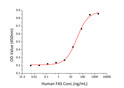


Human FAS/APO-1/CD95 protein (Recombinant) (C-hFc & His) (STJP002580)
SPECIFICATIONS
HostHEK293 cells
ConjugationUnconjugated
ImmunogenRecombinant Human FAS/APO-1/CD95 Protein is produced by HEK293 cells expression system. The target protein is expressed with sequence (Gln26-Asn173) of human FAS/CD95/APO-1/TNFRSF6 (Accession #NP_000034.1) fused with an Fc, 6×His tag at the C-terminu
General Information
| Short Description | Recombinant-Human FAS/APO-1/CD95-C-hFc & His protein was developed in hek293 cells using the region Gln26-Asn173. For use in research applications. |
| Host | HEK293 cells |
| Note | STRICTLY FOR FURTHER SCIENTIFIC RESEARCH USE ONLY (RUO). MUST NOT TO BE USED IN DIAGNOSTIC OR THERAPEUTIC APPLICATIONS. |
Product Properties
| Conjugation | Unconjugated |
| Formulation | Lyophilised from a 0.22 Mu m filtered solution of PBS, pH 7.4. |
| Storage Instruction | Store at-20°C for up to 1 year from the date of receipt, and avoid repeat freeze-thaw cycles. |
| Immunoreactivity | 1.Measured by its binding ability in a functional ELISA. Immobilized recombinant Human Fas Ligand at 2 Mu g/mL (100 Mu L/well) can bind recombinant Human FAS. The EC50 of Human FAS is 6.23 ng/mL.|2.Measured by its ability to inhibit Fas Li |
| Determination Method | < 0.1 EU/Mu g of the protein by LAL method. |
Target Information
| Gene Symbol | FAS |
| Gene ID | 355 |
| Uniprot ID | TNR6_HUMAN |
| Immunogen | Recombinant Human FAS/APO-1/CD95 Protein is produced by HEK293 cells expression system. The target protein is expressed with sequence (Gln26-Asn173) of human FAS/CD95/APO-1/TNFRSF6 (Accession #NP_000034.1) fused with an Fc, 6×His tag at the C-terminu |
| Immunogen Region | Gln26-Asn173 |
| Immunogen Sequence | QVTDINSKGLELRKTVTTVE TQNLEGLHHDGQFCHKPCPP GERKARDCTVNGDEPDCVPC QEGKEYTDKAHFSSKCRRCR LCDEGHGLEVEINCTRTQNT KCRCKPNFFCNSTVCEHCDP CTKCEHGIIKECTLTSNTKC KEEGSRSN |
Additional Info
| Post Translational Modifications | (Microbial infection) Glycosylated at Arg-250 by enteropathogenic E.coli protein NleB1: arginine GlcNAcylation prevents homotypic/heterotypic death domain interactions. Palmitoylated. Palmitoylation by ZDHHC7 prevents the lysosomal degradation of FAS regulating its expression at the plasma membrane. N- and O-glycosylated. O-glycosylated with core 1 or possibly core 8 glycans. |
| Function | Receptor for TNFSF6/FASLG. The adapter molecule FADD recruits caspase CASP8 to the activated receptor. The resulting death-inducing signaling complex (DISC) performs CASP8 proteolytic activation which initiates the subsequent cascade of caspases (aspartate-specific cysteine proteases) mediating apoptosis. FAS-mediated apoptosis may have a role in the induction of peripheral tolerance, in the antigen-stimulated suicide of mature T-cells, or both. The secreted isoforms 2 to 6 block apoptosis (in vitro). |
| Protein Name | Tumor Necrosis Factor Receptor Superfamily Member 6Apo-1 AntigenApoptosis-Mediating Surface Antigen FasFaslg ReceptorCd Antigen Cd95 |
| Database Links | Reactome: R-HSA-140534Reactome: R-HSA-3371378Reactome: R-HSA-5213460Reactome: R-HSA-5218900Reactome: R-HSA-6803211Reactome: R-HSA-69416Reactome: R-HSA-75157 |
| Cellular Localisation | Isoform 1: Cell MembraneSingle-Pass Type I Membrane ProteinMembrane RaftIsoform 2: SecretedIsoform 3: SecretedIsoform 4: SecretedIsoform 5: SecretedIsoform 6: Secreted |
| Alternative Protein Names | Tumor Necrosis Factor Receptor Superfamily Member 6 proteinApo-1 Antigen proteinApoptosis-Mediating Surface Antigen Fas proteinFaslg Receptor proteinCd Antigen Cd95 proteinFAS proteinAPT1 proteinFAS1 proteinTNFRSF6 protein |
Information sourced from Uniprot.org