
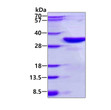


Human DKK2 protein (Recombinant) (His-Tag) (STJP017809)
SPECIFICATIONS
HostE.coli
ImmunogenHuman
General Information
| Short Description | Recombinant-Human DKK2-His-Tag protein was developed from e.coli and has a target region of His-Tag. For use in research applications. |
| Applications | SDS-PAGE/Denatured |
| Host | E.coli |
| Note | STRICTLY FOR FURTHER SCIENTIFIC RESEARCH USE ONLY (RUO). MUST NOT TO BE USED IN DIAGNOSTIC OR THERAPEUTIC APPLICATIONS. |
Product Properties
| Concentration | 0.25 mg/mL |
| Formulation | Liquid in 20mM Tris-HCl buffer (pH 8.0) containing 0.4M urea, 10% Glycerol |
| Storage Instruction | For short term storage, keep at +2C to +8C for up to 1 week. For long term storage, aliquot and store at-20C, and avoid repeat freeze-thaw cycles. |
Target Information
| Gene Symbol | DKK2 |
| Gene ID | 27123 |
| Uniprot ID | DKK2_HUMAN |
| Accession Number | NP_055236 |
| Immunogen | Human |
| Immunogen Region | 34-259aa |
| Immunogen Sequence |
Additional Info
| Tissue Specificity | Expressed in heart, brain, skeletal muscle and lung. |
| Post Translational Modifications | May be proteolytically processed by a furin-like protease. |
| Function | Antagonizes canonical Wnt signaling by inhibiting LRP5/6 interaction with Wnt and by forming a ternary complex with the transmembrane protein KREMEN that promotes internalization of LRP5/6. DKKs play an important role in vertebrate development, where they locally inhibit Wnt regulated processes such as antero-posterior axial patterning, limb development, somitogenesis and eye formation. In the adult, Dkks are implicated in bone formation and bone disease, cancer and Alzheimer disease. |
| Protein Name | Dickkopf-Related Protein 2Dickkopf-2Dkk-2Hdkk-2 |
| Database Links | Reactome: R-HSA-201681Reactome: R-HSA-3772470Reactome: R-HSA-5339717 |
| Cellular Localisation | Secreted |
| Alternative Protein Names | Dickkopf-Related Protein 2 proteinDickkopf-2 proteinDkk-2 proteinHdkk-2 proteinDKK2 proteinUNQ682 proteinPRO1316 protein |
Information sourced from Uniprot.org