

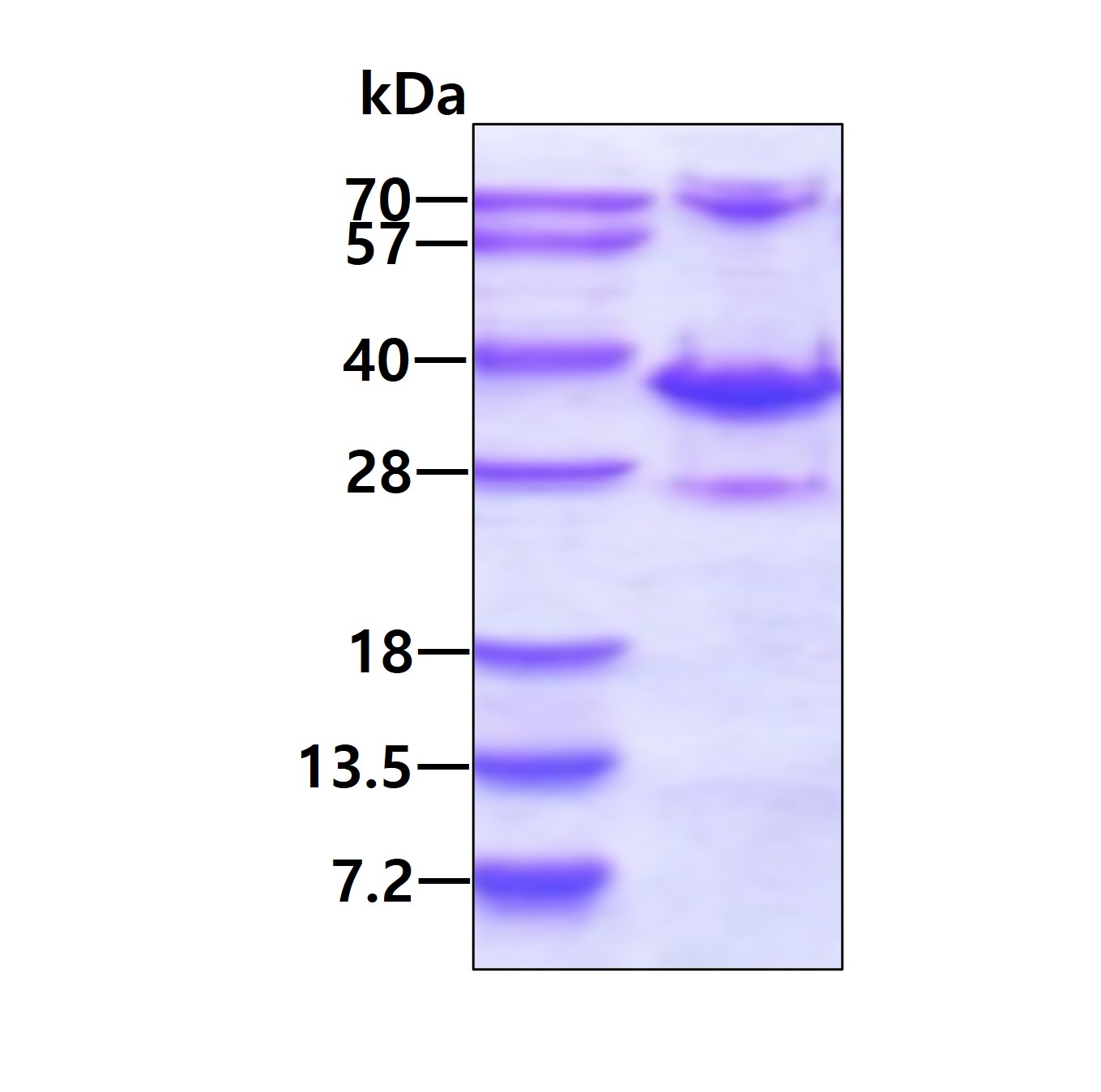

Human DHRS4 protein (Recombinant) (His-Tag) (STJP017450)
SPECIFICATIONS
HostE.coli
ImmunogenHuman
General Information
| Short Description | Recombinant-Human DHRS4-His-Tag protein was developed from e.coli and has a target region of His-Tag. For use in research applications. |
| Applications | SDS-PAGE |
| Host | E.coli |
| Note | STRICTLY FOR FURTHER SCIENTIFIC RESEARCH USE ONLY (RUO). MUST NOT TO BE USED IN DIAGNOSTIC OR THERAPEUTIC APPLICATIONS. |
Product Properties
| Concentration | 0.25 mg/mL |
| Formulation | Liquid in 20mM Tris-HCl buffer (pH 7.5) containing 20% Glycerol, 1mM DTT |
| Storage Instruction | For short term storage, keep at +2C to +8C for up to 1 week. For long term storage, aliquot and store at-20C, and avoid repeat freeze-thaw cycles. |
Target Information
| Gene Symbol | DHRS4 |
| Gene ID | 10901 |
| Uniprot ID | DHRS4_HUMAN |
| Accession Number | NP_066284 |
| Immunogen | Human |
| Immunogen Region | 1-278aa |
| Immunogen Sequence |
Additional Info
| Tissue Specificity | Isoform 1: Predominantly expressed in normal cervix (at protein level). Isoform 4: Expressed in some neoplastic cervical tissues, but not in normal cervix (at protein level). Isoform 5: Expressed in a few neoplastic cervical tissues. Isoform 6: Expressed in a few neoplastic cervical tissues. Isoform 8: High expression in liver. |
| Function | NADPH-dependent oxidoreductase which catalyzes the reduction of a variety of compounds bearing carbonyl groups including ketosteroids, alpha-dicarbonyl compounds, aldehydes, aromatic ketones and quinones. Reduces 3-ketosteroids and benzil into 3beta-hydroxysteroids and R-benzoin, respectively, in contrast to the stereoselectivity of non-primate DHRS4s which produce 3alpha-hydroxysteroids and S-benzoin. Diplays low activity toward all-trans-retinal and no activity toward 9-cis-retinal as compared to non-primate mammals. In the reverse reaction, catalyze the NAD-dependent oxidation of 3beta-hydroxysteroids and alcohol, but with much lower efficiency. Involved in the metabolism of 3beta-hydroxysteroids, isatin and xenobiotic carbonyl compounds. Isoform 7: No detected catalytic activity in vitro, possibly due to the lack of catalytic site. Isoform 8: NADPH-dependent oxidoreductase which catalyzes the reduction of a variety of compounds bearing carbonyl groups including ketosteroids, alpha-dicarbonyl compounds, aldehydes, aromatic ketones and quinones. Involved in the metabolism of 3beta-hydroxysteroids, isatin and xenobiotic carbonyl compounds. Has a higher catalytic activity for xenobiotic alpha-dicarbonyl compounds, sucha as benzil, than isoform 1 and is involved in benzil detoxification. |
| Protein Name | Dehydrogenase/Reductase Sdr Family Member 4Nadph-Dependent Carbonyl ReductaseCrNadph-Dependent Retinol Dehydrogenase/ReductaseNrdrHumnrdrPeroxisomal Short-Chain Alcohol DehydrogenasePscdScad-SrlShort Chain Dehydrogenase/Reductase Family 25c Member 2Protein Sdr25c2Short-Chain Dehydrogenase/Reductase Family Member 4 |
| Database Links | Reactome: R-HSA-5365859Reactome: R-HSA-9033241 |
| Cellular Localisation | Isoform 1: PeroxisomeIsoform 4 Is Not PeroxisomalIsoform 7: Nucleus |
| Alternative Protein Names | Dehydrogenase/Reductase Sdr Family Member 4 proteinNadph-Dependent Carbonyl Reductase proteinCr proteinNadph-Dependent Retinol Dehydrogenase/Reductase proteinNrdr proteinHumnrdr proteinPeroxisomal Short-Chain Alcohol Dehydrogenase proteinPscd proteinScad-Srl proteinShort Chain Dehydrogenase/Reductase Family 25c Member 2 proteinProtein Sdr25c2 proteinShort-Chain Dehydrogenase/Reductase Family Member 4 proteinDHRS4 proteinSDR25C2 proteinUNQ851 proteinPRO1800 protein |
Information sourced from Uniprot.org