

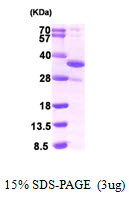

Human DDIT4 protein (Recombinant) (His-Tag) (STJP017034)
SPECIFICATIONS
HostE.coli
ImmunogenHuman
General Information
| Short Description | Recombinant-Human DDIT4-His-Tag protein was developed from e.coli and has a target region of His-Tag. For use in research applications. |
| Applications | SDS-PAGE |
| Host | E.coli |
| Note | STRICTLY FOR FURTHER SCIENTIFIC RESEARCH USE ONLY (RUO). MUST NOT TO BE USED IN DIAGNOSTIC OR THERAPEUTIC APPLICATIONS. |
Product Properties
| Concentration | 0.25 mg/mL |
| Formulation | Liquid in 20mM Tris-HCl buffer (pH 8.0) containing 0.2M NaCl, 5mM DTT, 1mM EDTA, 30% Glycerol |
| Storage Instruction | For short term storage, keep at +2C to +8C for up to 1 week. For long term storage, aliquot and store at-20C, and avoid repeat freeze-thaw cycles. |
Target Information
| Gene Symbol | DDIT4 |
| Gene ID | 54541 |
| Uniprot ID | DDIT4_HUMAN |
| Accession Number | NP_061931 |
| Immunogen | Human |
| Immunogen Region | 1-232aa |
| Immunogen Sequence | MGSSHHHHHH SSGLVPRGSH MPSLWDRFSS SSTSSSPSSL PRTPTPDRPP RSAWGSATRE EGFDRSTSLE SSDCESLDSS NSGFGPEEDT AYLDGVSLPD FELLSDPEDE HLCANLMQLL QESLAQARLG SRRPARLLMP SQLVSQVGKE LLRLAYSEPC GLRGALLDVC VEQGKSCHSV GQLALDPSLV PTFQLTLVLR LDSRLWPKIQ GLFSSANSPF LPGFSQSL |
Additional Info
| Tissue Specificity | Broadly expressed, with lowest levels in brain, skeletal muscle and intestine. Up-regulated in substantia nigra neurons from Parkinson disease patients (at protein level). |
| Post Translational Modifications | Phosphorylated by GSK3B.this promotes proteasomal degradation. Polyubiquitinated by a DCX (DDB1-CUL4A-RBX1) E3 ubiquitin-protein ligase complex with BTRC as substrate-recognition component, leading to its proteasomal degradation. |
| Function | Regulates cell growth, proliferation and survival via inhibition of the activity of the mammalian target of rapamycin complex 1 (mTORC1). Inhibition of mTORC1 is mediated by a pathway that involves DDIT4/REDD1, AKT1, the TSC1-TSC2 complex and the GTPase RHEB. Plays an important role in responses to cellular energy levels and cellular stress, including responses to hypoxia and DNA damage. Regulates p53/TP53-mediated apoptosis in response to DNA damage via its effect on mTORC1 activity. Its role in the response to hypoxia depends on the cell type.it mediates mTORC1 inhibition in fibroblasts and thymocytes, but not in hepatocytes. Required for mTORC1-mediated defense against viral protein synthesis and virus replication. Inhibits neuronal differentiation and neurite outgrowth mediated by NGF via its effect on mTORC1 activity. Required for normal neuron migration during embryonic brain development. Plays a role in neuronal cell death. |
| Protein Name | Dna Damage-Inducible Transcript 4 ProteinHif-1 Responsive Protein Rtp801Protein Regulated In Development And Dna Damage Response 1Redd-1 |
| Database Links | Reactome: R-HSA-5628897 |
| Cellular Localisation | MitochondrionCytoplasmCytosol |
| Alternative Protein Names | Dna Damage-Inducible Transcript 4 Protein proteinHif-1 Responsive Protein Rtp801 proteinProtein Regulated In Development And Dna Damage Response 1 proteinRedd-1 proteinDDIT4 proteinREDD1 proteinRTP801 protein |
Information sourced from Uniprot.org