
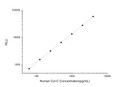


Human CYCS (Cytochrome c) CLIA Kit for Quantitative Detection
General Information
| Short Description | This human CYCS kit is a highly sensitive in-vitro chemiluminescent immunoassay for the measurement of trace amounts of analytes in serum, plasma and other biological fluids. |
| Applications | CLIA |
| Reactivity | Human |
| Sensitivity | 37.5pg/mL |
| Detection Limit | 62.5~4000pg/mL |
| Note | FOR SCIENTIFIC EDUCATIONAL RESEARCH USE ONLY (RUO). MUST NOT BE USED IN DIAGNOSTIC OR OTHER MEDICAL APPLICATIONS. |
Product Properties
| Storage Instruction | If unopened the kit may be stored at 2-8°C for up to 1 month. If the kit will not be used within 1 month, store the components separately, according to the component table in the manual. |
| Assay Time | 3.5h |
| Detection | Chemiluminescence |
Target Information
| Gene Symbol | CYCS |
| Gene ID | 54205 |
| Uniprot ID | CYC_HUMAN |
| Specificity | This kit recognizes Human Cyt-C in samples. No significant cross-reactivity or interference between Human Cyt-C and analogues was observed. |
| Sample Type | Serum, plasma and other biological fluids |
Additional Info
| Post Translational Modifications | Binds 1 heme c group covalently per subunit. Phosphorylation at Tyr-49 and Tyr-98 both reduce by half the turnover in the reaction with cytochrome c oxidase, down-regulating mitochondrial respiration. |
| Function | Electron carrier protein. The oxidized form of the cytochrome c heme group can accept an electron from the heme group of the cytochrome c1 subunit of cytochrome reductase. Cytochrome c then transfers this electron to the cytochrome oxidase complex, the final protein carrier in the mitochondrial electron-transport chain. Plays a role in apoptosis. Suppression of the anti-apoptotic members or activation of the pro-apoptotic members of the Bcl-2 family leads to altered mitochondrial membrane permeability resulting in release of cytochrome c into the cytosol. Binding of cytochrome c to Apaf-1 triggers the activation of caspase-9, which then accelerates apoptosis by activating other caspases. |
| Protein Name | Cytochrome C |
| Database Links | Reactome: R-HSA-111457Reactome: R-HSA-111458Reactome: R-HSA-111459Reactome: R-HSA-111463Reactome: R-HSA-111464Reactome: R-HSA-2151201Reactome: R-HSA-3299685Reactome: R-HSA-5620971Reactome: R-HSA-5628897Reactome: R-HSA-611105Reactome: R-HSA-9627069Reactome: R-HSA-9707564 |
| Cellular Localisation | Mitochondrion Intermembrane SpaceLoosely Associated With The Inner Membrane |
| Alternative CLIA Names | Cytochrome C CLIA kitCYCS CLIA kitCYC CLIA kit |
| Specificity | This kit recognizes Human Cyt-C in samples. No significant cross-reactivity or interference between Human Cyt-C and analogues was observed. |
| Reproducibility | Both intra-CV and inter-CV are |
Information sourced from Uniprot.org
| Item | Specifications | Storage |
|---|---|---|
| Micro CLIA Plate (Dismountable) | 96T: 8 wells ×12 strips strips | -20℃, 6 months |
| Reference Standard | 96T: 2 vials 48T: 1 vial | -20℃, 6 months |
| Concentrated Biotinylated Detection Ab (100×) | 96T: 1 vial, 120 μL 60 μL | -20℃, 6 months |
| Concentrated HRP Conjugate (100×) | 96T: 1 vial, 120 μL 60 μL | -20℃ (Protect from light), 6 months |
| Reference Standard & Sample Diluent | 1 vial, 20 mL | 2-8°C, 6 months |
| Biotinylated Detection Ab Diluent | 1 vial, 14 mL | 2-8°C, 6 months |
| HRP Conjugate Diluent | 1 vial, 14 mL | 2-8°C, 6 months |
| Concentrated Wash Buffer (25×) | 1 vial, 30 mL | 2-8°C, 6 months |
| Substrate Reagent A | 1 vial, 5 mL | 2-8℃ (Protect from light) |
| Substrate Reagent B | 1 vial, 5 mL | 2-8℃ (Protect from light) |
| Plate Sealer | 5 pieces | |
| Manual | 1 copy | |
| Certificate of Analysis | 1 copy |
| Sample Type | Range (%) | Average Recovery (%) |
|---|---|---|
| Serum(n=8) | 96-114 | 104 |
| EDTA plasma(n=8) | 93-107 | 99 |
| Cell culture media(n=8) | 87-98 | 93 |
| Intra-assay Precision | Intra-assay Precision | Intra-assay Precision | Inter-assay Precision | Inter-assay Precision | Inter-assay Precision | |
|---|---|---|---|---|---|---|
| Sample | 1.00 | 2.00 | 3.00 | 1.00 | 2.00 | 3.00 |
| n | 20.00 | 20.00 | 20.00 | 20.00 | 20.00 | 20.00 |
| Mean (pg/mL) | 182.06 | 586.24 | 1766.38 | 184.30 | 557.14 | 1923.43 |
| Standard deviation | 19.06 | 69.12 | 138.48 | 23.46 | 57.00 | 160.80 |
| CV (%) | 10.47 | 11.79 | 7.84 | 12.73 | 10.23 | 8.36 |
Citations
Product Review
Frequently Asked Questions
Common questions about Human CYCS (Cytochrome c) CLIA Kit for Quantitative Detection
This kit is designed to quantitatively detect Human Cytochrome c (CYCS, UniProt P99999) in human serum, plasma, and other biological fluids. No significant cross-reactivity or interference with analogues has been observed.
This kit has a detection range of 62.5 to 4000 pg/mL and a sensitivity of 37.5 pg/mL.
This kit uses chemiluminescence immunoassay (CLIA) for quantitative detection of Human Cytochrome c.
The total assay time for this kit is 3.5 hours from start to finish.
Unopened, this kit may be stored at 2 to 8 degrees Celsius for up to one month. If the kit will not be used within one month, components should be stored separately according to the component table provided in the manual.
This kit is validated for human samples only and is intended for research use only. It is not approved or validated for diagnostic or therapeutic applications.
Orders typically arrive within 1 to 2 weeks, and often sooner depending on your location. If your timeline is critical, please contact us before ordering and we can advise on current lead times.
This product is shipped on gel ice packs to maintain integrity during transit. Priority shipping is used as standard to minimise time in transit.
A Certificate of Analysis (CoA) is provided with every order. If you do not receive one, please contact us and we will issue it promptly.