
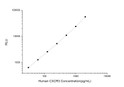


Human CXCR3 (C-X-C chemokine receptor type 3) CLIA Kit for Quantitative Detection
SPECIFICATIONS
General Information
| Short Description | This human CXCR3 kit is a highly sensitive in-vitro chemiluminescent immunoassay for the measurement of trace amounts of analytes in serum, plasma and other biological fluids. |
| Applications | CLIA |
| Reactivity | Human |
| Sensitivity | 18.75pg/mL |
| Detection Limit | 31.25~2000pg/mL |
| Note | FOR SCIENTIFIC EDUCATIONAL RESEARCH USE ONLY (RUO). MUST NOT BE USED IN DIAGNOSTIC OR OTHER MEDICAL APPLICATIONS. |
Product Properties
| Storage Instruction | If unopened the kit may be stored at 2-8°C for up to 1 month. If the kit will not be used within 1 month, store the components separately, according to the component table in the manual. |
| Assay Time | 3.5h |
| Detection | Chemiluminescence |
Target Information
| Gene Symbol | CXCR3 |
| Gene ID | 2833 |
| Uniprot ID | CXCR3_HUMAN |
| Specificity | This kit recognizes Human CXCR3 in samples. No significant cross-reactivity or interference between Human CXCR3 and analogues was observed. |
| Sample Type | Serum, plasma and other biological fluids |
Additional Info
| Tissue Specificity | Isoform 1 and isoform 2 are mainly expressed in heart, kidney, liver and skeletal muscle. Isoform 1 is also expressed in placenta. Isoform 2 is expressed in endothelial cells. Expressed in T-cells (at protein level). |
| Post Translational Modifications | Sulfation on Tyr-27 and Tyr-29 is essential for CXCL10 binding and subsequent signal transduction induction. N-glycosylated. |
| Function | Isoform 1: Receptor for the C-X-C chemokine CXCL9, CXCL10 and CXCL11 and mediates the proliferation, survival and angiogenic activity of human mesangial cells (HMC) through a heterotrimeric G-protein signaling pathway. Binds to CCL21. Probably promotes cell chemotaxis response. Upon activation by PF4, induces activated T-lymphocytes migration mediated via downstream Ras/extracellular signal-regulated kinase (ERK) signaling. Isoform 2: Receptor for the C-X-C chemokine CXCL4 and also mediates the inhibitory activities of CXCL9, CXCL10 and CXCL11 on the proliferation, survival and angiogenic activity of human microvascular endothelial cells (HMVEC) through a cAMP-mediated signaling pathway. Does not promote cell chemotaxis respons. Interaction with CXCL4 or CXCL10 leads to activation of the p38MAPK pathway and contributes to inhibition of angiogenesis. Overexpression in renal cancer cells down-regulates expression of the anti-apoptotic protein HMOX1 and promotes apoptosis. Isoform 3: Mediates the activity of CXCL11. |
| Protein Name | C-X-C Chemokine Receptor Type 3Cxc-R3Cxcr-3Ckr-L2G Protein-Coupled Receptor 9Interferon-Inducible Protein 10 ReceptorIp-10 ReceptorCd Antigen Cd183 |
| Database Links | Reactome: R-HSA-380108Reactome: R-HSA-418594 |
| Cellular Localisation | Isoform 1: Cell MembraneMulti-Pass Membrane ProteinIsoform 2: Cell Membrane |
| Alternative CLIA Names | C-X-C Chemokine Receptor Type 3 CLIA kitCxc-R3 CLIA kitCxcr-3 CLIA kitCkr-L2 CLIA kitG Protein-Coupled Receptor 9 CLIA kitInterferon-Inducible Protein 10 Receptor CLIA kitIp-10 Receptor CLIA kitCd Antigen Cd183 CLIA kitCXCR3 CLIA kitGPR9 CLIA kit |
| Specificity | This kit recognizes Human CXCR3 in samples. No significant cross-reactivity or interference between Human CXCR3 and analogues was observed. |
| Reproducibility | Both intra-CV and inter-CV are |
Information sourced from Uniprot.org
| Item | Specifications | Storage |
|---|---|---|
| Micro CLIA Plate (Dismountable) | 96T: 8 wells ×12 strips strips | -20℃, 6 months |
| Reference Standard | 96T: 2 vials 48T: 1 vial | -20℃, 6 months |
| Concentrated Biotinylated Detection Ab (100×) | 96T: 1 vial, 120 μL 60 μL | -20℃, 6 months |
| Concentrated HRP Conjugate (100×) | 96T: 1 vial, 120 μL 60 μL | -20℃ (Protect from light), 6 months |
| Reference Standard & Sample Diluent | 1 vial, 20 mL | 2-8°C, 6 months |
| Biotinylated Detection Ab Diluent | 1 vial, 14 mL | 2-8°C, 6 months |
| HRP Conjugate Diluent | 1 vial, 14 mL | 2-8°C, 6 months |
| Concentrated Wash Buffer (25×) | 1 vial, 30 mL | 2-8°C, 6 months |
| Substrate Reagent A | 1 vial, 5 mL | 2-8℃ (Protect from light) |
| Substrate Reagent B | 1 vial, 5 mL | 2-8℃ (Protect from light) |
| Plate Sealer | 5 pieces | |
| Manual | 1 copy | |
| Certificate of Analysis | 1 copy |
| Sample Type | Range (%) | Average Recovery (%) |
|---|---|---|
| Serum(n=8) | 95-107 | 100 |
| EDTA plasma(n=8) | 86-99 | 93 |
| Cell culture media(n=8) | 100-114 | 106 |
| Intra-assay Precision | Intra-assay Precision | Intra-assay Precision | Inter-assay Precision | Inter-assay Precision | Inter-assay Precision | |
|---|---|---|---|---|---|---|
| Sample | 1.00 | 2.00 | 3.00 | 1.00 | 2.00 | 3.00 |
| n | 20.00 | 20.00 | 20.00 | 20.00 | 20.00 | 20.00 |
| Mean (pg/mL) | 110.69 | 194.55 | 842.02 | 110.24 | 180.00 | 856.08 |
| Standard deviation | 11.18 | 18.40 | 56.67 | 9.89 | 15.14 | 88.09 |
| CV (%) | 10.10 | 9.46 | 6.73 | 8.97 | 8.41 | 10.29 |